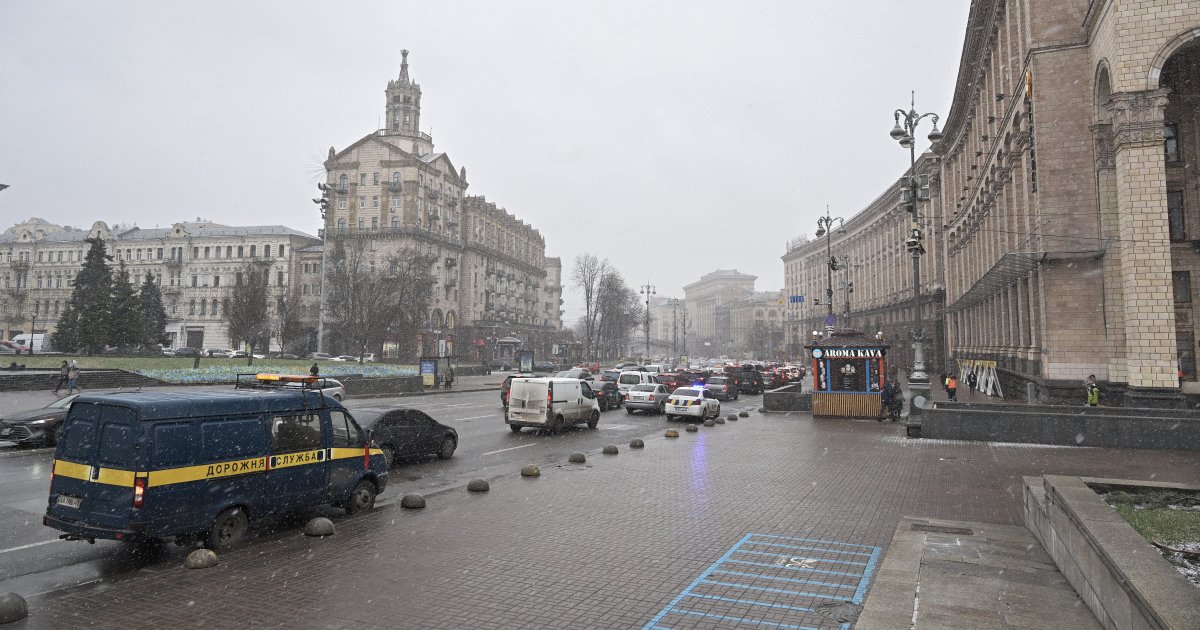
If federalists needed one defining test of whether Europe is serious about power, responsibility, and solidarity, then Ukraine is precisely that. This is not just a moral abstraction, but a concrete question: is Europe willing to be a security actor in its own right? As we head into 2026, the contours of the next phase of the conflict are becoming clear. What lies ahead cannot be decided by Washington or Moscow, but by Kyiv itself with the support of its partners.
The illusion that the war in Ukraine can be ended quickly, as President Trump proposed in his election campaign, has already collapsed. False promises of instant peace ignore the strategic reality: a ceasefire without credible security guarantees would simply reward aggression and prepare the ground for another, bigger war. It is no longer simply a case of whether Europe supports Ukraine, but how far it is willing to use its power to make its solidarity meaningful.
However, the tests facing Europe this year go beyond the war in Ukraine. Our democracy is under threat – not just from Russia, but from within. The US is hostile to our interests in more areas than one. Technology giants undermine our sovereignty. In a crucial moment, the EU hesitates on whether it wishes to recognise the threats it is facing and tackle them with the attention and the funding that they require. This year is going to be a decisive test for the future of European federalism.
Are we at a turning point in Ukraine?
Firstly, European cooperation in fiscal terms is no longer a taboo. Joint debt instruments in the EU were once unthinkable. Now, they have been used for defence and security-related expenditures. This forms a crucial precedent: when the Union faces an existential threat, it can now act beyond convention. What remains to be seen is whether this precedent is followed upon, or if the exemption tolerated for Hungary, Slovakia, and Czechia has weakened it too much to survive the geopolitical headwinds.
Secondly, Europe’s leverage over Russia continues to be underestimated. Europe’s economy makes Russia’s economy seem tiny in comparison, while European defence production is ramping up quickly. Long-range Ukrainian strikes have already damaged over a third of Russia’s oil refineries and a large share of Russian seaborne oil exports pass through European-controlled choke points. These are not minor facts; they are strategic levers that the Union can pull – if only it has the courage.
Thirdly, time is not on the side of the Kremlin. If Europe sustains military support for Ukraine and tightens economic pressure, the incentive structure for President Putin could shift. At that point, the message from Russia’s generals (“we are losing troops”) and its central bank (“the economy is cracking”) may converge. Peace would then become a consequence of European strategic actions, not a concession to Russian aggression.
Formally, power still appears to lie with the US, which is dominating NATO more than ever, and Russia. Yet, this reading of the situation misses the deeper shift that is underway. Europe already holds decisive, latent powers such as its economic weight, its industrial capacity, and – most importantly of all – the legitimacy to define the terms of any post-war settlement on its own continent. What Europe lacks is not capacity, but federal coherence. As written by Timothy Garton Ash of the European Council on Foreign Relations, Europe will continue to underperform its own strength as long as security policy remains hostage to national vetoes and short-term party politics.
Europe must hold firm and stick with Kyiv
The greatest danger in 2026 is not escalation, but a premature “peace” that actually freezes injustice in place. A deal that pressures Ukraine into territorial concessions, lacks security guarantees with an outline for how they will be enforced, or trades accountability for short-term stability would be a strategic defeat for Europe. It would show not just Russia, but all illiberal actors, that borders can once again be changed by force and international law is all but meaningless.
For federalists, the correct response is clear. European security guarantees must be real and include an on-the-ground European military presence at Ukraine’s borders and, after the war, an EU-led peacekeeping mission. Europe must lead on the prosecutions of war crimes, reparations for Ukraine, and continue the freezing of Russian state and oligarch-held assets. In parallel, Ukraine’s accession to the EU must be fast-tracked – with a clear focus on strengthening anti-corruption measures and supporting Ukrainian industry leaders and emerging entrepreneurs.
Above all else, the reconstruction must be financed through joint instruments and, where possible, through the proceeds of sanctions. None of this is maximalism. None of this is fantasy. This is the minimum that is required to make peace durable and to make true on the promise to support Ukraine for “as long as it takes.” If Europe rises to that challenge this year, it will not only change the course of the war – it will take a crucial step toward becoming a security actor. If it fails, the price will be paid elsewhere than just Kyiv.
European federalists must prioritise democratic resilience
Democracy is no longer just undermined through tanks at borders, like Russia’s encroaching on Crimea and the Donbas. Democracy is undermined within our own borders through the systematic manipulation of our information spaces. Disinformation campaigns distort political debates across Europe, weaken trust in our institutions, and deliberately target the EU for being a supranational project.
As federalists, this is an existential threat: a Union that cannot protect the integrity of its democratic processes cannot credibly claim sovereignty. It certainly cannot aspire towards the creation of a federal state in Europe. The erosion of democratic resilience is enabling the right-wing forces which, through mere opportunism or outright malice, are trying to take back power from the European people and sacrifice the constructive decision-making the EU has delivered.
Disinformation is a threat that exploits fragmentation, regulatory gaps, and uneven enforcement across the member states of the EU. This is why only a European-level response can match the scale and the coordination of hostile actors seeking to destabilise European democracy. To counter these developments, the Commission has proposed a European Democracy Shield, structured around three pillars: safeguarding the integrity of information spaces, strengthening democratic institutions such as elections and media, and boosting engagement in civic society.
This is a welcome development for the federalist cause. Combined with the Digital Services Act, the Digital Markets Act, the Regulation on the Targeting and Transparency of Political Advertising, the European Media Freedom Act, the Artificial Intelligence Act, and many other initiatives from the Commission, the EU is growing its competence to act on the threat of disinformation. However, it is clear to all of us that many of these well-meaning measures are met with direct opposition from the US and its powerful technology industry.
The US is behaving more like an enemy than an ally
The recent US security strategy openly provides support for anti-European parties, encouraging nationalist governments to weaken the EU’s cohesion from within. The relationship with the US under the Trump administration is no longer a reliable one. Additionally, even the new head of the MI6 now openly speaks about how power is “shifting from states to corporations and sometimes to individuals”.
The most insidious threat lies in the weaponisation of “free speech”. Under the guise of defending liberty, the promoters of this narrative seek to undermine the regulations which allow a democracy to sustain itself, reducing trust in the institutions which promote democracy, and weakening our civic society more broadly. As written by Arthur Leichthammer and Luise Quaritsch of the Jacques Delors Centre, “the freedom to regulate digital space is a matter of democratic self-determination”.
Is Europe willing and, most importantly, able to use its regulatory power consistently? The core risk lies in political retreat and selective enforcement as a result of external pressure. The Commission is already using its deregulation agenda branded the “omnibus fleet” for concessions to US demands on technology and trade. The aforementioned acts and regulations will all be enforceable by next year, but if member states apply it unevenly then Europe will maintain weak points that can be exploited.
The EU needs to prove it can keep up with a changing world
Where national governments lack a cooperative spirit, European rules risk becoming symbolic rather than iron-clad. Without EU-level independent audits and transparent oversight of the so-called “Very Large Online Platforms”, commitments to counter disinformation will remain ineffective. Furthermore, the rapid spread of AI-generated content is raising the stakes higher. The enforcement of provisions on transparency, labelling, and detection of AI will be a litmus test of whether Europe can keep pace with technological acceleration.
Closely linked is the pressure on independent media and civil society. Attacks on non-governmental organisations, journalists, and watchdogs are no longer isolated incidents, but they are part of a broader strategy of delegitimisation, defunding, and criminalisation. A positive surprise in this regard was the Commission’s proposal of a new Strategy for Civil Society. However, its success will ultimately depend on whether it translates into concrete protection, funding, and political backing, especially in member states with the greatest democratic backsliding.
Combined with the withdrawal of US funding for independent journalism abroad, this creates a responsibility vacuum that Europe must be prepared to fill. Our democratic resilience will be determined by whether Europe can withstand pressure from authoritarian states, technological giants, and our internal illiberal forces. Europe may now be the “land of the free” as it was recently labelled in The Economist and one of the last bastions of liberal democracy, but we must realise that – if we do not put up a fight – this can and will be taken away from us in the blink of an eye.
How can we preserve peace and freedom?
At the heart of federalism lies a simple but demanding conviction: peace is not merely the absence of war, but the presence of institutions strong enough to make war impossible. The EU was built on this idea and recognised for it with the Nobel Peace Prize in 2012. Today, that promise feels increasingly close to being broken. As the geopolitical reality continues to destabilise and authoritarian actors gain more and more influence, the EU is under growing pressure to assert itself.
Europe’s ability to preserve our peace and freedoms depends on whether it is able to invest in them sufficiently. The upcoming negotiations on the Multiannual Financial Framework (MFF) for 2028–2034 will be more important than any previous economic cycle. Despite this, the debate in Brussels is already dominated by an all-too-familiar pattern: a zero-sum struggle between member states, each defending their short-term interests and re-election rather than our shared priorities.
This approach is fundamentally incompatible with the challenges Europe faces from a federalist perspective. Yet, even from a strategic point of view, Europe needs significantly higher public investment at the EU level – the Letta and Draghi reports were very clear on this. European funding is essential to support strategic sectors such as defence, clean energy, finance, research and development, infrastructure, as well as preparing candidate countries for accession and holding together an economically and socially heterogeneous Union. Europe needs to leverage its money to promote peace and freedom, both at home and abroad.
The EU must take its role as an economic superpower
The last MFF, adopted in December 2020, amounted to just 1.12% of EU Gross National Income (GNI) – a negligible share compared to the near-50% of GNI spent by public authorities across the Union as a whole. Meanwhile, German Chancellor Merz is already calling for “across-the-board cuts”. This risks hollowing out the EU precisely at a moment when more, not less, European capacity is needed. These negotiations will be telling for whether the EU wants to put its money where its mouth is.
The ability of the EU to survive and evolve into a federal state will be about more than money, however. As long as the MFF requires the unanimous support of the Council, its approval by the European Parliament is turned into a rubber-stamping exercise. It must be up to the elected representatives of the European people to decide how the EU’s resources are spent, not national governments.
Furthermore, the EU must have the power to suspend funds when countries are not meeting their obligations on the rule of law and judicial independence, as well as the power to collect its own resources and stop being dependent on its member states. There are decisions which will not wait long for the EU to figure out whether it wishes to accept its role in the world. Europe is well and truly facing a test: will it be able to deliver on its promises?
The wider challenges for Europe
The climate emergency will not stop in 2026 – it will become worse and its effects will be felt more widely across the board. The European Green Deal is supposed to reach its enactment stage, for example on the regulation on nature restoration, but “ambition” would not be an accurate description of the ongoing political work. The word of the day is “delaying”, as reported by Politico on the repeated setbacks to the anti-deforestation provisions. As climate politics does not make headlines anymore, will the Commission use infringement procedures and conditionality mechanisms to defend the new climate rules?
Another vital struggle is the struggle for our freedom of movement. The Schengen Area is being eroded with internal border checks, in open violation of EU law. This is only going to get worse as radical and extreme right-wing parties gain ground across member states. Europe needs a human-rights based approach to migration that “builds capacities for intra-European responsibility-sharing”, but in 2026 it looks like the focus will be on pushing back migrants by force, with little regard for their safety, wellbeing, or willingness to contribute. As federalists, this is antithetical to our people-centred politics.
The creation of a defence union is on the table for the first time in decades and this is very welcome, but Europe must deliver on its words. With yet more underfunding, governance-by-veto, and retreating from shared priorities, it will steadily lose the ability to guarantee peace, freedom, and prosperity. If, however, Europe makes the right choices over the next year, guided by subsidiarity and the founding values of the EU, this can be the year that the momentum swings towards a stronger and more sovereign Union, working towards a closer relationship with the candidate states, Britain and other allies outside of Europe like Canada and Australia.
In 2026, from security, to democracy, to investment, the EU is going to face challenges like it has never encountered before. Europe has almost all of the tools it needs to grasp this challenge, but it is missing the political will to use them. This could be the year where the EU moves from being a crisis-driven improvisation to a durable structure for a federal century. If not, the time may soon come when Europe is nothing more than a rich but impotent space – unable to preserve anything that matters for the next generation. It is our task to stop this from happening.