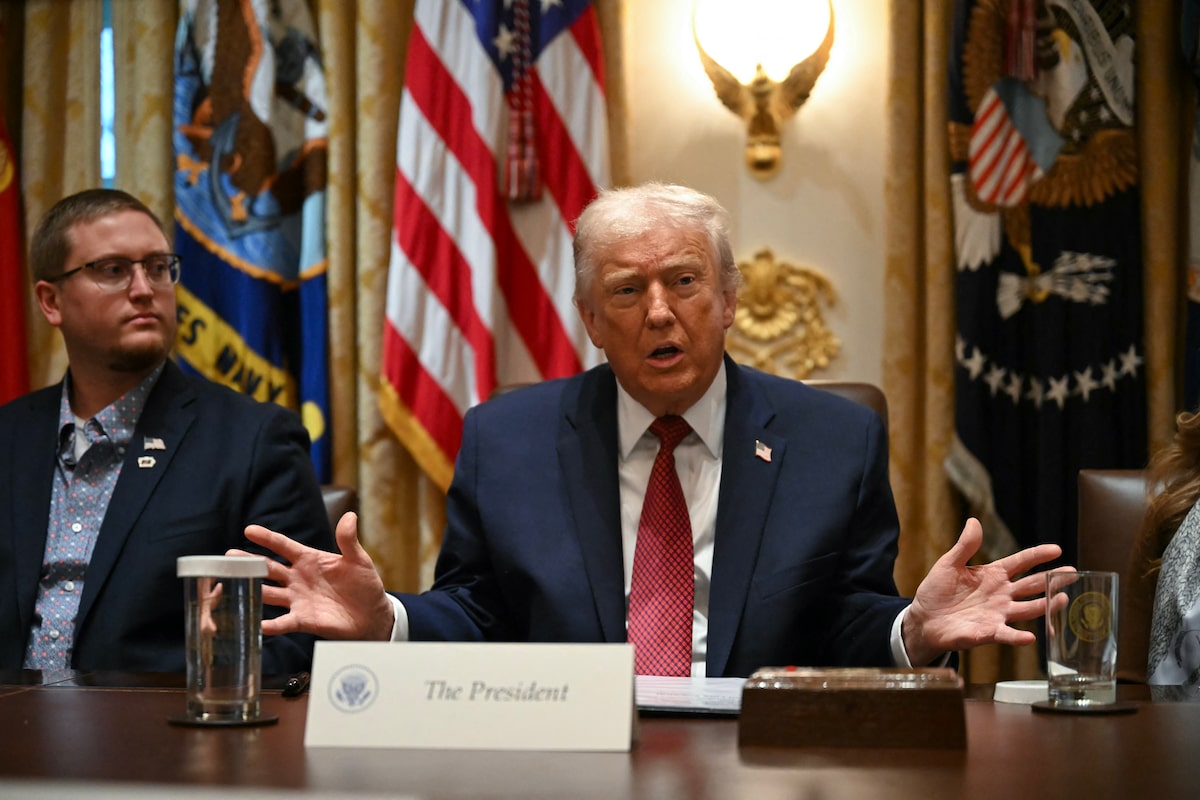
U.S. President Donald Trump speaks at the White House in Washington on Dec. 8.ANDREW CABALLERO-REYNOLDS/AFP/Getty Images
A central pillar of U.S. President Donald Trump’s protectionist trade policy could be struck down early in the new year, but lawyers and trade experts expect the President to rapidly reconstruct his tariff regime using other legal tools while questions remain about whether companies will be able to secure refunds.
In November, the U.S. Supreme Court heard a case brought by a group of businesses and U.S. states that are challenging Mr. Trump’s use of the International Emergency Economic Powers Act, or IEEPA, to impose sweeping tariffs.
These include the “fentanyl tariffs” imposed on Canada, Mexico and China, and the “Liberation Day” or “reciprocal” tariffs placed on the rest of the world – but not the sector-specific tariffs on steel, aluminum, automobiles and lumber, which are based on different legislation.
After grilling the Trump administration’s lawyers at the November hearing, the Supreme Court is seen by many legal experts as likely to declare the IEEPA tariffs illegal – confirming two lower court decisions. The ruling is expected in January or February.
More tariffs, more problems: 12 charts to watch in Year 2 of the trade war
A negative decision would be an indictment of the haphazard way Mr. Trump has pushed through his protectionist agenda over the past year, and would create a headache for the U.S. government, which has collected more than US$130-billion in tariff revenue using IEEPA that may need to be refunded.
However, it’s unlikely to blow a permanent hole in the U.S. tariff wall.
“I do think that if the Supreme Court were to strike down the IEEPA tariffs there would be some period where the overall tariff burden on goods being imported into the United States would be lower. But I don’t think that that period is going to last very long,” said Patrick Childress, a partner at the U.S. law firm Holland & Knight LLP and a former assistant general counsel at the Office of the U.S. Trade Representative.
“We could be talking about days or weeks. I don’t think we’ll be talking about months. Because I do think the administration has the tools it needs to recreate all or substantially all of the IEEPA tariff framework using other statutory authority,” Mr. Childress said in an interview.
The U.S. Supreme Court is seen by many legal experts as likely to declare the IEEPA tariffs illegal.Kevin Mohatt/Reuters
For importers that have paid billions of dollars in IEEPA tariffs, the question of refunds looms large. Lawyers expect there to be an opportunity for reimbursement if the IEEPA tariffs are struck down. But it’s unclear at this point what the refund process will look like and whether this will be available to all companies that paid the tariffs, or only to businesses that have sued the government.
Dozens of companies have already filed lawsuits in the U.S. Court of International Trade to try to protect their right to a refund or position themselves at the front of the line for one.
Meanwhile, hedge funds and investment banks have offered to buy the rights to refunds from companies, taking on the risk of non-repayment in the hope of securing the full refund.
Rita Trichur: Countries are crusty about cheese, causing free trade to crumble
“We saw a flurry of advertisements and people asking about [selling refund rights] end of September, early October,” said Jill Hurley, senior director of global trade consulting at the U.S. customs brokerage Livingston International.
“It seemed to be most beneficial for companies who are in dire straits from a cash flow perspective. They needed the money now to keep the doors open, because you’re going to be paid pennies on the dollar for your claim.”
Canada has less of a stake in the Supreme Court case than some other countries. Most Canadian exports are exempt from Mr. Trump’s 35-per-cent “fentanyl tariff” thanks to a carve-out for products that comply with the United States-Mexico-Canada free-trade agreement.
As of mid-December, U.S. Customs and Border Protection had collected around US$2.4-billion in IEEPA tariff revenue on imports from Canada – less than 2 per cent of the total.
Still, the outcome of the court case will provide the backdrop to Ottawa’s continuing efforts to secure relief from the separate sectoral tariffs, and to the five-year review of the USMCA that will kick into high gear in the coming months.
Mr. Trump announces new tariffs at the White House on April 2.Mark Schiefelbein/The Associated Press
Mr. Trump has leaned heavily on IEEPA to increase U.S. tariffs and put pressure on other countries to offer trade concessions over the past year. The 1977 legislation allows the President to take extraordinary measures to regulate international commerce after declaring a national emergency.
“The reason that President Trump likes IEEPA is that he can wake up in the morning, declare a national emergency and establish a tariff rate at whatever level he wants,” said Timothy Meyer, a professor of international business law at Duke University. Other legislation that grants the President the power to levy tariffs requires more procedural steps and has more checks in place, he said.
There have been legal challenges to the IEEPA tariffs from the outset. In May, the Court of International Trade ruled that the President had gone beyond the authority granted to him by U.S. Congress. The power to levy tariffs rests with Congress unless it is specifically delegated to the President, and unlike other pieces of legislation, IEEPA does not explicitly mention tariffs.
This decision was upheld by the U.S. Court of Appeals for the Federal Circuit in August. And based on the line of questioning in the November hearing, it appears the Supreme Court is leaning in the same direction, said Prof. Meyer. He expects five or six of the nine Supreme Court judges to come out against the Trump administration, despite the conservative tilt of the court.
“This is an incredibly important decision about the scope of presidential power, because if the President can, for instance, impose a tax based on a law that doesn’t mention taxes and contains no process requirements, then there’s very little the President can’t do,” Prof. Meyer said.
IEEPA is not, however, the only arrow in the President’s quiver. Mr. Trump has also made extensive use of Section 232 of the U.S. Trade Expansion Act of 1962, which allows the President to impose tariffs on specific industries following an investigation by the Department of Commerce.
This law underpins the tariffs on steel, aluminum, autos and other sectors, which are hammering Canadian industry. It has a solid legal footing, having been litigated in Mr. Trump’s favour during his first administration.
Rita Trichur: U.S. trade war highlights absurdity of interprovincial barriers for alcohol
A number of Section 232 investigations are already under way – including into aircraft, semiconductors and critical minerals – suggesting the administration could move rapidly to impose additional sectoral tariffs.
The White House has also used Section 301 of Trade Act of 1974, which permits tariffs on an entire country following an investigation into alleged unfair trading practices. This has been used most extensively against China.
There are two other potential routes forward: Section 122 of the Trade Act of 1974, which allows for tariffs up to 15 per cent for 150 days before Congress must vote to extend them; and Section 338 of the Tariff Act of 1930, which authorizes tariffs up to 50 per cent in certain circumstances.
Mr. Childress of Holland & Knight said the administration could quickly impose new tariffs using Section 122, and then use the 150-day period as a bridge to launch a series of Section 301 investigations.
“I don’t believe that a negative ruling from the Supreme Court is going to convince the administration that the use of tariffs, which is its signature international economic policy tool to this point, is unwise,” he said.