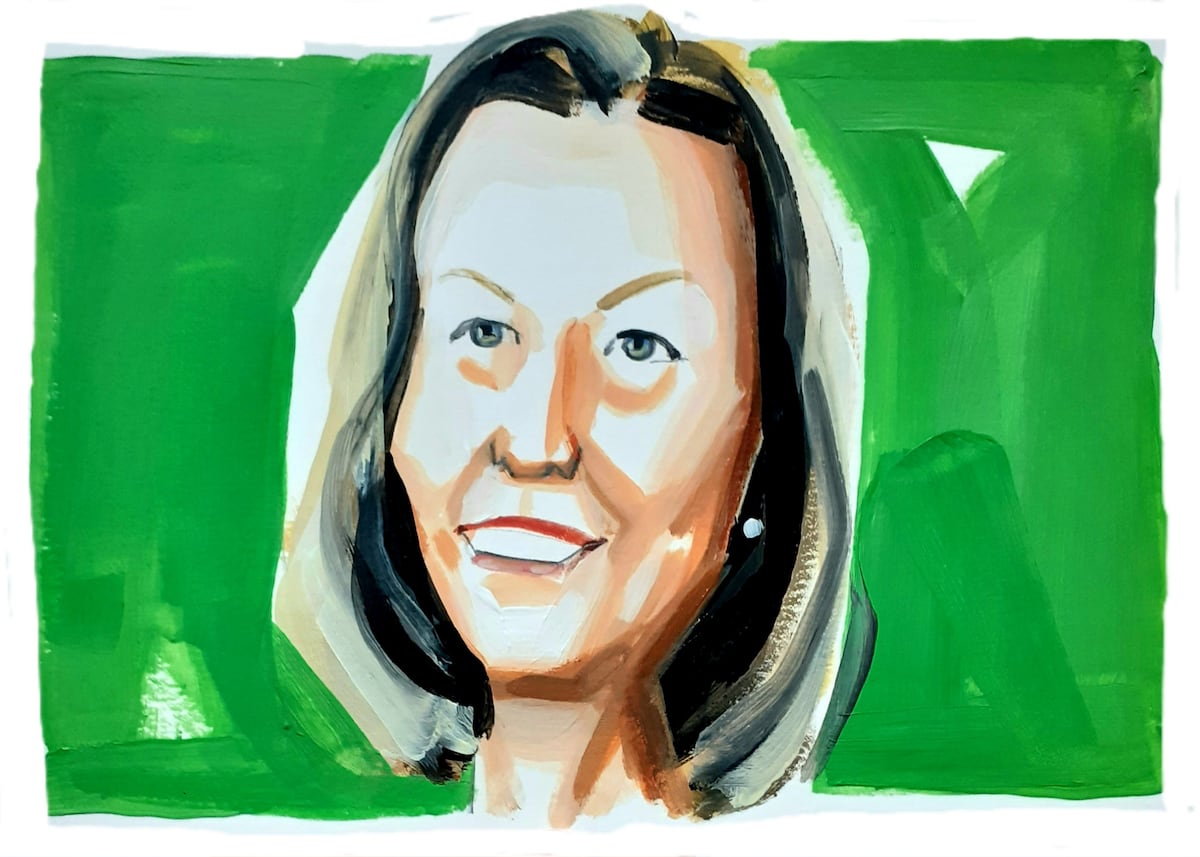
Stereotypes are rarely useful. It is difficult to pigeonhole, for example, an openly gay woman tasked with definitively reversing the green strategy that BP undertook in recent years. Meg O’Neill (Colorado, 55 years old) will take on the role of the company’s CEO in April. She will be the first woman ever to lead one of the world’s five largest petroleum companies, and the first external hire to direct the company in its 115 years of existence.
O’Neill will replace Murray Auchincloss, who stepped into the position after the abrupt 2023 exit of Bernard Looney, who resigned after acknowledging a lack of transparency regarding his personal relationships with others at the company. Until the arrival of O’Neill in April, Carol Howarth, executive vice president, will act as chief executive officer.
The handover comes at a time of profound strategic reassessment at BP. In early 2023, under pressure due to mediocre earnings, the company significantly cut its planned investments in renewable energy and announced a shift toward strengthening its traditional oil and gas business. Its rivals, Shell and Norway’s Equinor, have also scaled back their plans to invest in green energy, and Donald Trump’s call to “drill, baby, drill” has encouraged many companies to invest in fossil fuels.
Given her past, O’Neill is expect to align with the new strategy. While BP fought to maintain its valuation amid a failed green shift, changes at the top, as well as growing rumors about a possible acquisition, O’Neill led the merger of Australian petroleum company Woodside Energy with BHP Group’s oil and gas portfolio.
O’Neill has described herself as a stern and direct person who doesn’t beat around the bush. She is married to Vicky Hayes, with whom she has an adolescent daughter. In an interview with The West Australian, she spoke about her process of coming out in the petroleum industry as having its highs and lows. “I think that it is important, as a gay woman in a position of high responsibility, to be visible so that young queer people can see me and say, ‘Look, there’s someone like me. I can feel comfortable being who I am at work.’”
She has also received heavy criticism from climate activists, including a protest in front of her home in Perth, where protestors attempted to damage walls and a garage door with paint. “That was not a harmless protest,” she would later say. “It was designed to intimidate me, my partner, and our daughter in our own home. This kind of action by extremists should be condemned by anyone who respects the law.”
O’Neill has been interested in science since she was young, doubtless influenced by her father, who worked as an engineer at Bell Labs. She studied at MIT, where she earned her degree in chemical engineering and ocean engineering.
Upon graduating in 1994, she was hired at ExxonMobil, where she would remain for 23 years, holding various positions across different countries. She began in offshore oil fields modeling in Houston and later worked as a reservoir engineer in New Orleans. With time, she took on weightier international responsibilities. She led liquid natural gas operations in Indonesia after the 2004 tsunami; directed offshore operations in Canada, and was country manager in Norway, where she learned the local language.
In 2016, she joined ExxonMobil’s senior management team upon being appointed executive advisor to then-CEO Rex Tillerson. She has said that working with him gave her the opportunity to observe a values-based management model up close. Two years later, she decided to leave the company to join Woodside Petroleum in Australia, attracted in part by the opportunity to be more directly involved in the company’s major strategic decisions, and moved to Perth with her wife and daughter.
At Woodside, she began running operations and project development in Australia and Senegal. Between 2019 and 2021, she climbed the ranks at the company and was eventually named CEO. That promotion made her one of the few women to lead an ASX20 corporation, the name given to Australia’s 20 highest-valued firms. One of the biggest changes she introduced was a more horizontal management style: she had posters hung that read “come up and see us,” an explicit invitation to employees to visit the executive floor. According to several former coworkers, her management style is characterized by being accessible to employees.
One of her first big challenges was overseeing a merger with BHP’s petroleum division, an operation valued at around $28 billion that doubled the size of Woodside and situated it among the 10 largest independent petroleum companies in the world. After the operation, the company exceeded $40 billion in market capitalization.
O’Neill signed off on several large-scale projects, including a $7.2 billion investment in the development of the Trion field in the Gulf of Mexico and an increase in Woodside’s stake in the North West Shelf gas consortium, with the aim of extending its utility for several decades. In 2023, she also acquired the developer of a liquefied natural gas project in Louisiana. Her growth strategy has been characterized by a clear preference for “buying barrels” rather than exploring for new sources of petroleum. O’Neill has repeatedly stated that Woodside prioritizes investment in existing fields over developing projects from scratch.
It’s clear, given her trajectory, the operations she has overseen, and some of her own statements that O’Neill fits better into the classic vision of the petroleum industry than the green shift that BP attempted in recent years. Hers is a vision that during the last decade may have appeared to be outdated, but that today is once again being seen as a pragmatic, even intelligent, bet.
Beyond the board room, O’Neill has always loved sports. She plays netball and is a big golf fan.
Sign up for our weekly newsletter to get more English-language news coverage from EL PAÍS USA Edition