For the last seven decades, every US President has flirted with the idea of solving the Middle Eastern quagmire by resolving the Israel-Palestine issue and leaving behind a lasting legacy.
From the 1949 Armistice Agreements signed under Harry S. Truman, the Camp David Accords signed in 1978 under Jimmy Carter, the Oslo Accords in 1993 signed under Bill Clinton, to the Abraham Accords in 2020 signed during President Donald Trump’s first administration, there is an endless list of failed talks, agreements, and accords.
In Trump’s case, he also has a not-so-secret desire to win the Nobel Peace Prize. Trump realizes that there can be no better shot at the Nobel Peace Prize and a lasting legacy than resolving the Israel-Palestine issue.
However, Tehran has been the biggest obstacle to a lasting peace agreement in the Middle East at least since the 1979 Islamic revolution in Iran.
As protests spread to more and more Iranian cities, and Israel and the US prepare for the next round of strikes, in the year 2026, Trump is closer than any other U.S. president in history to achieving both of these dreams.
Next Round Of Attacks On Iran
“Once a mirror is cracked, it never reflects the same.”
In June 2025, Israel and the US crossed a historic threshold by launching direct strikes inside Iran, something that both countries had avoided since the Iranian revolution of 1979.
Since that taboo has been shattered, direct strikes on Iran seem like a fair game.
On January 2nd, Trump issued another warning to Iran, which reads like a thinly-garbed threat of regime-change in Tehran.
“If Iran shots and violently kills peaceful protesters, which is their custom, the United States of America will come to their rescue. We are locked and loaded and ready to go,” Trump wrote on social media.
Earlier in June 2025, Trump wrote on Truth Social, “It’s not politically correct to use the term, ‘Regime Change,’ but if the current Iranian Regime is unable to MAKE IRAN GREAT AGAIN, why wouldn’t there be a Regime change???”
Since, as per reports, seven people have already died in the current Iranian protests, according to Trump’s logic, it’s a fit case for US involvement in Iran.
Meanwhile, Reza Pahlavi, the former Crown Prince of Iran, who is living in exile in the US, has already issued video messages for the Iranian people, encouraging them to rebel against the Iranian regime.
On his part, Israeli Prime Minister Benjamin Netanyahu has been telling the Iranian people for a year that the regime in Tehran is at its “weakest point.”
“It has never been weaker. This is your opportunity to stand up and let your voices be heard. Woman, Life, Freedom Zan, Zendegi, Azadi,” Netanyahu said in June last year, and he is not wrong.
In the last two years, Iran has, one by one, lost its leverage in the Middle East. Israel has systematically degraded all of Iran’s proxies, be it Hamas, Hezbollah, or Houthis. Meanwhile, Bashar al-Assad, one of Tehran’s closest allies in the region, has lost power in Syria.
Meanwhile, the issue of the Iranian nuclear program, one of the biggest irritants in Iran’s relations with the West and the US, and the main target of Israeli and US airstrikes in Iran in June last year, is still unresolved.
In November 2025, the New York Times reported that the June strikes by Iran and the US failed to destroy the Iranian stockpile of enriched Uranium.
Rafael Grossi, director of the International Atomic Energy Agency, told The Financial Times that the organization believes the majority of Iran’s stockpile of highly enriched Uranium survived the war, but that its status is unclear without inspections.
He estimated that Iran has roughly 400 kilograms of 60 percent enriched uranium, which is close to weapons-grade.
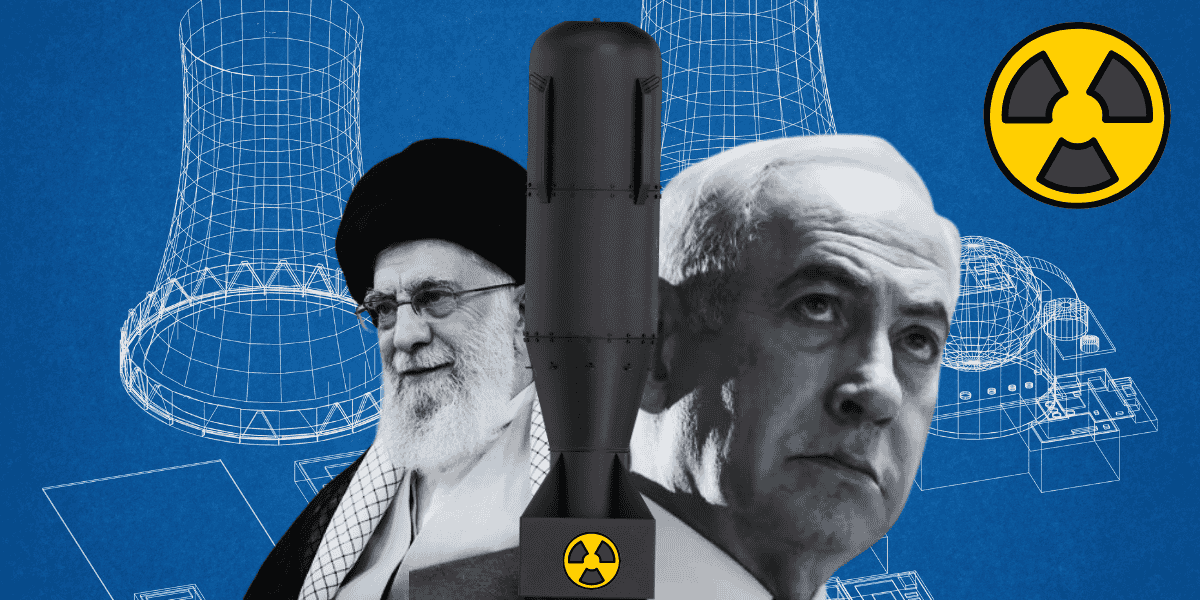 Edied Image of Iranian Supreme Leader Ayatollah Ali Khamenei and Israeli Prime Minister Benjamin Netanyahu.
Meanwhile, the US efforts to persuade the Iranian regime to give up its nuclear program through talks seem to have hit a dead end.
For its part, Israel views the Iranian nuclear program as an “existential threat.” Experts believe that another round of the Israel-Iran war is imminent in 2026.
According to the Brussels-based International Crisis Group (ICG), an independent organization that works toward preventing wars, there are 10 conflicts to watch in 2026. It has divided the 10 flashpoints into three categories: Tier I flashpoints, with the highest likelihood of escalating into war; Tier II flashpoints, with a moderate probability of escalation; and emerging flashpoints.
According to ICG, another round of direct confrontation between Iran and Israel is highly likely. There is another reason Netanyahu is upbeat about attacking Iran again: President Trump’s support.
Is Trump The Most Israel-Friendly President In The White House?
On December 30, Netanyahu met with Trump at Mar-a-Lago in Florida.
According to Axios, Israeli Prime Minister Netanyahu discussed the possibility of attacking Iran again in 2026 during his meeting with President Trump.
“Trump and Netanyahu both saw the 12-day war with Iran in June as a tremendous success. But Netanyahu has argued more strikes might be necessary to prevent Tehran from rebuilding its capabilities,” it said.
Trump said after the meeting that if Iran tries to rebuild its nuclear program, the U.S. will destroy it again.
In June, Trump became the first US President to order air strikes on Iran, supporting Israel’s 12-day war against Iran.
After meeting Trump in Florida, Netanyahu said, “Israel has never had a friend in the White House like President Trump. His leadership, clarity, and unwavering support for Israel are exceptional.”
 An Iraqi youth throws darts at a dartboard bearing an image of US President Donald Trump during a ceremony on January 2, 2026, in Baghdad to commemorate the sixth anniversary of the killing of Iranian Revolutionary Guards commander Qassem Soleimani and Iraqi commander Abu Mahdi al-Muhandis in a US drone strike. (Photo by AHMAD AL-RUBAYE / AFP)
Netanyahu also announced that Israel would award Trump its highest civilian honour, marking the first time it would go to a non-Israeli.
“President Trump has broken so many conventions to surprise people, so we decided to break a convention or create a new one,” Netanyahu said.
It might be tempting to dismiss Netanyahu’s high praise for Trump as a crude attempt to impress Trump’s inflated ego; however, his statement is not far from the truth.
In 2018, Trump became the first U.S. president to recognize Jerusalem as Israel’s capital and to move the U.S. Embassy from Tel Aviv to Jerusalem.
Trump also spearheaded the effort to persuade Muslim countries to sign the Abraham Accords. In 2020, the United Arab Emirates, Bahrain, Sudan, and Morocco signed the Abraham Accords, normalizing relations with Israel.
In 2019, Trump formally recognized Israel’s sovereignty over the Golan Heights through a presidential proclamation. This move was a reversal of decades of official U.S. policy, which had previously considered the territory as occupied Syrian land.
In 2018, Trump also scrapped the Iranian nuclear deal, which had been signed under former President Obama.
For these pro-Israel steps, in 2018, Netanyahu even compared Trump to the great Persian king Cyrus the Great, the mysterious Persian ruler credited with helping Jews return from exile to Jerusalem 2,500 years ago, and rebuild the Temple.
In Jewish memory, Cyrus the Great is very highly respected and loved.
“I want to tell you that the Jewish people have a long memory, so we remember the proclamation of the great king, Cyrus the Great, the Persian king 2,500 years ago. He proclaimed that the Jewish exiles in Babylon could come back and rebuild our Temple in Jerusalem. We remember a hundred years ago, Lord Balfour, who issued the Balfour Proclamation that recognized the rights of the Jewish people in our ancestral homeland.
“We remember 70 years ago, President Harry S. Truman was the first leader to recognize the Jewish state. And we remember how a few weeks ago, President Donald J. Trump recognized Jerusalem as Israel’s capital. Mr. President, this will be remembered by our people through the ages,” Netanyahu said.
In his first term as president, Trump scrapped the Iranian nuclear deal. In the first year of his second presidential term, Trump became the first US President to order air strikes on Iranian nuclear strikes.
Trump has only three years left in his second term. The Iranian regime is at its weakest, all of Iran’s proxies are fighting an existential battle, Tehran has lost all its leverage, and now civil protests are spreading like wildfire in Iran.
Trump realizes that this could be his moment to make history and topple the Iranian regime, one of Washington’s primary adversaries since 1979.
If Trump succeeds in toppling the Tehran regime, he would have a real shot at making a final settlement in the Middle East, something that almost all US Presidents have dreamed of since 1948.
Sumit Ahlawat has over a decade of experience in news media. He has worked with Press Trust of India, Times Now, Zee News, Economic Times, and Microsoft News. He holds a Master’s Degree in International Media and Modern History from the University of Sheffield, UK.
THIS IS AN OPINION ARTICLE. VIEWS PERSONAL OF THE AUTHOR.
He can be reached at ahlawat.sumit85 (at) gmail.com