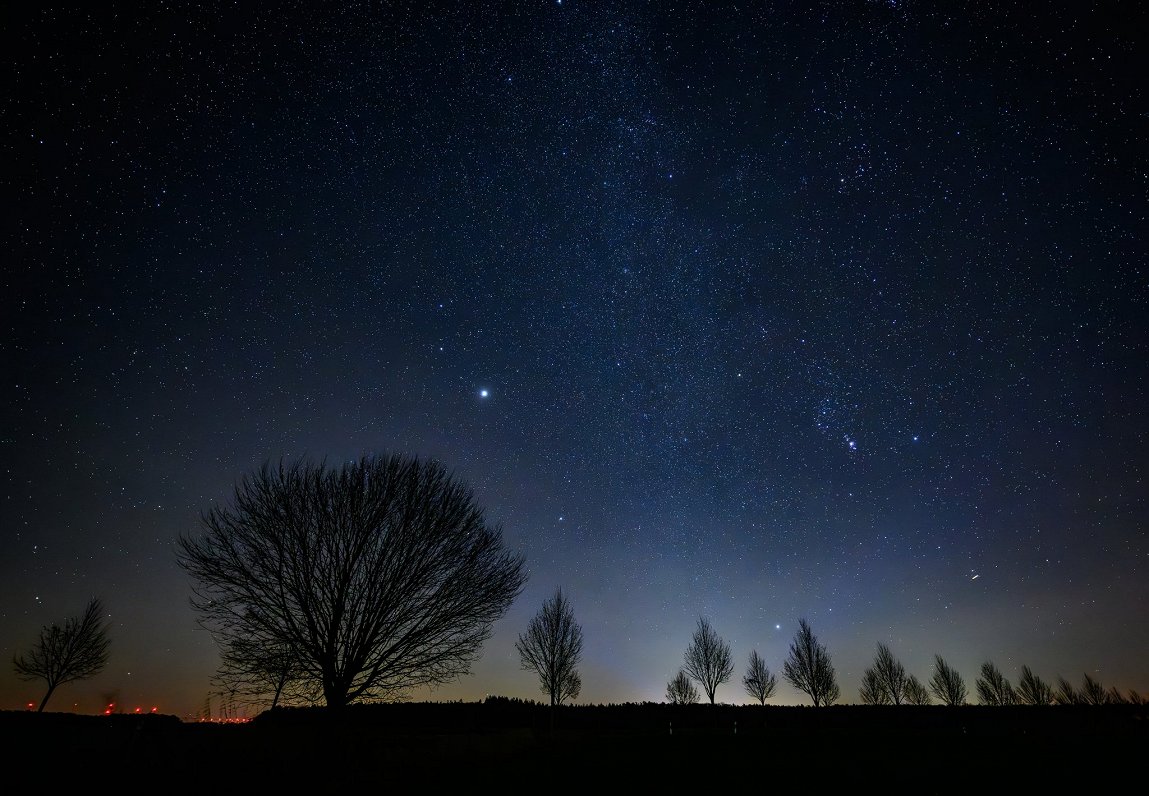
In 2026, it will be possible to observe various interesting astronomical events in the sky. A solar eclipse, a parade of planets, and meteor showers are expected. The University of Latvia Observatory is already in its 40th season, and this year, a new telescope has also attracted visitors, Latvian Radio reports.
This autumn, the 40th observation season has begun at the University of Latvia’s Astronomical Tower. Although there have been many cloudy days so far, limiting sky observation, the season has commenced. Despite this, the observatory is attracting more and more visitors, as the new telescope installed this year, with a lens diameter of 254 mm, has also attracted attention, allowing visitors to see more distant, smaller, and dimmer stars.
In addition to individual comets and the aforementioned planetary rings, astronomer Vitalijs Kuzmovs also highlights the red lunar eclipse that occurred in September:
“The beautiful red eclipse of the Moon – the blood Moon, which immediately made people wonder why it was called that. The Moon was completely covered and because it happened at sunset, it was so red. I watched and photographed it myself, and it was another “wow” moment for astronomers. I must say that when the eclipse first began, I started to doubt whether we would actually see it, because the moon was quite dark and the sky was quite light, and there was nothing to see. And then suddenly the first photos appeared. It was September 7, it started at 8:40 [p.m.]. The sun had also set, and it was clear that the sky was still too bright to see such a dark object, but then at around 10 p.m., all that beauty was there. In March, some will observe the same moon on the other side of the ocean.”
Speaking about what to expect in the field of celestial observations this year, the astronomer points out that on August 12, there will be a total solar eclipse, which in Latvia will be visible as a partial eclipse.
Meanwhile, in February, we can expect another planetary parade, when it will be possible to see almost all the planets in the solar system at the same time.
“In February, the next planetary parade will take place on the 28th, but it will have to be observed just as the sun sets. If we wait an hour later, some of the planets will already have disappeared below the horizon. It will be around five in the evening,” notes Kuzmovs.
“It will be possible to see all the planets in the solar system at the same time, except for Mars, which is still on the other side of the Sun. All the others—Venus, Mercury, Jupiter, Saturn, Uranus, and Neptune—will be visible, but Neptune will only be visible with the aid of a telescope. Uranus can also be seen with binoculars, but all the others will be visible. And there will also be the Moon,” he continues.
As usual, there will be several meteor showers or “star showers” each year. The most popular meteor shower is the Perseids, which will peak on the night of August 12th-13th, with up to 100 meteors per hour. Future generations, however, will be able to experience a literal meteor storm, says the astronomer:
“Let’s put it this way – the intensity of the shower varies from year to year. It depends on the point in the trajectory that the Earth passes through in its orbit, and our grandchildren will have something to watch at the end of the century, when it will not even be a meteor shower, but a meteor storm. That will mean somewhere around 20,000 meteors per hour, which is several meteors per second, but that will be the end of the century.”
Highlighting other significant space events expected this year, which are not related to observation, Kuzmovs mentions the Artemis 2 expedition or mission planned for February, in which a team of NASA astronauts plans to fly around the Moon.
“The first mission was three years ago, in 2022. It was Artemis 1, and it was an automatic flight around the Moon at a greater distance from Earth,” he explains. “Next year, they plan to repeat something similar with humans, with a group of four astronauts. This will be the first time in 50 years that humans have been near the Moon. Now, a group of people will fly around it. The mission will last about 10 days, and the next mission, Artemis 3, will involve humans landing on the surface of the Moon.”
The University of Latvia’s Astronomy Tower will continue its 40th season until the end of March and will be open to visitors on weekday evenings when the skies are clear.
Select text and press Ctrl+Enter to send a suggested correction to the editor
Select text and press Report a mistake to send a suggested correction to the editor
Tell us about a mistake