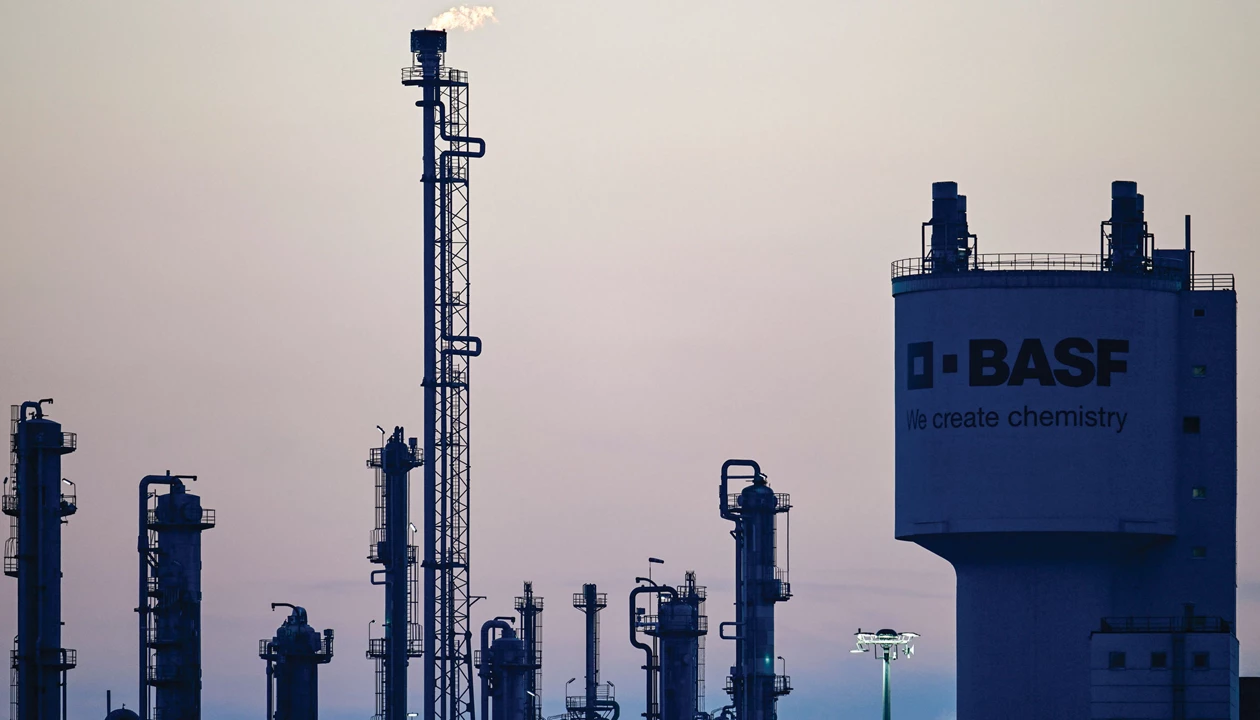
Europe’s petrochemical industry is set for another year of decline.
German chemical companies are responding to the country’s high production costs by investing elsewhere.
Some European companies could be broken up or disappear.
Europe’s chemical industry is desperate for signs of a recovery—anything to indicate that it can repel the rising tide of cheap commodity chemical imports that is steadily replacing its own domestic production. But industry experts see little sign of a change this year. A growing consensus is that the new normal for this once-global chemical powerhouse is a state of decline.
The region’s fundamental issue is that low-cost production capacity elsewhere in the world is growing. US exports of ethylene-based products more than tripled from 690,000 metric tons (t) worldwide in the first half of 2018 to 2.3 million t in the first half of 2025, New Normal Consulting notes in its monthly newsletter, the pH Report. “Chinese imports are also ramping up, as US tariffs force them to seek new markets,” it says.
Against this backdrop, this year promises to be another difficult one for European chemical producers. “2026 will thus see a painful continuation of the pressure to review traditional business models and beliefs,” says Richard John Carter, an independent consultant. “The focus on cost cutting in many organizations will continue. However, experience shows that companies cannot ‘cost save’ their way to success.”
Carter warns that switching from commodity to specialty chemicals is not going to be enough. “Specialties will not provide sufficient impetus to replace the collapse in commodity margins and thus will remain wishful thinking,” he says.
“2026 will thus see a painful continuation of the pressure to review traditional business models and beliefs.”
Richard John Carter, independent consultant
That warning chimes with the Swiss firm Clariant, one of Europe’s oldest specialty chemical companies, which told the Financial Times newspaper in late 2025 that it anticipates “more production shifting away from Europe.” The company expects more than half its sales growth in the next 5 years to come from China.
The German chemical industry is reacting by investing elsewhere. “Producing basic chemicals in Germany is becoming increasingly unattractive—now the industry is migrating,” says Jan Haemer, a partner at the consulting firm Simon-Kucher. The firm estimates that three-quarters of energy-intensive companies in Germany are shifting their investments abroad. High energy prices and lack of certainty about sustainability legislation are the main factors driving investment out, according to Simon-Kucher.
Legislators across Europe are not likely to provide the sector with any meaningful relief, says Stewart Hardy, a consultant with FGE NexantECA. “I don’t think anything on the legislative front is going to be happening quickly enough to stop the near-term closures.”
“Europe has been far too slow in implementing—or even thinking about the consequences of—CBAM, for example,” says Neil Varshney, vice president of chemicals and materials at FGE NexantECA, referring to Europe’s Carbon Border Adjustment Mechanism. CBAM is a system for adding a charge to imported carbon-intensive products so that products made with cheaper but dirtier production processes do not have an advantage. To date, the only chemicals to which the European Union has applied CBAM tariffs are fertilizers and hydrogen.
With no marked shift in industrial policy or economic fundamentals in the cards, European chemical industry analysts fear that it won’t just be chemical plants that close. “Some European companies may be broken up, and others could disappear,” Carter says.
Although Europe’s chemical industry is on its knees, analysts don’t expect it to be knocked out completely. “What we will have left is a capacity base which is better sized for its local market and more competitive,” Varshney says.

Alex Scott is a C&EN business reporter covering all chemistry-related issues in Europe.
Chemical & Engineering News
ISSN 0009-2347
Copyright ©
2026 American Chemical Society