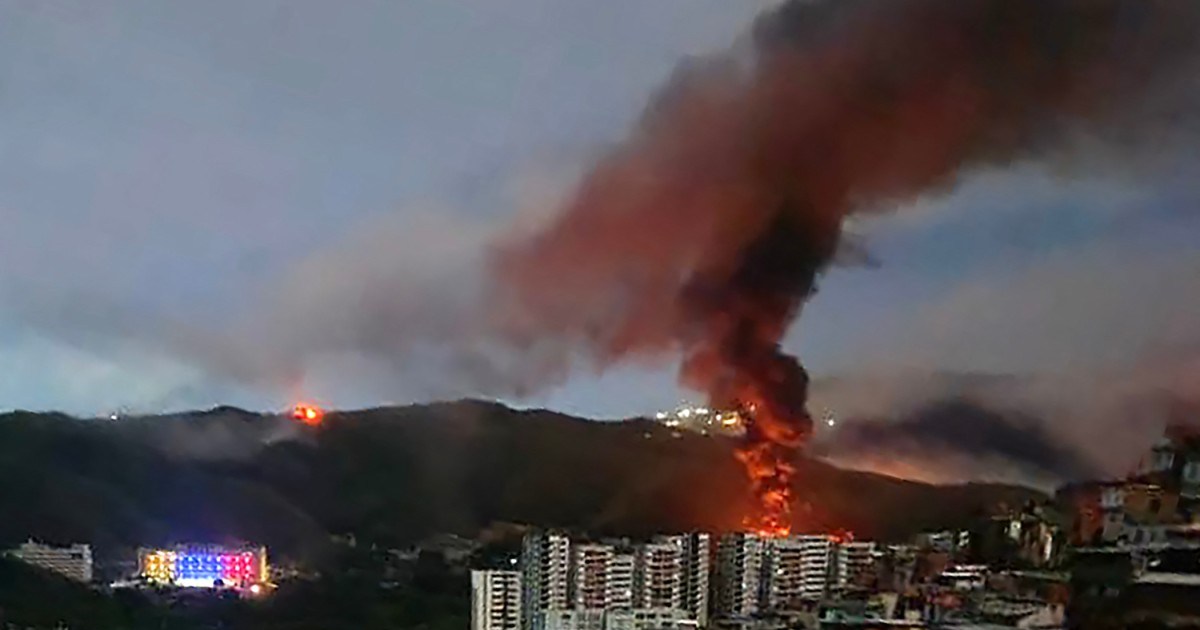
The United States has carried out a “large scale military strike” against Venezuela and captured its leader, President Nicolas Maduro, US President Donald Trump announced on social media.
Trump made the announcement on his Truth Social platform early on Saturday, shortly after loud explosions were reported in the Venezuelan capital, Caracas, marking a major escalation against the Latin American country.
Recommended Stories list of 3 itemsend of list
Trump said that Maduro’s wife, Cilia Flores, was also captured during the operation and both were “flown out of the country”. It remains unclear where Maduro and his wife were taken.
“This operation was done in conjunction with U.S. Law Enforcement,” Trump wrote.
In a statement, Venezuelan Vice President Delcy Rodriguez called on the US to issue “proof of life” of Maduro.
Speaking by telephone to Venezuelan TV Rodriguez said she did know the whereabouts of Maduro and his wife.
Phil Gunson, a Crisis Group analyst based in Caracas, compared the reported capture of Maduro to the fall of Panamanian leader Manuel Noriega on January 3, 1990, which was also orchestrated by the US.
“It’s not legal,” Gunson said of Maduro’s capture, while adding that it is the least of Venezuela’s worries at this time.
Earlier, it was reported that Maduro declared a national state of emergency in response to the attack, which the Venezuelan government described as a “military aggression”.
The government said the attacks occurred in the capital, Caracas, on Saturday as well as in the states of Miranda, Aragua, and La Guaira. Venezuela also accused Washington of staging the assault in an attempt to seize Venezuela’s oil and mineral resources, pledging that such efforts “will not succeed”.
Explosions were heard and plumes of smoke were seen rising in Caracas early on Saturday following the attack.
Video footage obtained by Al Jazeera showed balls of fire and thick smoke coming from a structure next to a body of water in Caracas early on Saturday.
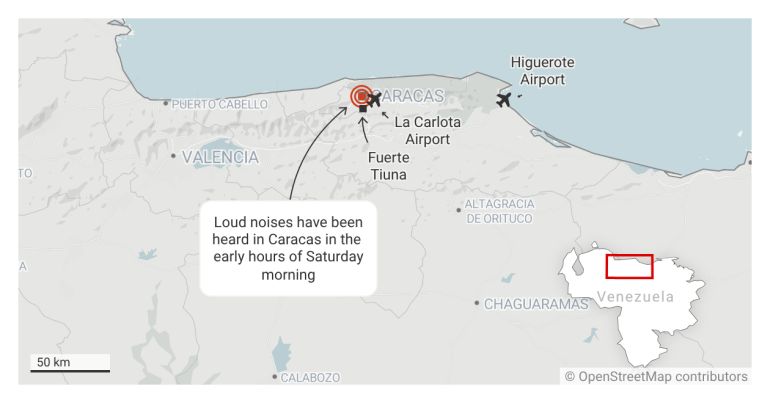
Quoting sources, Al Jazeera’s Lucia Newman, who is reporting from Santiago in Chile, said the explosion occurred near or around Fort Tiuna, the main military base in Caracas.
“Fort Tiuna is a key military base there. A series of explosions was reportedly heard throughout the area, followed by a blackout,” Newman said.
Reacting to the capture of Maduro, Newman later said that the development is “unprecedented, shocking, and extraordinary.”
Sissi De Flavis, a journalist based in Caracas, told Al Jazeera that she heard what sounded like a huge truck crashing, followed by an intense shaking of the ground.
“The skies started to light up. Then there was a ball of orange fire glowing. You can still hear planes flying over right now, although there have not been any explosions since then,” De Flavis told Al Jazeera.
The Associated Press news agency reported at least seven explosions and low-flying aircraft were heard in the capital.
An image published by AP also showed smoke rising at La Carlota airport following the series of explosions in the capital.
People in various neighbourhoods were seen rushing to the streets following the explosions. Some could be seen in the distance from various areas of Caracas.
“The whole ground shook. This is horrible. We heard explosions and planes in the distance,” Carmen Hidalgo, a 21-year-old office worker, told AP, her voice trembling. She was walking briskly with two relatives, returning from a birthday party.
“We felt like the air was hitting us.”
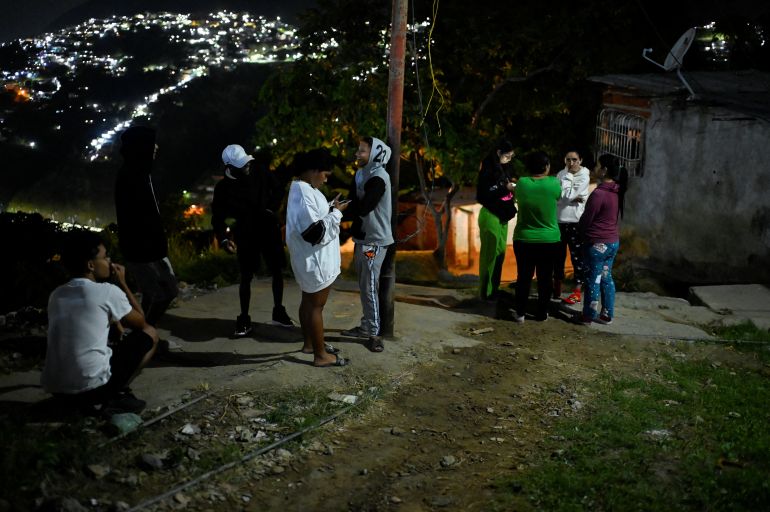 Residents stand in front of their homes in the Gramoven neighbourhood in Caracas after the US launched a military attack on the Venezuelan capital and reportedly captured President Nicolas Maduro [Maxwell Briceno/Reuters]
Tensions have been rising in recent weeks in Venezuela after Trump threatened to launch attacks on targets allegedly linked to drug trafficking.
Earlier this week, Trump also revealed a strike on a docking area for alleged Venezuelan drug boats last week, in the first known attack on Venezuelan territory of the US campaign.
The US president has repeatedly threatened ground strikes on drug cartels in the Latin American region, including Venezuela, which he has labelled “narcoterrorists”.
He has claimed, without providing evidence, that Venezuela’s Maduro leads a trafficking organisation that aims to destabilise the US by flooding it with drugs.
In an interview on Thursday, Maduro indicated that Venezuela was open to negotiating a deal with the US to combat drug trafficking, even as he remained silent on the reported CIA-led strike on Venezuelan soil.
Maduro also claimed in the interview that the US is trying to topple his government and gain access to Venezuela’s vast oil reserves through Washington’s months-long sanctions and military pressure campaign.
Asked point-blank if he confirmed or denied a US attack on Venezuelan soil, Maduro said: “This could be something we talk about in a few days.”
Maduro has said the Trump administration’s approach makes it “clear” that the US “seek to impose themselves” on Venezuela through “threats, intimidation and force”.