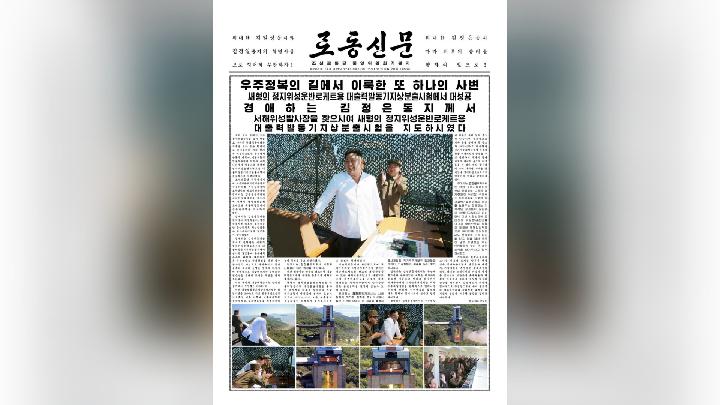
TEMPO.CO, Jakarta – Filled with missile tests, propaganda praising great leaders, and condemnation of the United States, the main newspaper of North Korea has long been considered highly provocative, leading South Korea to ban its citizens from reading it.
However, the pro-peace President Lee Jae Myung is now seeking to improve relations with Pyongyang. He even jokingly stated that he does not believe people will “turn into communists” by reading Rodong Sinmun.
Starting this week, as reported by Al Arabiya, South Koreans can access the publication, whose name translates to “Newspaper of the Workers,” at designated locations without state approval.
Although potential readers still need to visit public libraries to view copies, they no longer have to identify themselves or submit an explanation of their purpose.
Opinions in the South Korean capital, Seoul, are divided regarding the unrestricted access to propaganda from Pyongyang.
The government tightly controls all media in North Korea, and Rodong Sinmun serves as the mouthpiece of the ruling and repressive Workers’ Party.
“It’s like giving people access to ISIS propaganda,” said 22-year-old student Park Si-won, referring to the militant group.
“You wouldn’t do that unless you wanted them to join the terrorist group.”
81-year-old Hong Se-wung called the change “undesirable.”
“To allow people to read the newspaper of a hostile country, or to lead them towards reading it, the very idea itself is extremely unsettling.”
However, others are skeptical that South Koreans will bother to seek out the newspaper.
“Many people these days don’t even read physical newspapers anyway. I doubt they’ll make the effort to read Rodong Sinmun,” said 27-year-old postgraduate student Son Yu-jin.
Symbolic Change
South Korea and nuclear-armed North Korea are still officially at war, and Seoul has long banned all access to Pyongyang’s propaganda on security grounds.
Many restrictions still apply-North Korean websites are still inaccessible from South Korean IP addresses.
On Friday, at the National Library of Korea in Seoul, some people flipped through copies of Rodong Sinmun. Its pages were filled with photos of North Korean leader Kim Jong Un, whose name was always printed in bold.
However, in other places, few libraries have actually implemented the new rules.
“Practically speaking, this is really a symbolic change,” said Chad O’Carroll, whose website, NK News, provides a platform to read North Korean media.
“Overall, it would be much easier for students of North Korea studies to work with these materials if the South Korean government made the websites of North Korean state media accessible.”
He said this would require a difficult political change in Seoul’s security laws.
Seoul has pledged to “continuously expand access” to information about North Korea as it seeks to improve relations that have hit their lowest point in years.
This move is not reciprocal-North Koreans are still prohibited from accessing South Korean content altogether and face severe punishment if caught doing so.
Lee described the easing of Cold War-era censorship as a “chance to understand the reality of North Korea accurately.”
And businesswoman Bae Jee-woo agrees.
“Even if South Korean citizens can access the Rodong Sinmun directly, they would be able to interpret it based on their own standards and philosophies,” she said.
“It’s highly unlikely that they would be significantly influenced by North Korea’s propaganda or anything like that.”
Read: Kim Jong Un’s Daughter Visits Mausoleum, Fueling Heir Rumors
Click here to get the latest news updates from Tempo on Google News