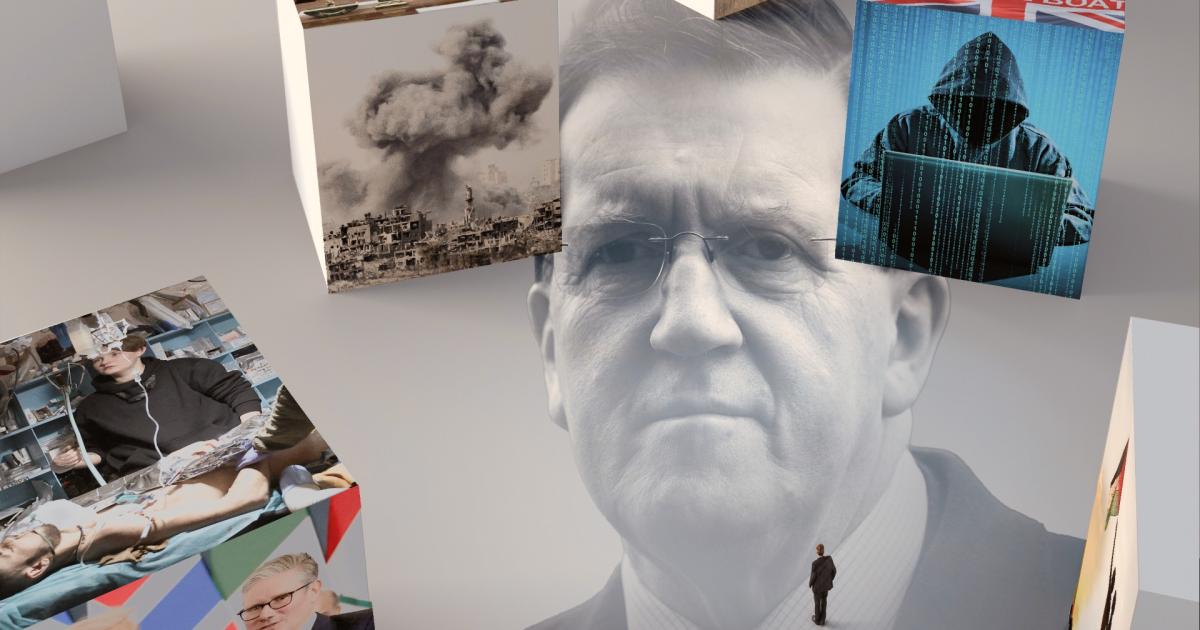
“We are in the grey zone,” former Nato secretary-general Lord George Robertson tells The Herald.
“We are under attack. Cyber warfare, targeted assassinations, sabotage, disinformation campaigns, election interference, the mapping and the threatening of undersea cables that carry 98% of all the data that we use, undersea pipelines that bring over 70% of gas supplies to this country.”
George Robertson and Defence Secretary John Healey (Image: PA)
“Our critical national infrastructure — an electricity system, a telecom system — all of it is on a knife edge and vulnerable,” he adds.
“You can see a time where our adversaries, our potential adversaries, see the weakness in our system and they get into these gaps in our system and exploit them to our disadvantage.
“I worry about that.
“I think we have to prepare.
“We are underinsured as a country and as a West against the forces outside who want to undermine what we have built up since the Second World War.”
“I am very, very worried about the state of the world today,” he adds. “There are significant things that we should be grateful for. The world today has never been better fed, better clothed, better sheltered, better communicated, better vaccinated than ever before in human history.
“This should have been a moment in time where we should have been able to recognise the peak of human civilisation. And yet we are now seeing a war in Europe with a major power attacking its neighbour.
“Where we have Middle East divisions between Palestinians and Israelis. Where China is rising.
“China, North Korea, Iran, Russia are conspiring together to undermine Western values — the values of democracy, free speech, press and toleration.
“We have been able to live our lives in a relative peace. And I do not think that we are going to hand over to future generations anything like the sort of society that we benefited from for so long.”
Lord Robertson is speaking to The Herald after winning the lifetime achievement award at the newspaper’s Scottish Politician of the Year ceremony, in association with Scottish Power.
The prize recognised his decades of public service and the sacrifices made.
George Robertson with First Minister John Swinney and The Herald’s Editor, Catherine Salmond (Image: Stewart Attwood)
Born on Islay in 1946, he grew up in the close-knit community of Port Ellen before studying economics at the newly created University of Dundee, where he was an active student campaigner.
He began his professional life in the whisky industry and entered Parliament in 1978 as Labour MP for Hamilton.
As Defence Secretary in Tony Blair’s first government, Lord Robertson oversaw the landmark Strategic Defence Review and played a leading role during the Kosovo crisis.
In 1999 he became Secretary General of Nato, guiding the Alliance through the aftermath of 9/11 and overseeing the first-ever use of Article 5, opening the door to enlargement and helping stabilise conflicts in the Balkans.
Lord Robertson has spent the past year as an external reviewer for the Government’s 2025 Strategic Defence Review — a document he said would “transform the way we do defence” and reshape how the armed forces recruit and train.
Given the armed forces’ well-known struggles to recruit, and the pressing threat, is it time to look again at conscription, as some European neighbours do?
“Conscription is not the answer,” he replies. “At the moment, there are actually quite a lot of people who want to join the army and who find it very difficult to do so, because of the medical qualifications and the bureaucracy involved.”
“We have got to make it easier for people to join,” he adds.
“We have got to make it easier for people to try it.
“Other countries have a gap-year process, so you go into the armed forces for a year and over 85% of them in other countries stay in the military.
“But when you have got to sign up for five or six years, it is a big commitment for people to make.”
Donald Dewar, George Robertson and John Home Robertson during 79 referendym
Lord Robertson was in the Army Cadet Force when a pupil at Dunoon Grammar.
“I hated every single minute I was in it,” he says. “When I then became Defence Secretary — which would have alarmed and shocked the master who was in charge of the Dunoon force — I reformed it.
“Instead of square bashing all the time — which I was always really bad at — I changed it into much more of an activity-based series of organisations, which brings in a lot of the kids who have got the IT skills, the gaming skills, that are going to be so important in the armed forces.”
The main lesson of the strategic defence review, he says, is that it “has to be an all-of-country endeavour”.
“We cannot any longer contract out defence to the armed forces. We are all involved. We are all involved in knowing how we are going to protect critical national infrastructure and how we are going to stop cyber attacks.
“Everyone in society needs to know what they have to do and when to do it. And that will apply just as much to civil emergencies like floods or power cuts as it would for a full-scale cyber attack that closed down hospitals, traffic lights and stopped normal life from proceeding in the way that it does just now.”
Catherine Salmond, editor of The Herald, and event host Martin Geissler of the BBC with Lord Robertson (Image: Stewart Attwood)
Discussing Russia’s war in Ukraine, he said the conflict represents a direct threat to the UK.
“Russia is a threat to us, not just to the people of Ukraine,” he said. “It could easily happen to us as well.”
He praised Prime Minister Sir Keir Starmer’s work and said those within his own party plotting to oust the Labour leader needed to “back off”.
Labour MPs believe that if the party suffers heavy defeats in May’s Holyrood, Senedd and English local elections, the Prime Minister’s position will become untenable and a challenge could follow within weeks.
“Keir Starmer is doing a good job,” Lord Robertson says. “A difficult job in very, very difficult circumstances. When you look at what he is doing internationally in terms of Ukraine, he has been a leader in that field, and that takes up quite a lot of time.
“The government inherited a huge deficit, with the overhang of the financial crisis and the pandemic. These were really heavy loads for any new government to carry, and therefore it has been very difficult to make the kind of progress that he wants in order to create a society that he believes is absolutely necessary.
“So, all the manoeuvring and all the gossiping that is going on is counter-productive, not useful for the party, and certainly not useful for the country.”
Anti-Polaris demonstration at Holy Loch. Demonstrator Mike Nolan sits astride the after fin of the nuclear submarine Patrick Henry in the Holy Loch today.
It was the arrival of the US Navy’s Polaris submarine base at Holy Loch in 1961 that politicised the young George Robertson.
The deep, sheltered waters of the loch had long been a strategic naval site, but hosting the first American ballistic missile submarines in Europe — armed with nuclear weapons at the height of the Cold War — made the area a frontline in global nuclear strategy.
There were sustained demonstrations, ranging from marches and vigils to sit-downs blocking access to the pier, and lone protesters taking to the water in small boats.
“It was like a political fairground,” Lord Robertson says. “All these great national figures came to this small town of Dunoon.
“I was active in the debating society at school, so I got engaged in that.
“This was of considerable embarrassment to my father, because we had the same name and he was the Detective Sergeant, the head of the CID of Dunoon.
“And I was going around on my bike to the campsite for the demonstrators. He arrested them when they demonstrated. So that was a bit of an embarrassment, I think, to him.”
“For a year, I was actually in the SNP.
“I joined because they were very much anti-Polaris. And I treasure the letter I got welcoming me to membership. And a year later, at the age of 15, resigning from them pretentiously and getting a letter back regretting my leaving.
“The two letters, which I carefully kept, were very handy when I fought the Hamilton by-election in 1978. I was able to show that I left the SNP on a point of principle.
“I joined the Labour Party then, and I have been in the Labour Party ever since.”
Lord Robertson defeated the SNP’s Margo MacDonald at that by-election and entered the Commons in the final weeks of James Callaghan’s government.
He says he never assumed his seat was safe.
“I was always conscious I was in a marginal constituency,” he said. “At every election you know your livelihood and your family’s livelihood is in the hands of an electorate who can change their mind.”
“My predecessor as Defence Secretary was Michael Portillo. In 24 hours he had gone from being Her Britannic Majesty’s Principal Secretary of State for Defence to plain Mr Michael Portillo, aspiring to run documentary programmes about railways.
“You go from hero to zero depending on the fickleness of the public,” he said. “I approached my life between elections as if I was fighting a marginal every time.”
It is not an easy life, and one that has required sacrifice, not just from Lord Robertson.
“I do not think anybody can underestimate the burden that is carried by families of politicians.
“So much of the time you are engaged in it. And I would bow to their judgement rather than my judgement as to the impact it had on them.
“But if you feel that you have got to do it, if you feel that you can make a contribution, then you have got to continue to do it.”
He said he had never considered leaving public life for a different career.
“No, I never believed anything other than the mission that I was involved in to improve the country that I lived in and to look after the interests of the people who had voted for me, or even the people in the constituency who had not voted for me as well.”
“One of the great failures of our time is that we are making it so difficult for people to be involved in the political process.
“But everyone has got a view. Everyone has got an opinion. Everyone can tell you what is wrong with the country and what is wrong with the political process.
“But too few of them actually get engaged in it in order to participate and make it safe. And only when people do will things actually change.”
Lord Robertson said he never expected to receive a lifetime achievement award, joking: “It is nice to hear compliments after a lifetime of abuse.”
Asked for the moment he realised politics would define his life, he pointed to his teenage years.
“I knew in the maelstrom of Dunoon at the time — all these famous people came to the small plainside town — and I got embroiled, and I felt that time very strongly.
“And I still knew that the world could be a better place if people actually were active and engaged.”
“I still strongly believe that we can make the country and the world a better place if all of us play a more active part in the political process,” he added.