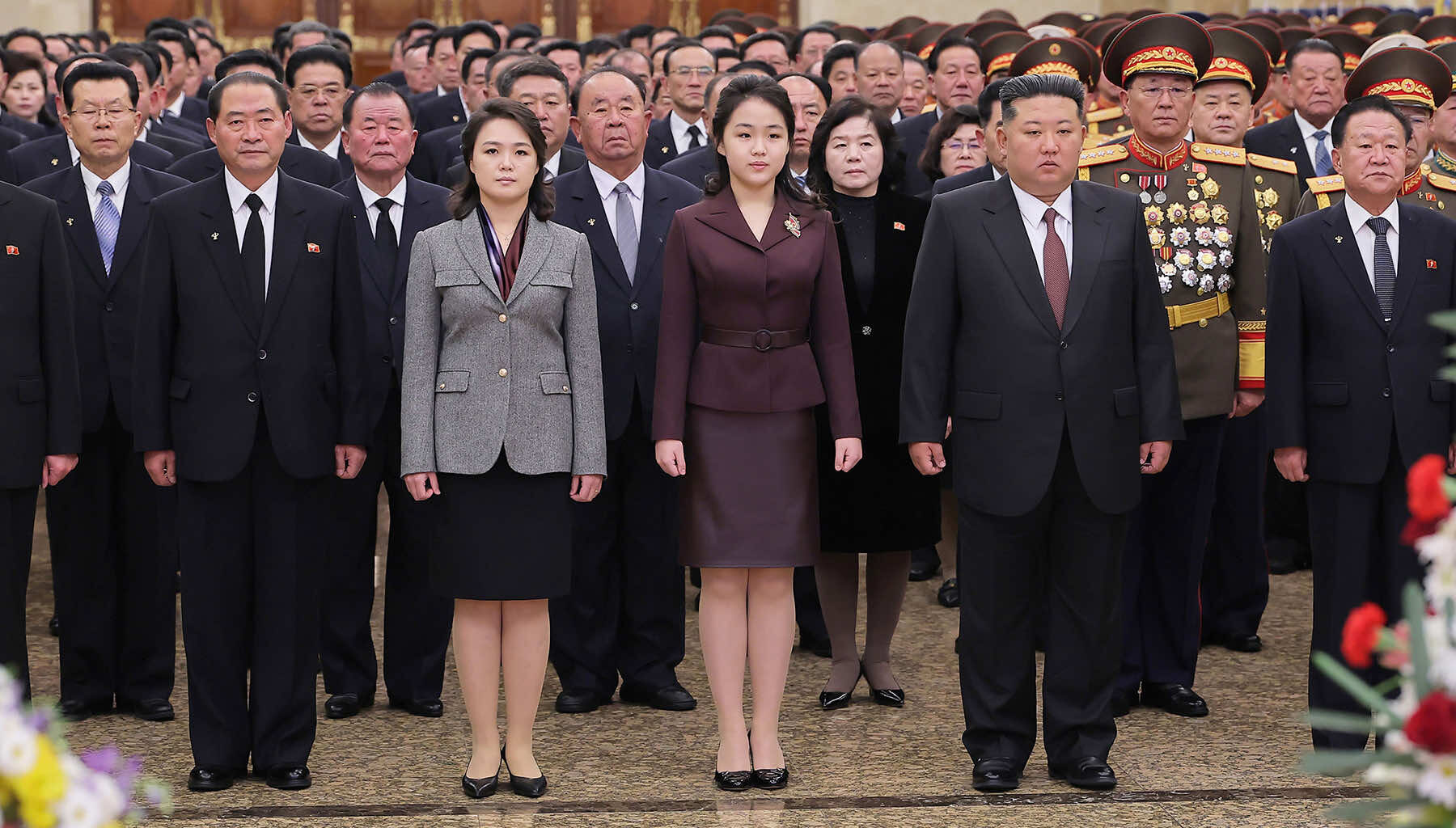
North Korean State media portrayed the scene as a routine commemorative event, but analysts say her inclusion marks a significant escalation in how the ruling family is shaping the next generation of leadership.
In a country where succession signals are rare, selective, and highly symbolic, a public appearance at the regime’s most sacred site is widely interpreted as a deliberate test of her emerging role.
The visit follows nearly two years of gradual exposure orchestrated by Kim Jong Un. The girl, reportedly named Kim Ju Ae and aged about 13, first appeared in late 2022 at the launch of a Hwasong-17 intercontinental ballistic missile. That moment, presented through choreographed images of her standing beside her father, broke decades of precedent.
Until then, no minor child of a North Korean leader had appeared in a venue tied directly to the country’s strategic weapons program. Her subsequent presence at military inspections, commemorative ceremonies, and official banquets has shifted from novelty to recurring feature, forming a pattern that state media now reinforces with increasingly elevated language.
The honorifics used to describe her have drawn particular attention. North Korean propaganda outlets have referred to her as the “beloved daughter” and the “most respected child,” titles that mirror early references to Kim Jong Un during the final years of his father’s rule. Those phrases are not benign flourishes.
In the North Korean system, where political legitimacy is framed as an inherited authority descending from Kim Il Sung, such language is used to prepare the public and elite institutions for an eventual transfer of power. The girl’s appearance at Kumsusan, a space that functions simultaneously as shrine, historical archive, and ideological anchor, establishes her within that lineage in a manner few outside the ruling family have ever attained.
Her emergence also reflects the constraints of the Kim dynasty’s succession model. The state has never publicly confirmed how many children Kim Jong Un has, though South Korean intelligence has asserted that he has three. A son has been rumored but never introduced, and no alternative successor has been positioned in public view.
North Korea faced internal instability when Kim Jong Il’s health declined, and Kim Jong Un ascended to power without a long grooming period. His early years were marked by purges, reshuffles, and public displays of control meant to eliminate rivals. The current approach appears designed to avoid repeating that transition.
By introducing a potential heir while still a child, Kim Jong Un has begun the process of conditioning the elite, limiting speculation, and reducing the opportunity for competing factions to form.
Unlike hereditary systems constrained by law or custom, North Korea’s model centers on the preservation of the Paektu bloodline. Legitimacy derives from ancestry rather than gender, seniority, or political record.
While the Korean Peninsula has no tradition of female heads of state within its modern authoritarian or democratic structures, North Korea’s political mythology does not depend on conformity to historical norms.
It depends on the idea that the Kim family alone embodies the revolution, the state, and the nation. Within that framework, the choice of a daughter does not challenge doctrinal principles. Instead, it reinforces the message that leadership is a birthright rather than an office determined by institutional mechanisms.
Still, the introduction of a female successor carries implications the regime will have to manage carefully. North Korea’s political culture is not gender-neutral, and senior military leadership is overwhelmingly male.
Yet gender is unlikely to determine her viability. The system is built on centralization, surveillance, and enforced loyalty, and authority flows downward through the party and military, regardless of who occupies the top position.
Analysts note that a female successor could even reduce internal rivalry because she may be viewed as a controlled focal point for legitimacy rather than a direct competitor to powerful generals. Her youth allows the regime to shape perceptions long before succession becomes imminent.
The handling of her image suggests the leadership is already refining the narrative architecture that would support a future transition. Each appearance has been staged to convey familiarity with the instruments of state power: missile sites, command facilities, and commemorative spaces tied to the founding generations.
These settings frame her not as a child observing ceremonies but as a figure being introduced to the mechanisms that define North Korean sovereignty. Imagery that places her alongside senior commanders indicates the regime’s intent to embed her in the visual grammar of authority long before she gains any operational role.
Her rise also reflects Kim Jong Un’s broader effort to preempt succession uncertainty. Observers have noted signs of chronic health problems over the past decade, though the government has never acknowledged any issue.
The lack of transparency surrounding the leader’s condition increases the significance of public succession signals. By elevating a possible heir early, the regime shapes elite expectations and reduces the space for power brokers to cultivate alternative candidates. That strategy parallels succession planning seen in other authoritarian dynasties, where prolonged exposure and managed visibility become tools to preserve stability as a ruler ages.
At the same time, the daughter’s role introduces questions about how a future transition would be structured. If she eventually becomes the designated successor, she would likely assume the position initially through a collective guardianship arrangement. Senior officials would manage day-to-day governance while affirming her symbolic authority.
That model mirrors earlier periods in North Korea when advisers and military leaders played substantial roles during leadership transitions. It would allow the system to maintain continuity while protecting a young successor from internal challenges until she consolidates authority.
For now, the regime’s messaging focuses less on immediate succession and more on establishing her as a natural extension of the ruling lineage. Her appearances emphasize proximity to her father, continuity of the revolutionary narrative, and association with the state’s most sensitive programs.
By placing her at the intersection of ideology and military power, the leadership is defining her future relevance through controlled symbolism rather than explicit announcements. The absence of formal acknowledgment is consistent with the state’s long-standing approach: succession is revealed gradually, through calibrated signals rather than official declarations.
Internationally, her emergence underscores the durability of the Kim dynasty. Despite economic pressure, sanctions, and diplomatic isolation, North Korea continues to invest heavily in the propagation of its ruling mythology.
The introduction of a potential fourth-generation leader signals the regime’s confidence in its internal cohesion and its intention to maintain a hereditary model indefinitely. For neighboring countries and the United States, the development does not change immediate policy calculations, but it offers insight into how the regime plans to manage long-term stability amid strategic ambitions.
Her visit to Kumsusan marked a notable progression in that broader strategy. The mausoleum is not merely a memorial; it is the physical embodiment of the state’s founding legitimacy. Entry into that space is a privilege reserved for senior leadership and carefully selected officials.
By bringing his daughter into that environment, Kim Jong Un aligned her with the foundational figures who anchor the regime’s ideological narrative. The gesture positions her within the symbolic lineage that sustains the country’s political structure, signaling that her role may extend far beyond ceremonial appearances.
Whether she ultimately becomes North Korea’s next leader remains an open question, but the pattern of her public emergence reflects intentional preparation rather than incidental exposure.
The state’s carefully constructed imagery, consistent messaging, and selection of venues demonstrate a long-term plan to shape how elites and the public perceive her place within the dynasty. In a system where legitimacy is inseparable from family lineage, these signals carry considerable weight.
The trajectory of her development will continue to inform assessments of North Korea’s political future. Each appearance offers insight into how the regime balances the demands of continuity, internal control, and strategic communication.
For now, her ascent illustrates how the Kim family is adapting its succession strategy to ensure the dynasty endures — not through abrupt announcements, but through a gradual, deliberate expansion of its public narrative.