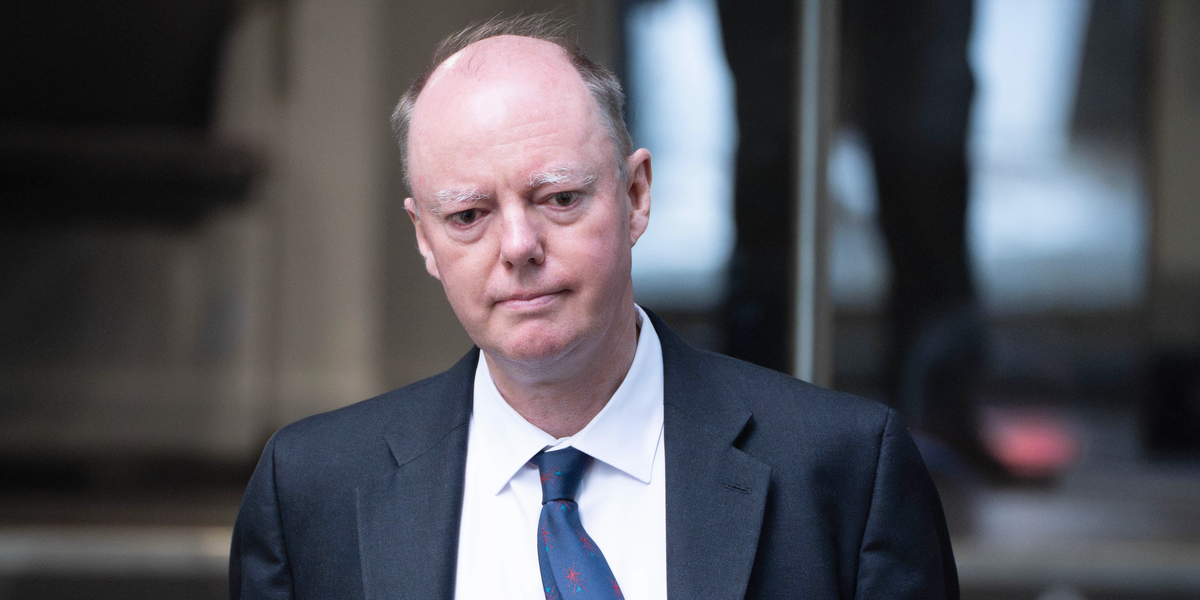
Britain’s top doctor is facing criticism after new emergency plans revealed how the public would be instructed to cope during a major power cut – from what food to eat first to how to make water safe.
The guidance, developed by England’s Chief Medical Officer Chris Whitty, sets out what would be broadcast to households if electricity, water, and communications failed for days.
The documents say such a blackout is “unlikely”, but their sudden appearance has sparked criticism from senior academics, who question whether this is the right focus at a time when the NHS is under extreme and deadly strain – and whether the tone of the advice is patronising.
The material draws on official Chief Medical Officer broadcast scripts, prepared for use if phone networks, the internet and TV services were knocked out.
Among the advice is tips on what food to eat advising people to “eat chilled and frozen food that is likely to go off quickly first… Keep food which you normally keep in the cupboard and that has a longer shelf life until last.”
For vulnerable groups, the warning specific: “Babies, young children, pregnant and breastfeeding women, older people and those who have weakened immune systems… should not eat chilled ready to eat food… after 4 hours of being without power.”
There is also guidance on filtering water using pillowcases, using bleach to disinfect river or rainwater, or drinking low alcoholic beverages such as beer as well guidance to as cook outdoors using camping stoves rather than lighting barbecue’s inside the home.
Supporters of the planning point to recent international events.

Professor Chris Whitty has been criticised for nanny state-ism before
| PA
Since 2022, Ukraine’s electricity grid has been repeatedly targeted by missile and cyber-attacks, leaving millions without power and knocking out water treatment, sewage works, mobile networks and hospitals. These attacks are now routinely studied by European emergency planners.
Planners also point to real-world power failures closer to home. In 2024, parts of Spain and Portugal suffered regional blackouts lasting up to two days.
Spanish authorities later confirmed eight deaths linked to the outages including people dependent on home oxygen machines, individuals trapped in lifts, and heat-related illness when cooling systems failed.
Some commentators also warn that modern energy policy has reduced resilience at home.

Britain has been close to a blackout before
| Getty
Andrew Montford, director of Net Zero Watch, which analyses the costs and benefits of Net Zero said relying too much on wind and solar has added to blackout risk as these renewable power sources are unreliable. He added: “Our energy system, now being mostly imports or offshore is also very vulnerable to hostile acts.”
One of the country’s top emergency planners Professor Lucy Easthope said: “A national outage or total outage is very unlikely,” she said “But if we lose power, we lose power to sewage works.”
She added: “There is no secret switch that protects critical infrastructure.”
Even people registered as vulnerable may not be protected, she warned: “You’re not protected for life-support equipment and medical feeds.”
And she said the Covid Inquiry, with its focus on what the Government did wrong, has meant Government and its civil servants are keen to avoid blame for any future disaster.
She said: “Before 2019 we were much more fatalistic about disasters, and we accepted there would be deaths as a result. But the Covid Inquiry heavily criticised Government and blamed them for not being ready and not doing enough. Ministers have become scared of this happening again and are much more risk averse.”
However, she added: “In reality we have ongoing chronic emergencies, such as the health and social care crisis and the housing crisis which are all also potentially deadly.”
Epidemiologist Carl Heneghan, Director of Oxford University’s Centre for Evidence Based Medicine, questioned why the Chief Medical Officer was associated with such advice while the health service is under unprecedented pressure.
“This document has come at a time when we’re in the midst of the doctors’ strike, huge A&E waits and while 7.4 million on the waiting list,” he said.
Prof Heneghan argues the scenarios are acknowledged to be unlikely, even in the documents themselves.
“We are focusing on a highly unlikely possibility,” he said.He added: “This is state advice on how much water to drink, how to wash your hands, how to eat food that is older first,” he said. “It’s nanny state-ism.”He also raised concerns about practical details.
“Putting bleach in water is not necessarily the best way to clean it,” he says, warning that such advice could be misunderstood.
He said Professor Whitty should focus on priorities elsewhere.
“He needs to focus on the serious issues at hand”, he told GB News.
“People getting an appointment with their GP, not waiting 12 hours in emergency care, or not waiting weeks for a cancer appointment.
“If I were chief medical officer, I would be focusing on the millions on the NHS waiting list and working out how many are harmed by the waits, and what should be done to reduce the sizeable problem.”