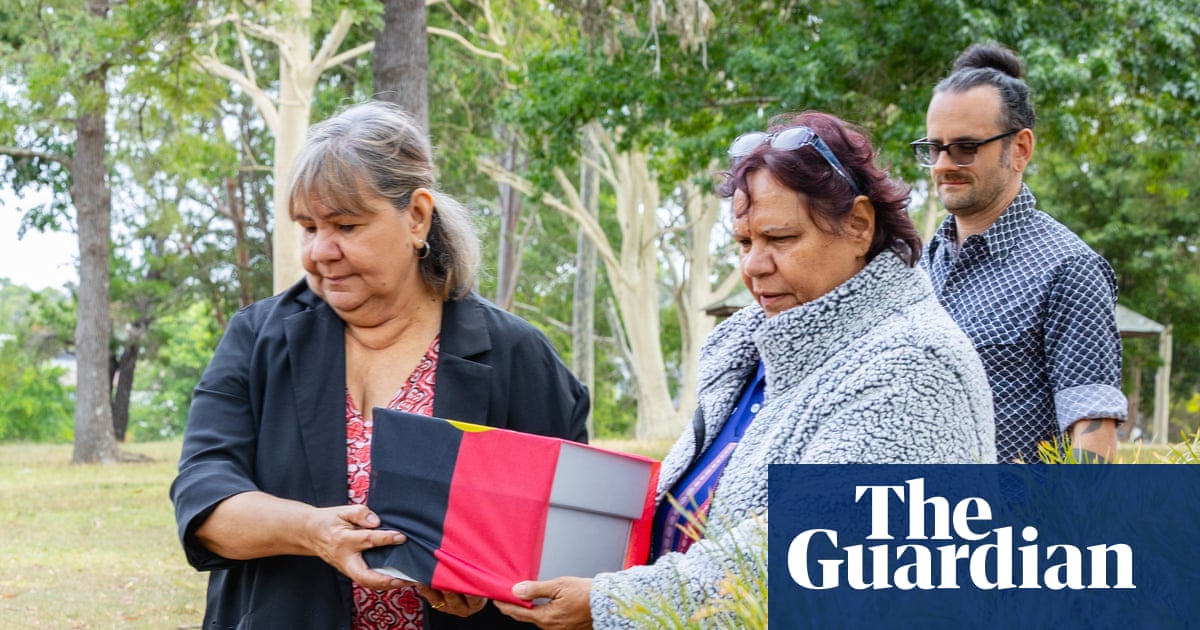
Elizabeth Dempsey felt it in her bones when she held them: these were her people.
“I just felt this full feeling inside,” she says. “We all felt it, and we knew they were ours.”
Dempsey and her siblings had flown to Sydney from the gulf country of north Queensland for a reunion a century in the making, after the remains of their Waluwarra ancestors were discovered in three institutions – including a university in the German city of Cologne.
The unfinished business of Australia’s colonial past lies in secret, dark places within the world’s leading institutions. The remains of thousands of Aboriginal and Torres Strait Islander people – collected, sold and traded over centuries – are held in museums, universities and private collections across Australia and internationally.
Staff at eight Australian museums have the complex and highly sensitive task of returning them to their ancestral lands, but the work is unending. The number of repatriations is outstripped by the remains they receive monthly; dug up on building sites, unearthed by erosion at national parks or found in dusty boxes on old farming properties.
About three months ago, Dempsey and her sister, Sylvia Price – through their native title body, the Bularnu Waluwarra Wangkayujuru Aboriginal Corporation – received an email from the federal arts department, which facilitates the return of First Nations ancestors from overseas collections.
Waluwarra elders speak at a repatriation ceremony for their ancestor in Sydney. Photograph: Mel Koutchavlis/Australian Museum
Aboriginal remains, originating from a cattle station on Waluwarra country outside Mount Isa, had been found at the institute of anatomy at the University of Cologne, the sisters were told.
The news brought mixed emotions, Price says.
“I questioned, ‘how could our Australian government allow that to happen, for our ancestor’s remains to be removed out of Australia?’” she says. “I came to the realisation that this has happened in the past. We can’t change it, but we need to move on.”
Further investigation identified the remains of two more ancestors on home soil: one at the Australian Museum in Sydney and another at the Queensland Museum in Brisbane. More information about them emerged through morphological markers, archival records and community knowledge.
“We’re still in the process of working with museum staff to get the whole picture,” says Price. “It’s sort of like a jigsaw puzzle – piece by piece, we’re just putting it together to find out what happened to them.”
Two of the ancestors were sold to the Australian Museum in extraordinary circumstances in 1905 by Walter Roth, who was then Queensland’s chief protector of Aborigines. The ethnographer collected thousands of cultural artefacts from north Queensland before being appointed one of the first officials to implement the state’s so-called Aboriginals Protection Act, ostensibly designed to protect Indigenous people from exploitation by controlling every aspect of their lives.
At the time, the body parts of Indigenous peoples around the world were sought-after antiquities to be studied or displayed in colonial homesteads or museum exhibitions. In Australia, some were taken from victims of massacres on the colonial frontier. Others were exhumed after burial.
Roth’s sale of 2,500 artefacts to the Australian Museum – including 97 human specimens from the Indigenous peoples he went on to govern – for £450($85,000 in today’s money) was one of the reasons for his resignation under public pressure the following year.
Aboriginal remains originating from a cattle station on Waluwarra country outside Mount Isa were found at the University of Cologne. Photograph: Mel Koutchavlis/Australian Museum
Of the two Waluwarra people in Roth’s collection, one was traded to a German university professor in 1936, museum records show, in exchange for the skull of an Inca person from Peru.
The body of the third Waluwarra ancestor was found by road workers outside Mount Isa in 1973. Police sent the remains for testing, which revealed they were more than a hundred years old. They were held in a forensic facility in the care of the state coroner until 2016, when custody was transferred to the Queensland Museum’s repatriation team.
This month, all three ancestors were reunited with their descendants. Moving ceremonies welcomed them to Sydney, then Brisbane, where they will remain at a secure keeping place while the Waluwarra community makes arrangements to return them to country.
As the remains were presented to their descendants at a smoking ceremony in Sydney, Dempsey’s thoughts turned to her grandfather.
“He used to play these clapsticks,” she says. “If he couldn’t have his clapsticks, he’d be hitting the tin with his long fingernails, so I could hear those sounds in my head while we were there.”
Representatives from the Australian and Queensland museums apologised to the Waluwarra people.
“We don’t want to hold any remorse against them, because we know that the staff have done all they can to help us return our ancestor, and that’s good enough for us,” Price says. “It feels like you’ve cried all your tears, you’ve grieved long enough – now it’s time for healing.”
New remains discovered faster than can be returned
More than 1,790 Aboriginal and Torres Strait Islander ancestral remains have been repatriated from 11 countries over the past 35 years. An unknown number remain abroad.
Australian museums have been trying to return human remains for decades. Several of these institutions have recently undergone something of a cultural reckoning, acknowledging their role in the grim trade and appointing Indigenous-led teams to lead repatriation work. Each of the eight major museums can apply for up to $100,000 a year in federal funding to support the return of ancestors and cultural objects.
The Waluwarra community will make arrangements to return three Aboriginal ancestors to country. Photograph: Mel Koutchavlis/Australian Museum
Repatriation was the top priority for Laura McBride, director of First Nations at the Australian Museum, when she became the first Indigenous person appointed to the institution’s executive leadership team in 2021.
“These people aren’t ancient human remains,” she says. “The human remains that we hold are generally from post colonisation, so they’re our grandparents, our great-grandparents.”
It’s hard to say how many First Nations ancestors are held at the museum, McBride says, because the numbers are always fluctuating – but there are hundreds.
The Queensland Museum faces a similar challenge. It holds about 840 Aboriginal and Torres Strait Islander ancestors, many collected by the notorious native mounted police who brutally suppressed Aboriginal resistance on the Queensland frontier. More than 30 human remains were surrendered to the institution in the past year alone.
“Our returns to community are being outstripped by the numbers of ancestors that are being returned,” says Bianca Beetson, the museum’s executive director of First Nations. “People finding them in their grandparents’ closets and things like that.”
The repatriation process is further complicated by insufficient records about the origins of the remains; native title disputes; community fears that burial sites could be vandalised and inadequate funding for research, consultation and the construction of on-country keeping places.
But it is crucial that the work continues, Beetson says.
“We talk about it being the most important act of reconciliation,” she says.
“Do we want these ancestors sitting in a museum for another two, three hundred years?”