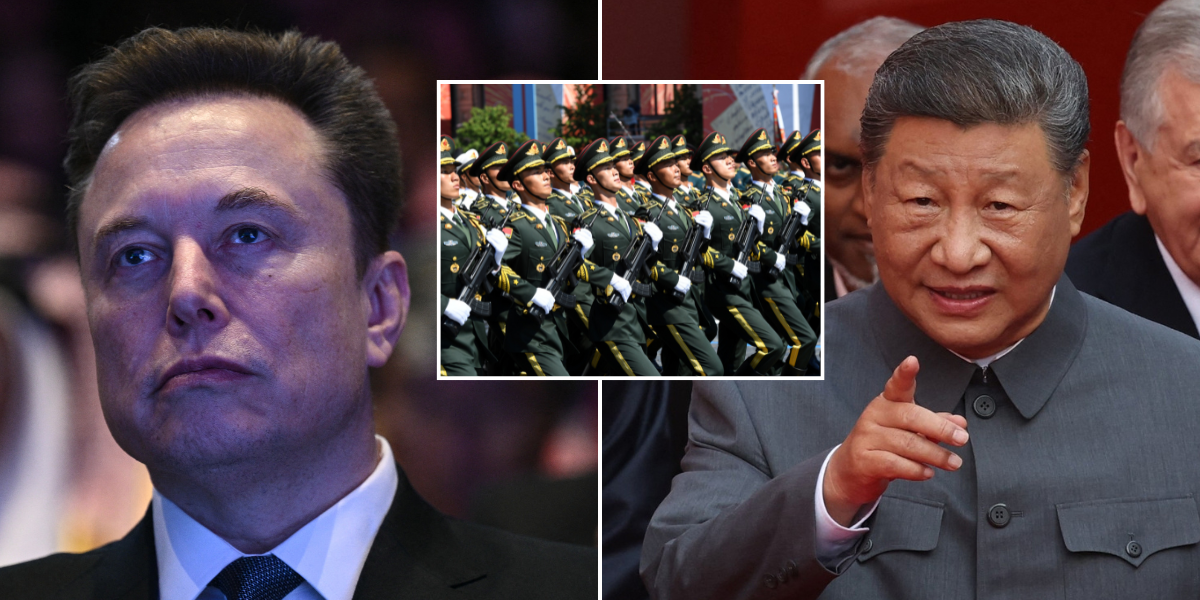
China and Russia are targeting Elon Musk’s Starlink satellite constellation, claiming the network poses dangers to spacecraft whilst facilitating criminal enterprises, drug trafficking operations and terrorist organisations.
It comes as Beijing is understood to be researching ways to disable the network should it launch an invasion of Taiwan.
The two powers, backed by Cuba and Iran, are pressing Washington to impose controls on the rapidly expanding satellite system, arguing its growth violates international space obligations.
SpaceX currently operates approximately 10,000 Starlink satellites in orbit, delivering internet connectivity worldwide beyond the reach of national government censorship or control.
The coordinated diplomatic push comes as both nations harbour distinct grievances against the American-owned network, with Moscow incensed by its deployment in Ukraine and Beijing strategising about potential Taiwan conflict scenarios.
As a result, China is exploring ways to neutralise Starlink in the event of a conflict erupting over Taiwan and the South China Sea.
Recent specialist journal publications revealed Chinese scientists testing blocking techniques, concluding that isolating the island would require a minimum of 1,000 jamming drones.
Ambassador Fu Cong, China’s UN representative, addressed a special meeting convened by Russia, stating: “The unchecked proliferation of commercial satellite constellations by a certain country, in the absence of effective regulation, has given rise to pronounced safety and security challenges.”

China and Russia have launched a campaign against Elon Musk’s Starlink
|
GETTY
Mr Cong, whilst declining to name the United States directly, reiterated previous complaints about close encounters between Starlink satellites and China’s Tiangong space station.
“The expanding military applications of such systems aggravate the risk of an arms race in outer space,” he said.
“A certain country has made extensive use of commercial space entities to provide military reconnaissance, battlefield communications and other services, and has even directly intervened in armed conflicts in other countries.
“This has blurred the boundary between military and civilian activities in outer space,” the diplomat continued.

Starlink’s satellite internet connectivity worldwide is beyond the reach of national government censorship or control
|
GETTY
He urged the “certain country” to “strengthen regulation and oversight of its commercial space activities, and respond to the concerns of the international community”.
Beijing recently fined a foreign vessel docked at Ningbo port for operating banned Starlink equipment within Chinese territorial waters, and lodged complaints after a Starlink satellite malfunctioned on December 17, releasing debris as it descended.
Russia’s anger stems directly from Starlink’s provision to Ukrainian forces, which has enabled frontline internet access and allowed Kyiv’s military to bypass Russian jamming efforts and attacks on domestic communications infrastructure.
Once America’s primary space rival during the Soviet era, Russia has fallen significantly behind in the modern space race, a decline made acutely apparent by Ukraine’s successful exploitation of the satellite network.
Moscow recently convened a security council expert meeting to examine low-earth orbit satellite systems, encompassing not only Starlink but also Amazon’s Leo and Europe’s Eutelsat OneWeb.
Russian officials alleged these networks threaten state sovereignty and international security despite their stated commercial purposes.
“Illegally imported terminals have been used to destabilise public order through dissemination of disinformation, manipulation of electoral processes and coordination of anti-government protests from abroad,” a Russian statement declared.
“Despite their declared commercial and civilian nature, these satellites have played a significant role in armed conflicts, including proxy wars,” they added, per The Times.

Beijing is understood to be developing ways to disrupt Starlink should it wish to invade Taiwan
|
GETTY
Britain has pushed back against Moscow’s characterisation of the debate, rejecting claims that low-earth-orbit satellite operations were unregulated and maintaining that existing international law adequately governs such systems.
Washington offered a pointed response to Russian complaints about Ukraine’s battlefield advantage.
US officials stated that if Moscow wished to halt Ukrainian forces’ use of Starlink against Russian military targets, it could achieve this straightforwardly by ending the war.