By Kim Hyung-Jin / AP, SEOUL
South Korea on Thursday formally ended its dwindling yet much-criticized bear bile farming industry, although about 200 bears are still kept in pens and raised for their gallbladders.
The South Korean Ministry of Climate, Energy and Environment on Tuesday announced it would ban breeding and possession of bears and extraction of their bile beginning Thursday. The change is in line with a revised animal rights protection law that imposes up to two or five years of prison sentences on violators.
South Korea is one of the few countries that allow farming to extract bile from bears, mostly Asiatic black bears known as moon bears, for traditional medicine or as food, as it is believed to boost vitality and stamina.
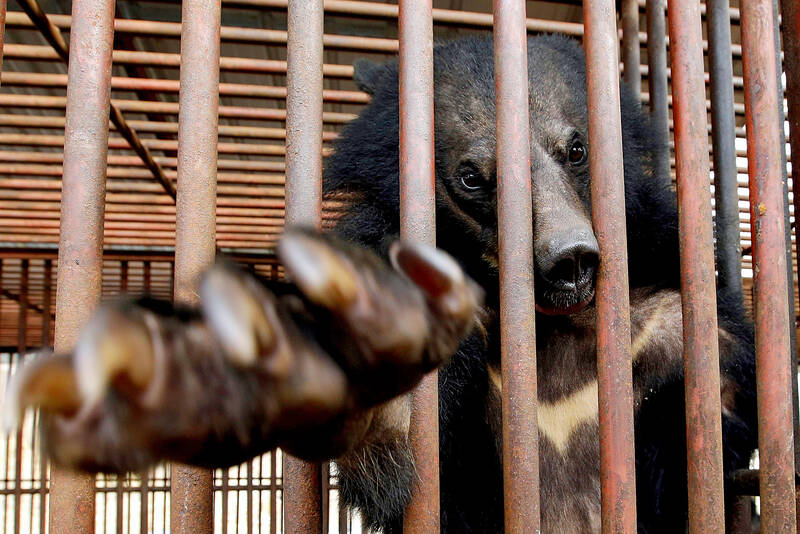
Photo: AP
However, the popularity of the practice has nose-dived in the past two decades in response to questions about its medicinal effects, the introduction of cheaper medical alternatives and public awareness of animal cruelty.
The ban is part of a broader 2022 agreement among officials, farmers and animal rights campaigners to prohibit bear bile farming beginning this year. Animal rights groups are responsible for handling purchases of bears from farmers, and the government for establishing facilities to hold them.
A total of 21 bears has been purchased and relocated to a government-run sanctuary in southern Jelloa Province last year. However, 199 bears are still raised in 11 farms across the country while disputes continue over the amount of money to be paid to farmers for giving up their bears, said officials, activists and farmers.
The ministry said bear farmers would have a six-month grace period, but would be punished by law if they extract bile from their animals. The ministry said it would financially support farmers for keeping their bears until they are sold and moved.
“Our plan to end bear farming business is an implementation of our country’s resolve to improve welfare of wild animals and fulfill our related international responsibility,” South Korean Minister of Climate, Energy and Environment Kim Sung-whan said in a statement. “We will strive to protect bears until the last one.”
Kim Kwang-soo, a farmer who raises 78 bears in the southern city of Dangjin, said other farmers sold their bears at extremely cheap prices because of economic difficulties, but he has not sold any of his animals.
“This is a very bad policy,” said Kim Kwang-soo, who serves as the secretary-general of a bear farmers’ association. “I’ll still observe the law.”
Bear farming began in South Korea in the early 1980s, with farmers importing bears from Malaysia and other Southeast Asian countries. The industry has since been condemned globally for keeping bears in small, barren cages their entire lives until they are slaughtered for their body parts.
About 1,000 bears were raised in farms in South Korea in 2014. Kim Kwang-soo said many farmers had since sterilized their bears in return for government compensations.
He said some bears died naturally while others have been slaughtered for their bile or killed after being attacked by other bears held in the same cages due to a lack of proper management.
Animal rights groups praised the South Korean government for pressing ahead with the 2022 agreement, but urged it to establish bigger protection facilities to accept rescued bears.
The government said its Jeolla Province sanctuary can carry up to 49 bears, but Kang Jae-won, an activist at the Korea Animal Welfare Association, said the number of bears should not exceed 30.
A second government facility was to be established in April last year, but the opening has been delayed until next year due to flooding.
Kang said that activists are discussing with foreign zoos to send some rescued bears there.
“It’s really good [for the government] to reflect on bear bile industry and push to end it, but it’s regrettable that there aren’t sufficient measures to protect bears,” said Cheon Jin-kyung, head of Korea Animal Rights Advocates in Seoul. “There aren’t place where these bears can stay.”
Humane World for Animals Korea campaign manager Lee Sang-kyung also called for a greater government role in removing the remaining bears from captivity without further delay and supporting the creation of private sanctuaries “to give back these animals a life of peace and relative freedom in natural surroundings.”