WASHINGTON — An audacious overnight raid by elite U.S. forces that seized Venezuelan President Nicolás Maduro from his bedroom in Caracas plunged the country into turmoil Saturday, prompting international concern about Venezuela’s future and President Trump’s attempt to take control of the sovereign nation.
Trump justified the stunning attack by accusing Maduro, without evidence, of sending “monsters” into the United States from Venezuelan prisons, and by claiming Maduro’s involvement in the drug trade. But the American president focused more on Venezuela’s vast oil reserves, accusing its government of stealing U.S. oil infrastructure in the country decades prior and vowing that, under new U.S. government control, output would increase going forward.
He spoke little about democracy there, dismissing a potential role for Venezuela’s long-standing democratic opposition in running the country with Maduro now gone. Instead, Trump said his team was in touch with Maduro’s handpicked vice president, Delcy Rodriguez, whom he called “quite gracious” and said was “essentially willing to do what we think is necessary to Make Venezuela Great Again.”
“We’re going to run the country until such time as we can do a safe, proper and judicious transition,” Trump said. “We can’t take a chance that somebody else takes over Venezuela that doesn’t have the good of the Venezuelan people in mind. We’re not going to let that happen.
“We’re going to have our very large United States oil companies, the biggest anywhere in the world, go in,” he added, “spend billions of dollars, fix the badly broken infrastructure, the oil infrastructure and start making money for the country.”
But the president offered few details on how his administration would exert control over Caracas — either through political coercion or by force. He suggested both options were on the table. “We’re not afraid of boots on the ground,” he added.
In a defiant speech, flanked by military leaders that had long stood by Maduro in the face of U.S. pressure, Rodriguez called for the “immediate release” of Maduro and his wife, who were flown to a New York airport Saturday afternoon. Top Venezuelan generals were also seen leaving the vice president’s office Saturday, indicating collaboration continues within the remnants of the government.
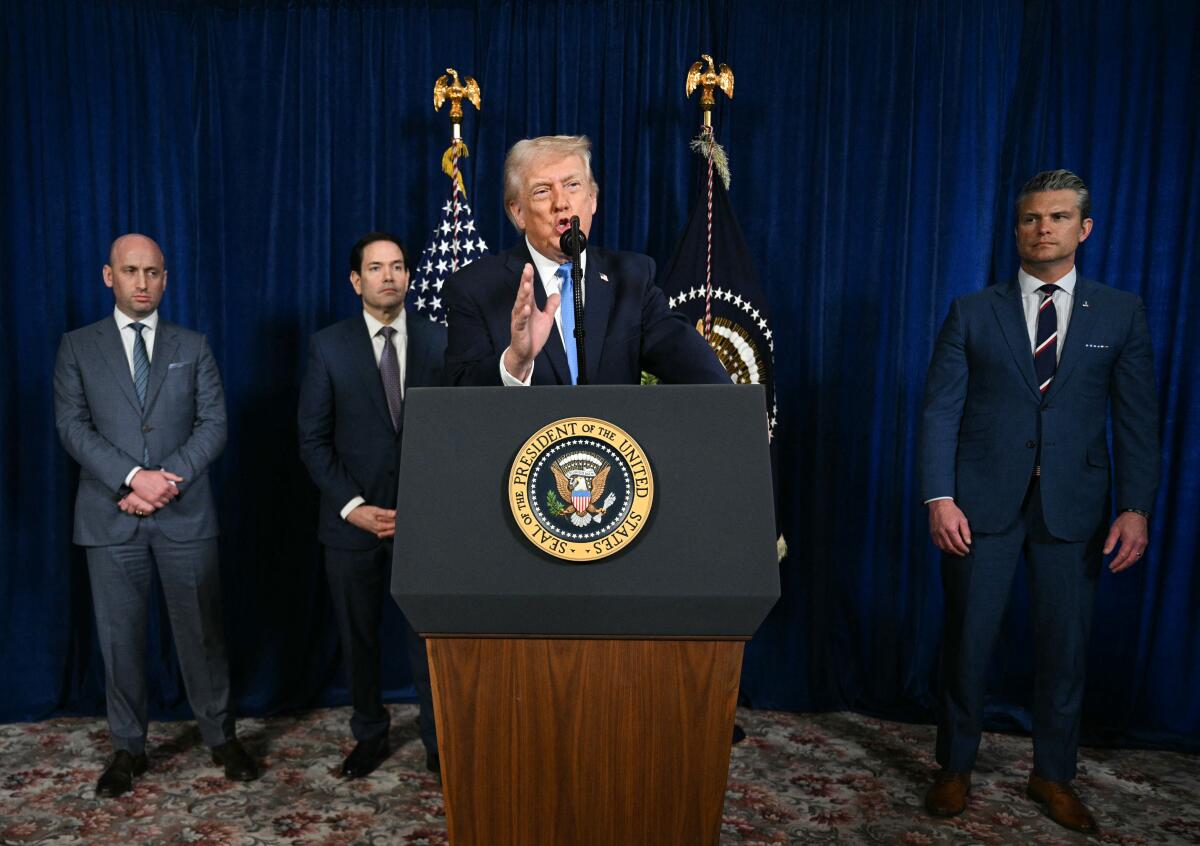
President Trump, alongside Deputy Chief of Staff Stephen Miller, Secretary of State Marco Rubio and Defense Secretary Pete Hegseth, speaks to the media Saturday after U.S. military actions in Venezuela.
(Jim Watson / AFP via Getty Images)
No timeline for transition
Trump did not offer a timeline for how long a transition would take, or which Venezuelan factions he would support to assume leadership.
Maria Corina Machado, a leader of the Venezuelan opposition and a recipient of the Nobel Peace Prize, said Saturday that she and her team were prepared to assume control of Venezuela.
“The hour of freedom has arrived,” she wrote on social media. “We are prepared to assert our mandate and take power.”
But in a surprising statement, Trump told reporters that he did not believe Machado had the “respect” needed to run the country.
Trump instead focused on how his Cabinet intends to run Venezuela in the coming days, stating that American oil companies are ready to descend on the country and begin “taking out tremendous amount of wealth out of the ground.”
“That wealth is going to the people of Venezuela and people from outside of Venezuela that used to be in Venezuela, and it goes to the United States of America, in the form of reimbursement for the damages caused to us by that country,” Trump said.
In recent speeches and media appearances, Machado has expressed support for privatizing Venezuela’s oil industry, without committing herself to granting U.S. companies preferential treatment in a post-Maduro world.
“Oil wealth was not used to uplift, but to bind,” Machado said in her Nobel Prize lecture last month. “And then came the ruin: Obscene corruption; historic looting. During the regime’s rule, Venezuela received more oil revenue than in the previous century combined. And it was all stolen. Oil money became a tool to purchase loyalty abroad.”
Among the world’s largest oil reserves
Venezuela, a country of 30 million people with twice the landmass of California, sits on one of the largest oil reserves in the world. But its production capacity has been relatively weak in recent years, owed in large part, experts say, to U.S. sanctions, as well as poor government investment in its infrastructure.
Up until now, China has been the largest importer of Venezuelan crude, purchasing between 60% and 80% of its barrels output each month. Senior Chinese officials were in Caracas when the raid occurred, and in a statement, China’s foreign ministry said it was “deeply shocked” by what it described as a “hegemonic” U.S. action that violated international law.
The U.S. operation began with explosions throughout Caracas, as more than 150 U.S. aircraft, including F-35 fighter jets, B-1 bombers and remotely piloted drones, cleared away Venezuelan air defenses to make way for the interdiction team, which included U.S. law enforcement officers. Electricity was cut throughout much of the city as the assault unfolded, Dan Caine, chairman of the Joint Chiefs of Staff, told reporters.
A Delta Force unit penetrated Maduro’s heavily fortified compound at 2:01 a.m., capturing him and his wife as they attempted to escape into a safe room, U.S. officials said. Only one helicopter in the U.S. fleet was hit by Venezuelan fire, but was able to continue flying through the mission. No U.S. personnel were killed, Caine said.
Trump, who had ordered the CIA to begin monitoring Maduro’s movements months ago, watched as the operation unfolded from a room at his Mar-a-Lago estate in Florida, “literally like I was watching a television show,” the president said in an interview with Fox News on Saturday morning.
‘Full wrath of American justice’
From there, Maduro and his wife, Cilia Flores, were taken to the USS Iwo Jima, stationed in the Caribbean alongside a third of the U.S. naval fleet, before the ship set course for New York, where Maduro will face charges over his alleged ties to illicit drug trafficking.
“If you would’ve seen the speed, the violence,” Trump told Fox. “Amazing job.”
In a social media post, Atty. Gen. Pam Bondi wrote that Maduro and his wife were “two alleged international narco traffickers” who would be facing criminal charges in New York.
“They will soon face the full wrath of American justice on American soil in American courts,” Bondi said.
Maduro, according to a new indictment, is charged with narco-terrorism conspiracy, cocaine importation conspiracy, possession of machine guns and destructive devices, and conspiracy to possess machine guns and destructive devices against the United States. His wife is charged in the cocaine conspiracy.
The indictment says Maduro “sits atop a corrupt, illegitimate government that, for decades, has leveraged government power to protect and promote illegal activity, including drug trafficking.”
“This cycle of narcotics-based corruption lines the pockets of Venezuelan officials and their families while also benefiting violent narco-terrorists who operate with impunity on Venezuelan soil and who help produce, protect, and transport tons of cocaine to the United States,” the indictment says.
‘Congress will leak,’ Trump says
The Trump administration did not seek congressional approval for the attack, prompting lawmakers from both parties on Capitol Hill to express trepidation and concern over the operation. But Secretary of State Marco Rubio told reporters on Saturday that it was “not the kind of mission that you can pre-notify because it endangers the mission.”
Trump agreed, saying that members of Congress tend to “leak” information to the public. “Congress will leak and we did not want leakers,” Trump said.
Democrats and some Republicans in Congress raised questions about the legality of the attack and the administration’s long-term vision for Venezuela.
Rep. Marjorie Taylor Greene (R-Ga.) questioned whether Trump’s operation was consistent with his vows to put “America first,” and said a U.S. military campaign targeting drug cartels would focus not on Venezuela, but on Mexico. And Rep. Thomas Massie (R-Ky.), a frequent critic of the president within his own party, expressed skepticism over the administration’s characterization of the attack as an “arrest with military support.”
“Meanwhile,” Massie wrote, “Trump announces he’s taken over the country and will run it until he finds someone suitable to replace him. Added bonus: says American oil companies will get to exploit the oil.”
Sen. Andy Kim (D-N.J.), a former national security official in the Obama administration, accused Rubio and Defense Secretary Pete Hegseth of “blatantly” lying to Congress, saying the administration officials had assured lawmakers that the goal in Venezuela was not regime change. Kim said the Trump administration plan to run Venezuela was “disastrous.”
“The American people deserve a government focused on running our own country, not the folly of trying to run another,” Kim wrote on social media.
Rep. Alexandria Ocasio-Cortez (D-N.Y.) dismissed the administration’s justification of the mission, stating on social media, “it’s not about drugs. If it was, Trump wouldn’t have pardoned one of the largest narco traffickers in the world last month,” referencing Trump’s recent pardon of former Honduran President Juan Orlando Hernández.
“It’s about oil and regime change,” she added.
Rep. Debbie Wasserman Schultz (D-Fla.), who represents a district with a large Venezuelan population, said she wants to know why Congress and the American people were “bypassed in this effort.”
“The absence of congressional involvement prior to this action risks the continuation of the illegitimate Venezuelan regime,” Wasserman Schultz wrote on social media.
Republicans largely backed the Trump administration’s action, but some did express some hesitancy about the attack’s potential implications.
Rep. Don Bacon (R-Neb.) said in a social media post that Maduro’s capture was “great for the future of Venezuelans and the region” — but raised concerns that other world leaders may follow the example in a way that may clash with U.S. interests.
“My main concern is now Russia will use this to justify their illegal and barbaric military actions against Ukraine, or China to justify an invasion of Taiwan,” Bacon said. “Freedom and rule of law were defended last night, but dictators will try to exploit this to rationalize their selfish objectives.”
Speaker Mike Johnson (R-La.) said the Trump administration is working to schedule briefings for members next week, when lawmakers are expected to return to Washington.
Tense hours in capital after attack
In Caracas on Saturday, the mood was tense. Long lines formed at supermarkets and pharmacies as shoppers, fearful of uncertainty, stocked up on essentials.
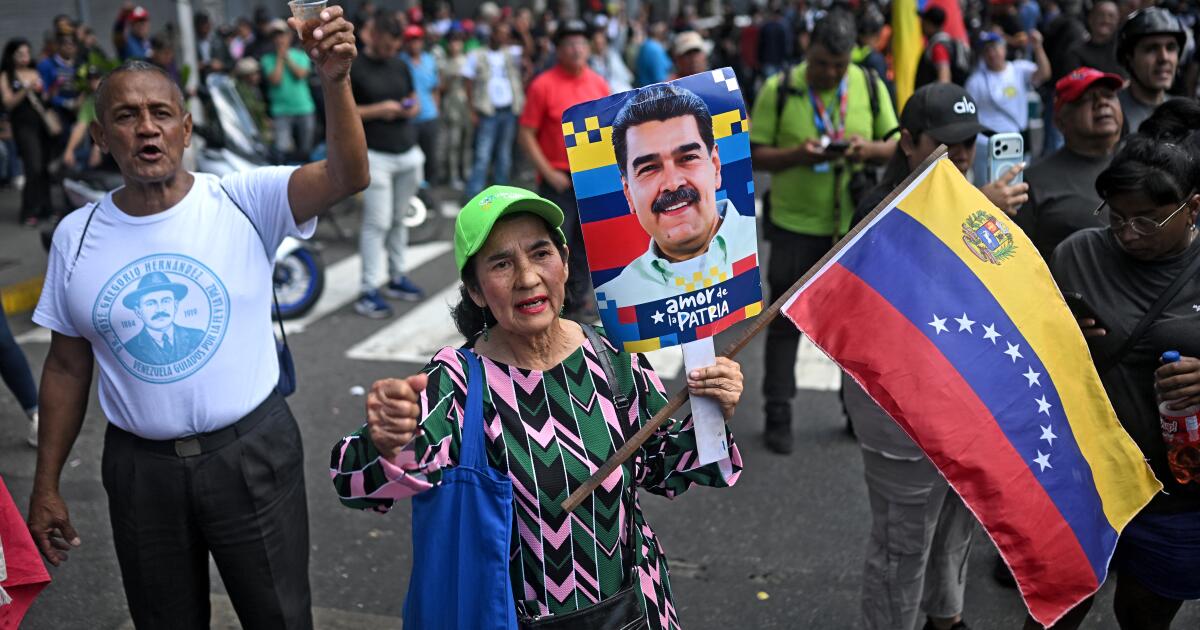
Maduro’s supporters gathered throughout the city, many bearing arms, but seemed unsure of what to do next. Across Latin America, reaction to the U.S. operation was mixed. Right-leaning allies of Trump including Argentina’s Javier Milei and Ecuador’s Daniel Noboa backed the U.S. attack, while leftists broadly condemned it.
Colombian President Gustavo Petro criticized an “aggression against the sovereignty of Venezuela and Latin America” and said he was ordering the deployment of the Colombian armed forces along his nation’s 1,300-mile-long border with Venezuela.
Brazilian President Luiz Inácio Lula da Silva said that the U.S. “crossed an unacceptable line” and compared the action to remove Maduro to “the darkest moments of [U.S.] interference in Latin America and the Caribbean.”
Trump, meanwhile, boasted that the U.S. operation in Venezuela would help reassert U.S. dominance in Latin America.
“American dominance in the Western Hemisphere will never be questioned again,” he said. “We are reasserting American power in a very powerful way in our home region.”