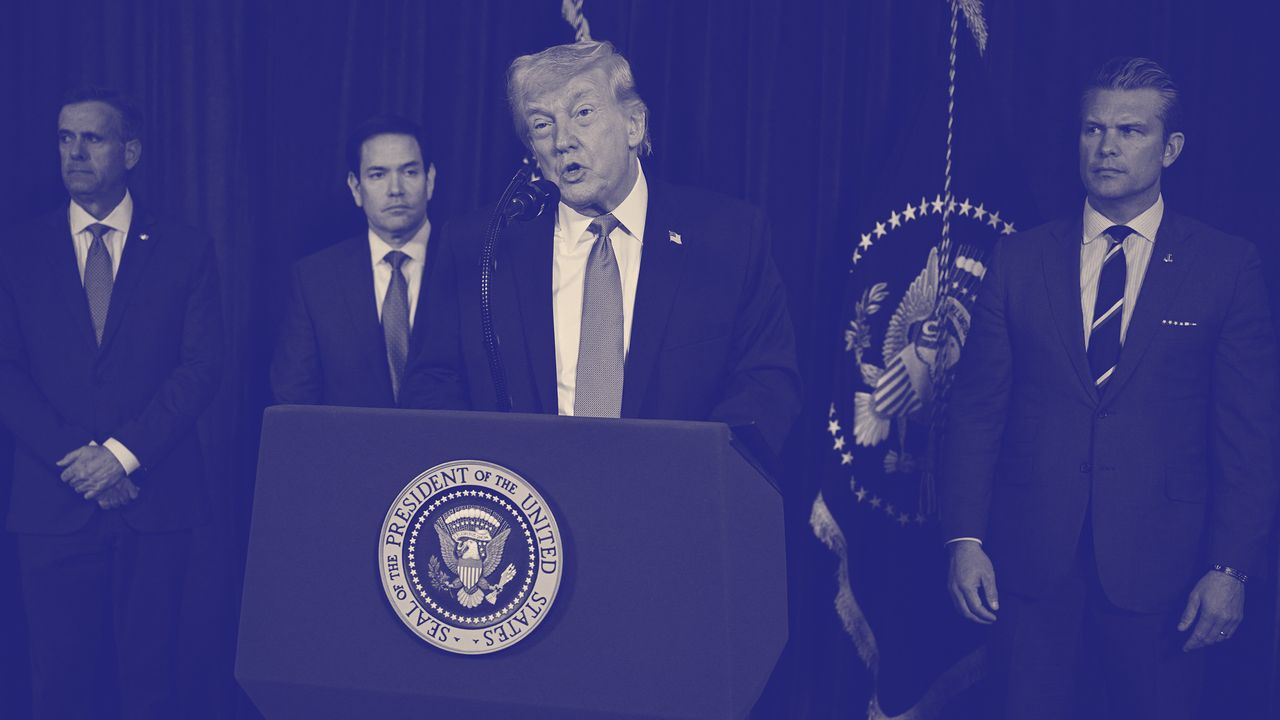
On Saturday morning, President Donald Trump announced that the United States military, working with American law-enforcement officials, had carried out a strike in Venezuela, capturing the country’s President, Nicolás Maduro, and his wife, Cilia Flores. Maduro was indicted in a federal court in New York for his role in what the Administration claims is a narco-terrorism conspiracy. At a press conference later on Saturday, Trump said, “We are going to run the country until such time as we can do a safe, proper, and judicious transition.” He also said that he was not concerned about “boots on the ground,” referring to an American military presence.
I spoke by phone on Saturday morning with Oona Hathaway, a professor at Yale Law School and the director of its Center for Global Legal Challenges. She is also the president-elect of the American Society of International Law. During our conversation, which has been edited for length and clarity, we discussed whether Maduro can legally be tried in American courts, the long history of U.S. meddling in Latin America, and what makes Trump’s decision so uniquely dangerous.
What is the legal basis, such as it is, for this action?
Unfortunately, I don’t think there is a legal basis for what we’re seeing in Venezuela. There are certainly legal arguments that the Administration is going to make, but all the arguments that I’ve heard so far don’t hold water. None of them really justify what the President seems to have ordered to take place in Venezuela.
What are the arguments that you’ve heard from either people in the Administration or from their supporters?
We’re still in the early hours, but the arguments that have been made in the run-up to this full-scale effort have largely focussed on self-defense against drug traffickers, who they claim are being supported or maybe even directed by Maduro and his administration. The problem is that that really doesn’t work under international law. There is a right of self-defense under the United Nations charter, which allows states to use force in self-defense against an armed attack. But it’s never been used for something like drug trafficking. And so all of these boat strikes that have been taking place over the past couple of months, which have been justified as self-defense, don’t fall within anything that anyone would recognize as self-defense under international law. Self-defense generally requires that there’s actually an armed attack. And it seems like they’re making a similar argument here to justify the capture of Maduro and the use of force on land in Venezuela.
What do you think of the argument that lots of people in America die from drug overdoses and so this is a form of self-defense?
Look, when the U.N. charter was written eighty years ago, it included a critical prohibition on the use of force by states. States are not allowed to decide on their own that they want to use force against other states. It was meant to reinforce this relatively new idea at the time that states couldn’t just go to war whenever they wanted to. In the old world, the pre-U.N. charter world, it would have been fine to use force if you felt like drug trafficking was hurting you, and you could come up with legal justification that that was the case. But the whole point of the U.N. charter was basically to say, “We’re not going to go to war for those reasons anymore.”
The charter included a very narrow exception, which was an exception for the use of self-defense. The idea there was that surely we shouldn’t have to wait for the Security Council to authorize a use of force in order to defend ourselves if we’re attacked. But that was meant to be a narrow exception.
If drug trafficking is a reasonable justification, then a whole range of possible arguments can be made that basically mean that self-defense is no longer a real exception. It’s the new rule. Why couldn’t you make the same argument about communicable diseases? There’s bird flu coming from a country, and therefore we have a legal justification for the use of military force. Once we start going down that road, the idea that there’s any limit evaporates. I mean, yes, drugs are horrific. Do they cause loss of life in the United States? Absolutely. There’s no doubt about that. It’s a terrible scourge, but the idea that because drugs are coming from a country it justifies an invasion and a change of administration in that country basically gets rid of any kind of limits on the use of force.
What other arguments have you heard from the Administration?
One of the claims is that Maduro is not, in fact, the leader of Venezuela. This is something that they’ve been saying for a while now—that he’s not the legitimate leader of the country, that they don’t recognize him as the head of state. And that might justify his seizure and indictment, although using military force to do that would not be justified. I don’t know how they get from there to an argument that they can use military force in Venezuela.
What do you mean, exactly, about his “seizure and indictment”? Venezuela had an election. It was not a free election. He declared himself President, and he’s broadly recognized as the President of Venezuela, but, again, he was not freely elected by the people of Venezuela. That could justify his indictment in an American court?
I should back up. As part of this military operation, at least one of the key goals seems to have been the capture of Maduro and his wife, who have been indicted for criminal charges in the Southern District of New York. The only way they can do that is if they’re claiming that he’s not a head of state, because heads of state get immunity and heads of state are not subject to criminal prosecution in the domestic courts of other states. That’s just a basic rule of international law. The United States has long recognized it.
So you were not saying that the fact that he stole an election per se means you can grab him and try him in an American court, but rather that if he were not a head of state, that would at least allow for trying him in an American court, which normally would not be the case?
Right. So if he’s not actually a head of state, then head-of-state immunity doesn’t apply. And it’s connected to this broader question of the use of military force in that it may be that they would make a claim, although I haven’t yet seen this, that because he’s not the legitimate head of state that somehow they have a legal authority to use force to grab him. But, again, the two don’t connect. So the problem is that merely saying that he’s not head of state doesn’t then justify the use of military force in Venezuela.