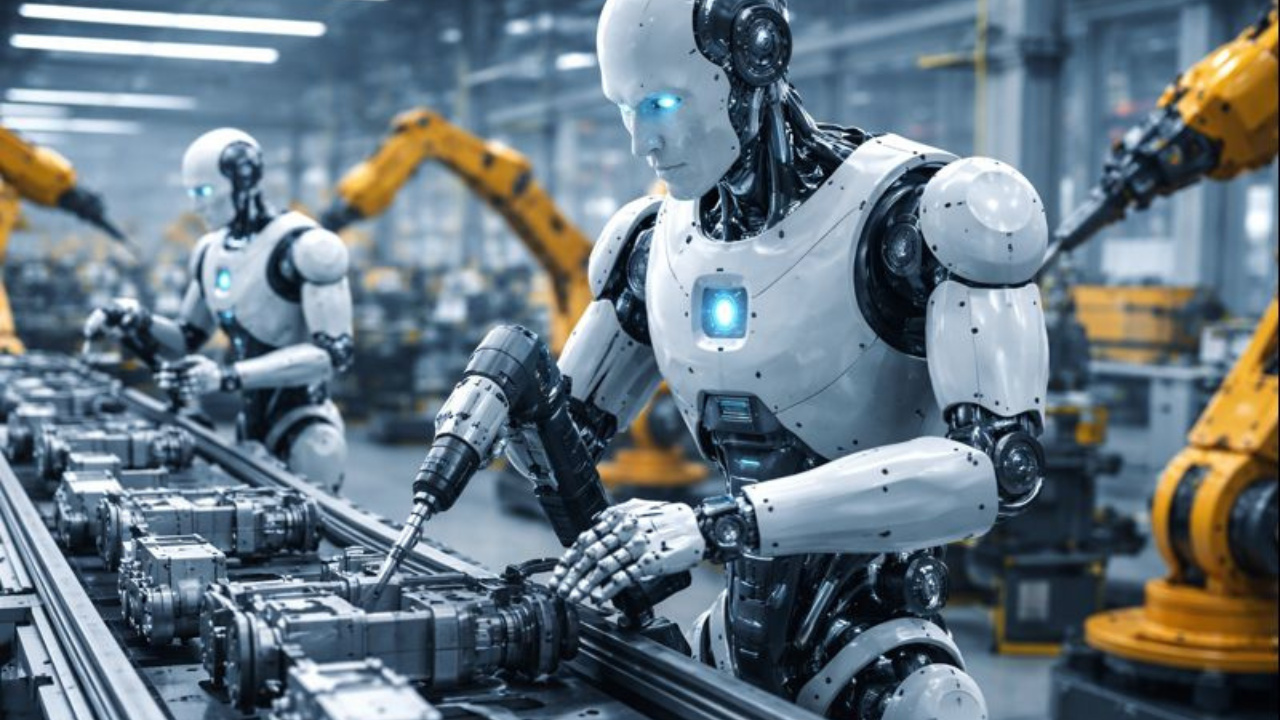
Advances in artificial intelligence and humanoid robots are accelerating industrial automation and putting pressure on the global labor market.
The rapid evolution of artificial intelligenceThis, coupled with the advancement of humanoid robots, has once again brought to the forefront a sensitive issue: the impacts of industrial automation on the labor market.
The debate gained momentum after the Chinese company Ubtech released a promotional video of a worker robot capable of working 24 hours a day, changing its own battery, and operating without breaks.
While recent data points to historic job cuts in the United States by 2025, with AI cited as one of the contributing factors.
The case has reignited long-standing concerns about so-called technological unemployment, a concept that describes the replacement of human workers by machines and automated systems.
Although the promise of productivity gains is attractive to companies, experts warn that the effects of this logic may go beyond cost reduction.
Humanoid robots and the new frontier of industrial automation.
The video of Ubtech It went viral after showing a humanoid robot acting as an industrial worker, controlled by artificial intelligence and designed to operate continuously.
The proposal symbolizes a new stage in industrial automation, in which machines not only perform repetitive tasks, but simulate human movements and make basic decisions autonomously.
This type of technology is of particular interest in sectors such as manufacturing, logistics, and industrial assembly, where the standardization of processes facilitates the replacement of manual labor.
For companies, the equation seems simple: lower fixed costs, greater predictability, and increased profit margins.
However, this technical efficiency has significant social and economic implications, especially when applied on a large scale.
Historic job cuts and warnings from the United States
In October 2025, the United States They recorded the largest job cuts for the month in 22 years.
Among the reasons cited by market analyses, artificial intelligence emerged as a relevant factor, especially in administrative functions, customer service, and operational areas.
Although technology is not solely responsible for layoffs, its increasing adoption reinforces fears that automation is advancing faster than the market’s ability to absorb and retrain workers.
This scenario intensifies the debate about technological unemployment and its potential expansion in the coming years.
The job market is undergoing rapid transformation.
The job market is not only shrinking in certain sectors, but is undergoing a profound transformation.
Repetitive and highly standardized tasks tend to be the first to be affected by industrial automation, while the demand for professionals linked to technology, systems maintenance, and data analysis grows.
On the other hand, the speed of this transition is worrying.
Not all workers are able to retrain at the same pace as companies implement new solutions based on artificial intelligence and humanoid robots.
Thus, the promise of new tech jobs does not always compensate, in the short term, for the jobs eliminated.
Cost reduction today, economic risks tomorrow.
Eliminating labor costs can, in fact, significantly increase a company’s profit margin.
However, experts warn that this strategy could become a structural problem in the future.
With fewer people employed, consumption tends to fall, directly affecting the demand for products and services.
In other words, the logic of completely replacing human labor could end up backfiring on companies, by reducing the purchasing power of the population and slowing down the economy.
This paradox makes the debate about humanoid robots, artificial intelligence, and technological unemployment even more complex.
The challenge of balancing innovation and social impact.
The advancement of industrial automation is inevitable and brings clear gains in efficiency and competitiveness.
However, the central challenge lies in finding a balance between technological innovation and social responsibility.
Governments, businesses, and educational institutions will play a decisive role in creating professional retraining policies.
Social protection and adaptation of the labor market to this new reality.
Otherwise, the growth of technological unemployment could widen inequalities and generate economic instability.
Meanwhile, the image of the robot that never tires, never gets sick, and works tirelessly is ceasing to be merely a technological showcase.
And this becomes a central question for the future: how to guarantee progress without excluding millions of workers from the productive system?