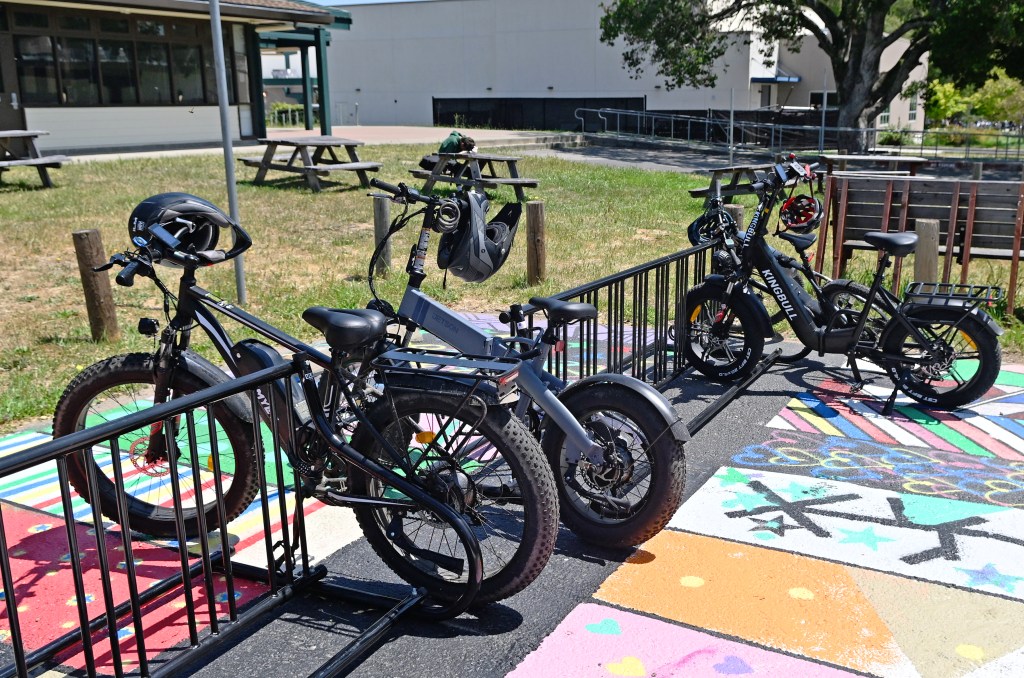
Most e-motos — high-powered motorized electric bikes — parked at Marin schools are not street legal, according to a survey by county officials and cycling advocates.
That includes 80% of e-motos at middle schools and 90% at high schools, the survey found.
The study was conducted last year by E-Bike Access, an advocacy organization, and Safe Routes to Schools, an organization funded by the Transportation Authority of Marin.
The review found 277 two-wheelers at 12 schools that exceeded the state’s definition of e-bikes, which is based on their engine power and their potential speed. Only 37 e-bikes parked outside the dozen schools were street legal, he said.
“That’s the blockbuster,” said Robert Mittelstaedt, founder of E-Bike Access. “If it’s more than what’s allowed for an e-bike, 750 watts, which is about 1 horsepower capable of going more than 20 or 28 miles per hour, then it’s not an e-bike.”
“It’s a motorized something,” he said. “And it does not qualify as a bicycle.”
The survey counted 713 conventional bicycles at the Marin schools.
The statistics are among the Marin data cited in a new statewide report commissioned by the Legislature that recommended further regulation and enforcement of the higher-powered vehicles. The recommendations include requiring licensing higher-powered e-motos and prosecuting retailers who falsely sell them as e-bikes.
“The concept of an electric bicycle might seem simple — a bicycle with an electric motor — but Californians do not have a shared understanding of what devices are legal electric bicycles,” said the report, produced by the Mineta Transportation Institute at San Jose State University.
“In addition to devices sold as ‘e-bikes’ that would never meet the state regulations, some device owners use simple software or hardware changes to increase their device’s power or speed above the legal limits,” the 210-page report said.
Asha Weinstein Agrawal and Kevin Fang, researchers at the institute, surveyed state and national data to suggest how California might address gaps in its laws and enforcement.
“The fact that electric bicycle riders, like pedal bicycle riders, do not need to have a driver’s license opens up important mobility options for children and older adults,” Agrawal said. “However, I don’t think the Legislature intended for children or people who have never studied the rules of the road to have access to a device that, quite literally, gives them the power equivalent to a horse.”
Their report distinguishes between lower-powered e-bikes, which are a slower and safer clean-energy alternative to cars, and e-motos, which are the higher-powered, higher-speed, throttle-driven motorized bikes.
“Used safely and age-appropriately, e-bikes are net good for the community and the environment,” said Matthew Hartzell, policy director for WTB-TAM, a pro-cycling organization in Marin. “They are also not the same thing as the unlicensed, unregulated e-motos that have become popular with teenagers and have been tied to unsafe behavior and injuries. It is unfortunate that much of the public discourse conflates the two.”
The institute’s report noted pathbreaking efforts in Marin to regulate the vehicles in response to a notable increase in serious injuries among young riders.
In late 2024, the Legislature passed AB 1778, which allowed the county to implement a pilot program banning riders under 16 from Class 2 (throttle) e-bikes; requiring helmets for all ages; and restricting Class 3 (28 mph) e-bikes to bike lanes and roads, with fines and safety courses for violations. The rules took effect in the fall.
County officials also have been tracking accidents and injuries. The county requires emergency medical personnel to document the involvement of electric bikes, and public safety officials have a web page that lists all 911 responses, including accidents.
Between Oct. 1, 2023, and Oct. 6, 2025, “there were 412 incidents involving conventional bikes and 159 incidents involving electric bicycles,” the report said, citing Marin 911 data.
“For those aged 16 and up, there were several times more cases involving conventional bicycles than electric bicycles,” it said.
“However, for those aged 10-15, there were more incidents involving electric bicycles than conventional bicycles,” it said. “Thus, for electric bicycles, 31% of the patients were aged 10-15, while they made up only 10% of conventional bicycle patients.”
The report suggested a series of policy and regulatory reforms.
On the policy side, the academics wished there were better data. For example, while Marin’s 911 records listed accidents involving conventional bikes and electric bikes, its accident reporting does not distinguish between lower- and higher-powered bikes — street-legal e-bikes versus street-illegal e-motos.
In addition to calling for more public education efforts, the report suggested two major focuses for reform.
The first concerned updating and enforcing the state’s motor vehicle code, which was primarily written for gas-powered vehicles. It suggested changing “rules for operating the devices,” which means e-motos could need license plates like mopeds and require licensed drivers.
The second focus suggested updating and enforcing consumer protection laws surrounding retailers, including “adopting strict disclosure requirements on retailers, so that buyers understand whether the device is a legal electric bicycle.”
The report also suggested county and state prosecutors go after manufacturers and retailers who promote street-legal e-bikes but sell street-illegal e-motos.
“At the state level, the legislature could amend the Vehicle Code to specify penalties for retailers who do not comply with disclosure laws and direct the Attorney General to investigate whether manufacturers and retailers have been misleading buyers about devices marketed as electric bicycles that may be ridden on public streets and roads,” the report said.
Marin cycling advocates praised the report, saying the high-powered e-motos have hurt their efforts to promote biking as an alternative to cars.
“I’m hopeful the study includes solid actionable suggestions in a way that promotes e-biking while also addressing the infestation of e-motos on our streets,” said Tarrell Kullaway, Marin County Bicycle Coalition executive director.
The organization hopes the Legislature will regulate the vehicles in ways that were not possible at the local level.
“You can’t do anything systemic at the municipal level because these e-motos are coming to the community, and, in many cases they are impossible to distinguish from a legal e-bike except to anyone who has an encyclopedic knowledge of all the different makes and models,” said Warren Wells, the organization’s policy director. “Our frustration is that there has been a lack of attention to this at the state level.”
“All throttle devices should be in that high-power category,” Mittelstaedt said. “This would eliminate manufacturers’ incentives to mislabel electric motorcycles as e-bikes, because the law would treat all high-power throttle devices consistently.”
The cycling advocates also said safer bike infrastructure was needed locally.
“As the county’s own dashboard shows, nearly half of the young people involved in e-bike/e-moto crashes are colliding with other vehicles,” Wells said.