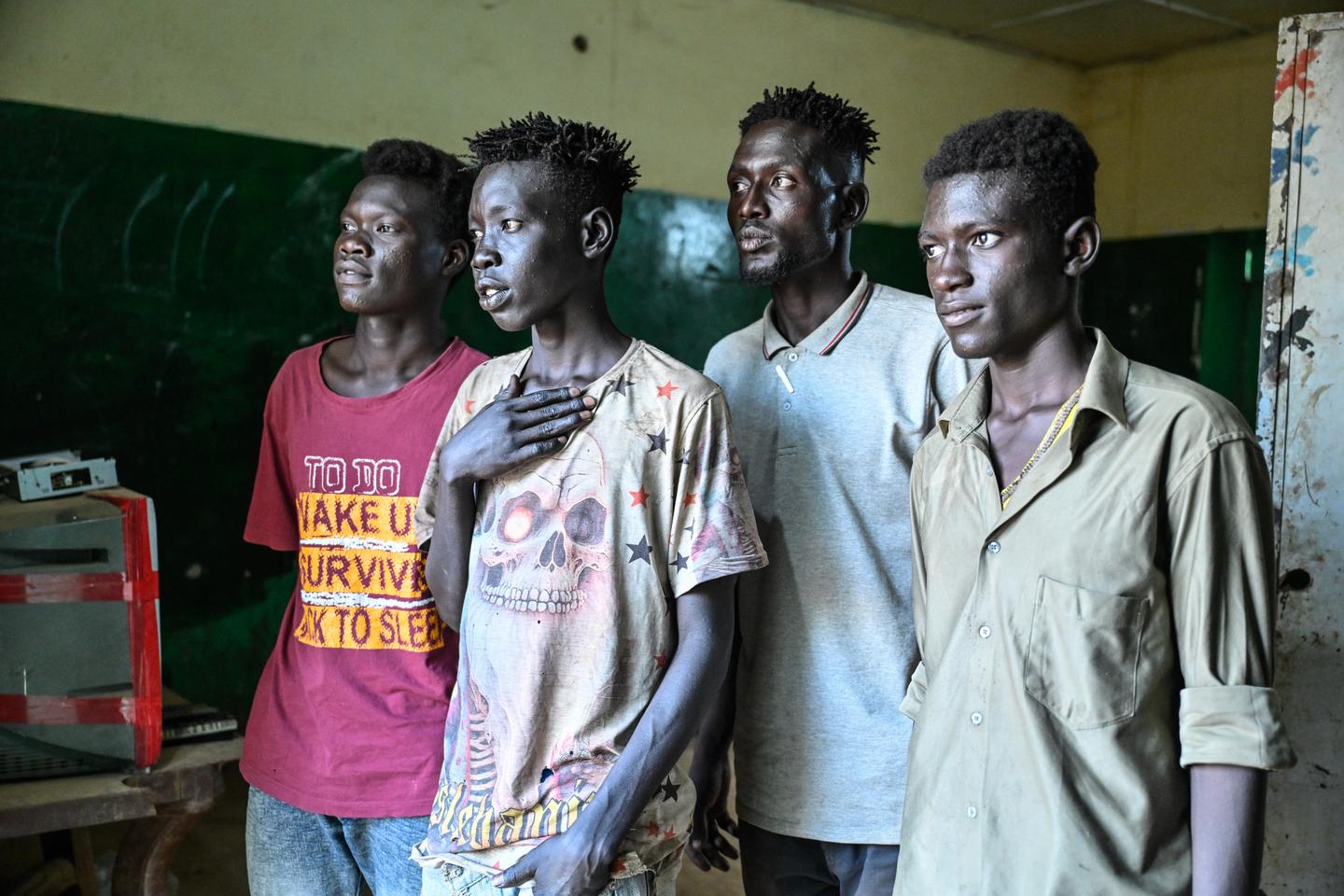
James is 16 or 17 years old; he is not exactly sure. For as long as he can remember, he has always lived on the streets. He has worked as a cigarette seller, shoe shiner, rag picker and scrap dealer. The slim teenager with prominent veins has always taken whatever odd job he can find. Before the war broke out on April 15, 2023, James toiled in a restaurant, “either scrubbing dishes or mopping the floor.” On a good day, he could earn as much as 10,000 Sudanese pounds – less than €3.
From left to right, Monadel, James, Jalal and Motwakel, inside the Markaz Mahaba center, a non-profit organization in the Al-Shuhada neighborhood that takes in and helps reintegrate street children, in Omdurman, Sudan, on December 4, 2025. ABDULMONAM EASSA FOR LE MONDE
Since the start of the clashes that have already claimed some 200,000 lives between the Sudanese army, led by General Abdel Fattah al-Burhan, and the paramilitary forces of Mohammed Hamdan Dagalo, known as “Hemedti,” James has lost his meager livelihood and his two companions in hardship, Sabeed and Deng, who were killed by a drone strike. “Apart from the shells that were falling all the time, the war didn’t change much,” he said, his bright, unflinching eyes fixed. “We’ve never known anything but violence.”
They are known as the shamassa, the “children of the sun.” Armed with rags, they make the cars of the capital shine, picking up everything the city spits out – its garbage, bits of scrap metal and plastic bottles. You can hear them coming from the scraping of their worn-out sandals on the pavement, or by the whistling that offers to shine shoes for passersby. Often orphans, they have also become cannon fodder in the Sudanese war. They are easy prey for recruitment by the militias of the Rapid Support Forces (RSF), who fill their ranks with these street children.
You have 84.74% of this article left to read. The rest is for subscribers only.