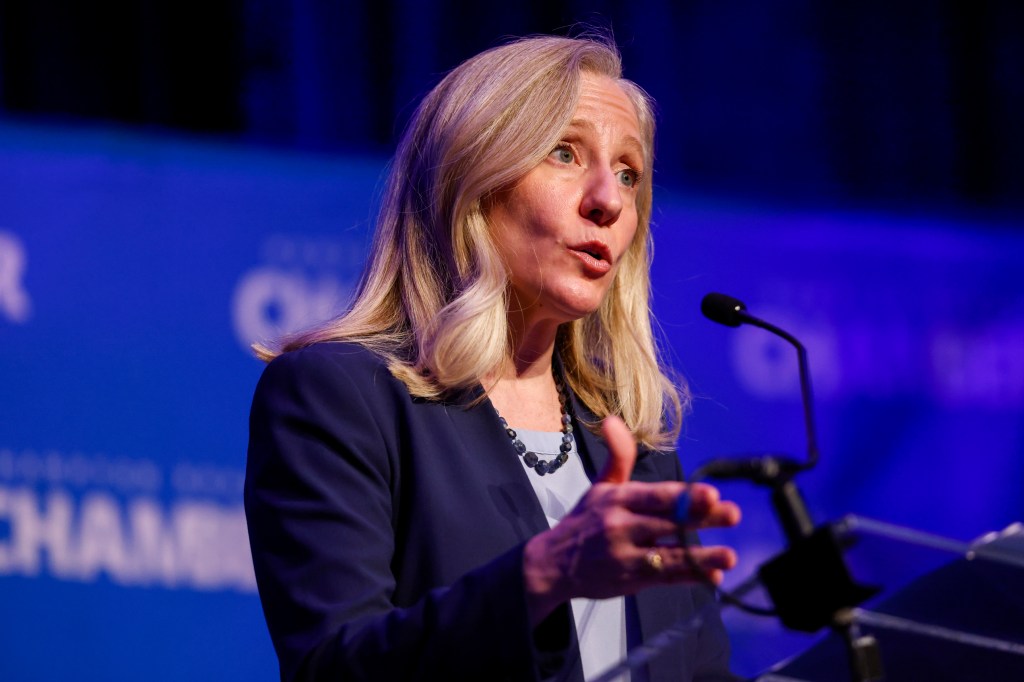
After winning election in November as Virginia’s next governor, Abigail Spanberger has been busy assembling a Cabinet and staff, setting her agenda and preparing to hit the ground running. Amid that, it’s notable that she has spent a great deal of that time discussing affordability and economic development, two central issues in her successful campaign.
The governor-elect will have a challenge ahead of her as federal pressure and economic uncertainty make a sluggish economy likely in the coming year. But by buttressing successful initiatives already in place, Spanberger has an opportunity to solidify Virginia’s reputation as a top state for business — a status that will ensure greater economic opportunity for more residents.
When Spanberger takes the commonwealth’s reins from outgoing Gov. Glenn Youngkin, she will inherit a state government that has made great strides in cultivating a climate conducive to economic growth. Youngkin did well during his four years to partner with lawmakers to make Virginia more attractive for business relocation and to build on areas of traditional strength.
Under his leadership, and with General Assembly support, Virginia expanded the number of shovel-ready sites, bolstered vocational and skills training, invested in education, continued the build-out of critical infrastructure and launched programs that worked with businesses looking to locate here to smooth the path to relocation.
In 2024, those efforts were recognized by business channel CNBC, which returned Virginia to the No. 1 spot in its annual “Top States for Business” ranking — the sixth time it landed atop the list since CNBC began its evaluations in 2007. In 2025, however, the commonwealth slipped to No. 4 as federal downsizing slowed the state economy and unemployment rose.
Inexplicably, Youngkin cheered the Trump administration’s assault on the federal workforce, even as it threatened the livelihoods of thousands of Virginians. Expect Spanberger to be a more vocal critic of presidential actions which harm the commonwealth and a more forceful advocate for Virginia workers.
But so long as President Donald Trump holds office, Virginia’s economic health will be in flux. While defense spending remains robust, our traditional reliance on federal spending means Virginia is uniquely vulnerable to the whims of the White House.
That makes economic diversification — often discussed, but yet to fully take shape — essential to Virginia’s future. The commonwealth has one of the best educated, best trained workforces, which made it an attractive location for tech companies such as Amazon, Meta and Google, and that should appeal to other businesses looking to relocate and expand.
Green energy remains an area of tremendous potential, especially since Hampton Roads is among the regions most threatened by climate change driven by fossil fuel consumption. However, even that area faces new uncertainty following the Trump administration’s indefensible decision to halt the Coastal Virginia Offshore Wind project.
Thankfully, Spanberger doesn’t need to reinvent the wheel for Virginia’s economic development efforts to deliver. The framework is in place and it’s working. The commonwealth has seen billions in investment in recent years, with welcome growth in health and life sciences leading the way, and the country’s largest concentration of data centers makes Virginia an attractive location for further development of the tech sector.
There are headwinds, of course. Tariffs continue to constrain growth and erratic Trump administration policies have many companies longing for stability. While defense spending has increased, Pentagon leadership is unpredictable which could put Virginia’s defense sector at risk. How the commonwealth navigates a turbulent health care landscape will also affect small business growth, which is an important employment base.
But what Virginia needs from its new governor is continuity and moderation, clear communication about plans and expectations, and an understanding that tweaks to effective strategies are better than wholesale changes. Spanberger has signaled that will be her approach when she takes office, and the commonwealth’s business community will look for her to follow through.