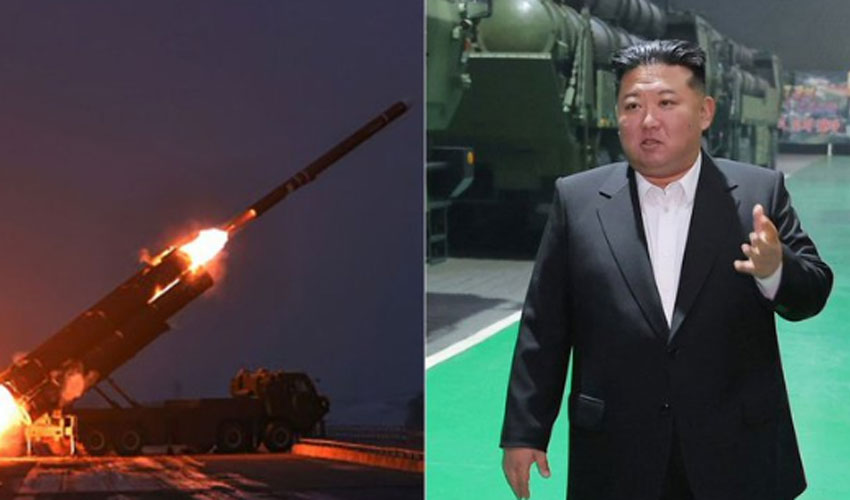
North Korea launched ballistic missiles on Sunday, coinciding with South Korean President Lee Jae Myung’s state visit to China and hours after the US military operation in Venezuela.
The strikes mark Pyongyang’s first missile tests in two months and raise tensions across East Asia.
South Korea and Japan reported that at least two ballistic missiles were fired from Pyongyang into the East Sea, flying approximately 900–950 km. The launch is the first since November 7 and comes amid heightened regional concerns following the US strike on Venezuela.
Officials said the missile tests were intended as a signal to China and the United States, asserting that North Korea is a nuclear power capable of responding with “aggressive deterrence.”
Message to China and US
Analysts suggest the launches were a warning to Beijing against closer ties with Seoul during President Lee’s visit, which includes a summit with Chinese President Xi Jinping.
“The launches represent a message to China to deter closer ties with South Korea and to counter China’s stance on denuclearization,” said Lim Eul-chul, a professor at the Institute for Far Eastern Studies in Seoul.
Additionally, the missile tests send a signal to the US that North Korea is not Venezuela, emphasizing its nuclear and military strength.
Seoul and Tokyo condemn launches
South Korea’s presidential office convened an emergency security meeting, urging North Korea to stop “provocative acts that violate United Nations Security Council resolutions.”
Japanese Defense Minister Shinjiro Koizumi condemned the launches, stating they threaten regional and international peace.
“Our government lodged a strong protest with North Korea and strongly condemned it,” Koizumi said.
US Indo-Pacific forces added that the event does not pose an immediate threat to American personnel or territory but emphasized ongoing consultation with allies.
Kim Jong Un’s military preparations
North Korea’s leader, Kim Jong Un, has been increasing military production and testing ahead of the Ninth Party Congress later this year. Recent activities include visits to munitions factories, a nuclear-powered submarine, and oversight of missile tests.
On Saturday, Kim called for a more than doubling of tactical guided weapons production, reflecting Pyongyang’s focus on strengthening its military deterrence.
President Lee’s visit to Beijing aims to encourage China to facilitate dialogue with North Korea and promote peace on the Korean Peninsula. Experts say the missile tests may be intended to strengthen Pyongyang’s leverage ahead of potential negotiations.
The simultaneous US operation in Venezuela adds an additional layer of complexity, demonstrating to North Korea the reach and willingness of the United States to carry out high-profile military actions abroad.
North Korea missile test
ballistic missiles
East Sea
South Korea China summit
Kim Jong Un
US Venezuela strike
Pyongyang
regional security
East Asia tensions
Seoul Beijing dialogue