
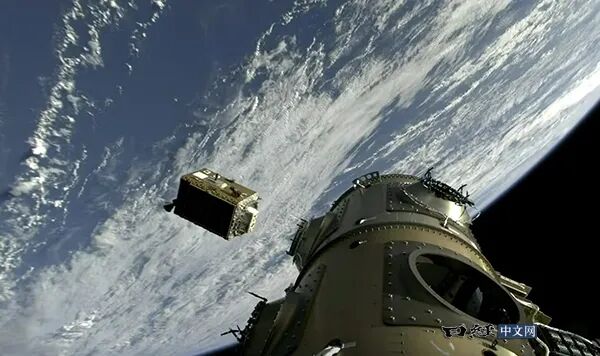
The first satellite of Starcloud, carrying NVIDIA semiconductors, separated from the rocket (November, cited from SpaceX’s official website)
Building a large number of AI data centers on the ground will lead to power shortages, and a large amount of water is also needed for cooling. In space, the power generation efficiency of photovoltaic cells can be up to eight times that on the ground, and no cooling water is required to release waste heat into space. American technology giants are starting to push forward the concept of space data centers…
American technology companies are promoting the concept of building data centers for AI in space. Google plans to launch artificial satellites in 2027, and SpaceX and OpenAI have also shown interest. NVIDIA is providing support for companies launching artificial satellites equipped with AI semiconductors. Space data centers may replace the surging ground infrastructure for AI.
Install servers on artificial satellites and power them with solar energy 24/7
A space data center is a mechanism where servers are installed on artificial satellites in Earth’s orbit to perform data processing and storage in cosmic space. Companies are envisioning replacing ground data centers by group – controlling artificial satellites with computing and communication capabilities.
Electricity can be generated day and night in cosmic space using photovoltaic cells. As it will be difficult for ground data centers to secure the large amount of power and water required in the future, space data centers are rapidly attracting attention as a future infrastructure form.
“This is a bold challenge to expand machine learning computing power in cosmic space.” Google announced in November the “Project Suncatcher” for its space data center project. Two experimental satellites equipped with Google’s high – performance AI semiconductor “TPU” will be launched into Earth’s orbit by early 2027.
Google revealed that the power generation efficiency of photovoltaic cells in orbit can be up to eight times that on the ground, and power can be generated almost continuously. Multiple small artificial satellites combining photovoltaic cells and TPUs will be launched, and these satellite groups will be used as data centers.
SpaceX’s IPO may also target data centers
Regarding this plan, SpaceX CEO Elon Musk posted on X, saying “It’s a good idea.” Google CEO Sundar Pichai replied on X, stating “This benefits from the amazing progress of SpaceX’s launch technology.”
Google is not the only company interested in space data centers. It is well – known that SpaceX is preparing for an IPO, and Bloomberg reported that one of its financing purposes is to build a space data center.
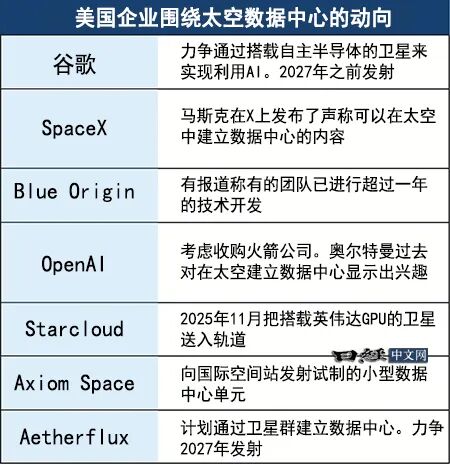
OpenAI CEO Sam Altman is also one of those interested in space data centers. He said in a past podcast that setting up data centers on Earth “may not make sense.” In December, reports said that OpenAI was eyeing space data centers and proposed an acquisition to a startup involved in rocket development.
NVIDIA semiconductors enter space
Starcloud, an American startup supported by NVIDIA, is ahead of the tech giants. The company launched NVIDIA’s AI semiconductor “H100” into space in October. Starcloud’s CEO predicted that “within 10 years, almost all new data centers will be built in space.”
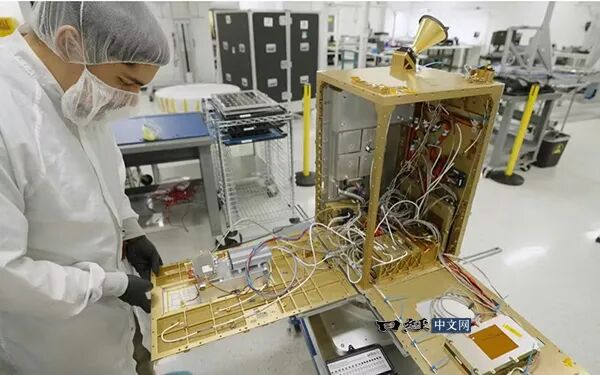
A view of the American Starcloud artificial satellite carrying American NVIDIA AI semiconductors being inspected before launch (cited from NVIDIA’s official website)
NVIDIA revealed that Starcloud’s first satellite weighs 60 kilograms and is about the size of a small refrigerator. The company said that since waste heat can be released into space during operation, it does not require water for cooling like on the ground. CNBC reported on the 10th that the AI semiconductor is still in use, enabling Google’s AI models to run continuously.
If AI data centers are built on the ground, the power of 100 nuclear power plants is needed
The background for the attention on space data centers is that building a large number of data centers on the ground will lead to power shortages.
BloombergNEF released a forecast in December, stating that the power demand of American data centers will reach 106 gigawatt – hours (GWh) in 2035, equivalent to more than 100 large – scale nuclear power plants. This forecast was revised upward by 36% compared to the data released only 7 months ago, and it is about 2.6 times the demand in 2025.
In the United States, plans to build new large – scale nuclear power plants have been proposed, but construction takes time. Cooling data centers also requires a large amount of water. Due to concerns about too many construction projects and rising electricity bills, the public believes it will cause trouble, and opposition movements have begun to emerge.
The challenge for space data centers is cost. Google’s analysis shows that if the launch cost in low – Earth orbit drops to $200 per kilogram in the mid – 2030s, the space data center project will be close to realization. McKinsey & Company in the United States believes the current cost is $1500.
The impact of space radiation is also important. In space with high radiation levels, electronic devices are more likely to age and malfunction. In addition, there are risks such as collisions with space debris, and research and development are still ongoing.
This article is from the WeChat public account “Nikkei Chinese Net” (ID: rijingzhongwenwang), written by Yusuke Ohira and Shunsuke Akagi, and is published by 36Kr with authorization.