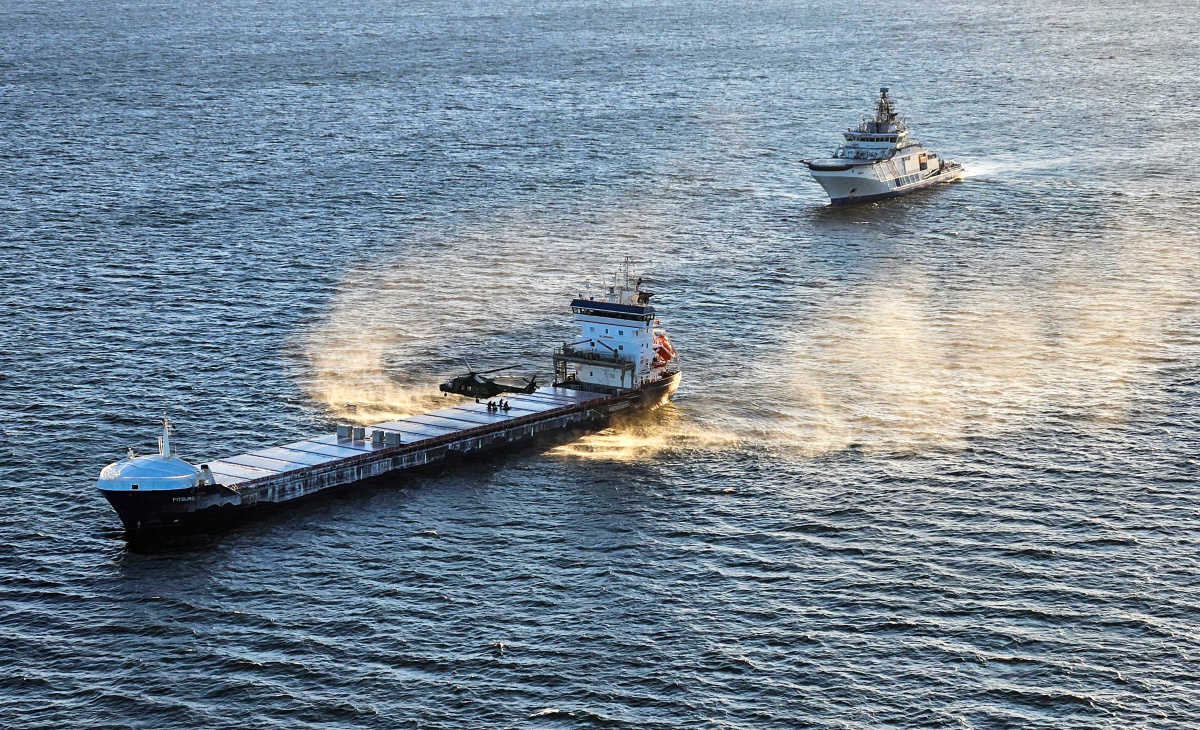
 Press photo: the boarding of the Fitburg by Finnish law enforcement and the Finnish military (Press photo: Polisi (Finnish Police))
Finnish police have arrested two crew members of a cargo vessel suspected of damaging an undersea telecommunications cable between Finland and Estonia, according to Yle.
Police have asked the court for permission to keep one of the detained crew members in custody while the investigation continues, meaning the person would remain jailed instead of being released. Authorities said the individual facing possible continued detention is an Azerbaijani national. A Russian national is among several other crew members placed under travel bans, preventing them from leaving Finland.
The arrests are linked to the cargo ship Fitburg, which was seized on New Year’s Eve after damage was discovered to a telecommunications cable owned by Finnish operator Elisa. Investigators suspect the vessel damaged the cable with its anchor while sailing through the Gulf of Finland.
The ship was travelling from St Petersburg to Haifa, Israel, and was later brought to port in Kirkkonummi. The case is being handled by Finland’s National Bureau of Investigation, which has launched both onboard inquiries and underwater inspections at the site of the cable damage. Police say the preliminary investigation is expected to take several weeks.
Detective Superintendent Risto Lohi said the crew has cooperated with investigators and stressed that it is too early to speculate on whether the incident could be linked to state-level hybrid activity. The suspected offences under investigation include aggravated interference with telecommunications and aggravated damage.
Finland’s defence minister has confirmed that Russia offered assistance to the ship’s crew but said Finnish authorities are proceeding independently and according to their own procedures, according to Yle.
From an Asian point of view, the recent years of several deliberate cable destructions in the Baltic Sea is a worrying trend. In Asia as elsewhere, Subsea telecommunications cables are a critical part of global data traffic, carrying the vast majority of internet, financial and communications flows between Asia, Europe and North America. Asia is linked to Europe and the United States through dozens of major undersea cable systems crossing the Indian Ocean, South China Sea and Pacific Ocean.
In recent years, the protection of these cables has increasingly been discussed in NATO, EU and Asia-focused security and digital infrastructure forums, including within ASEAN and Indo-Pacific policy dialogues. Officials and industry representatives have warned that repeated disruptions to subsea cables — including incidents reported in the Baltic Sea in recent years — highlight how vulnerable global data connections can be, and how damage in one region may have wider consequences for communications, trade and financial systems across multiple continents.