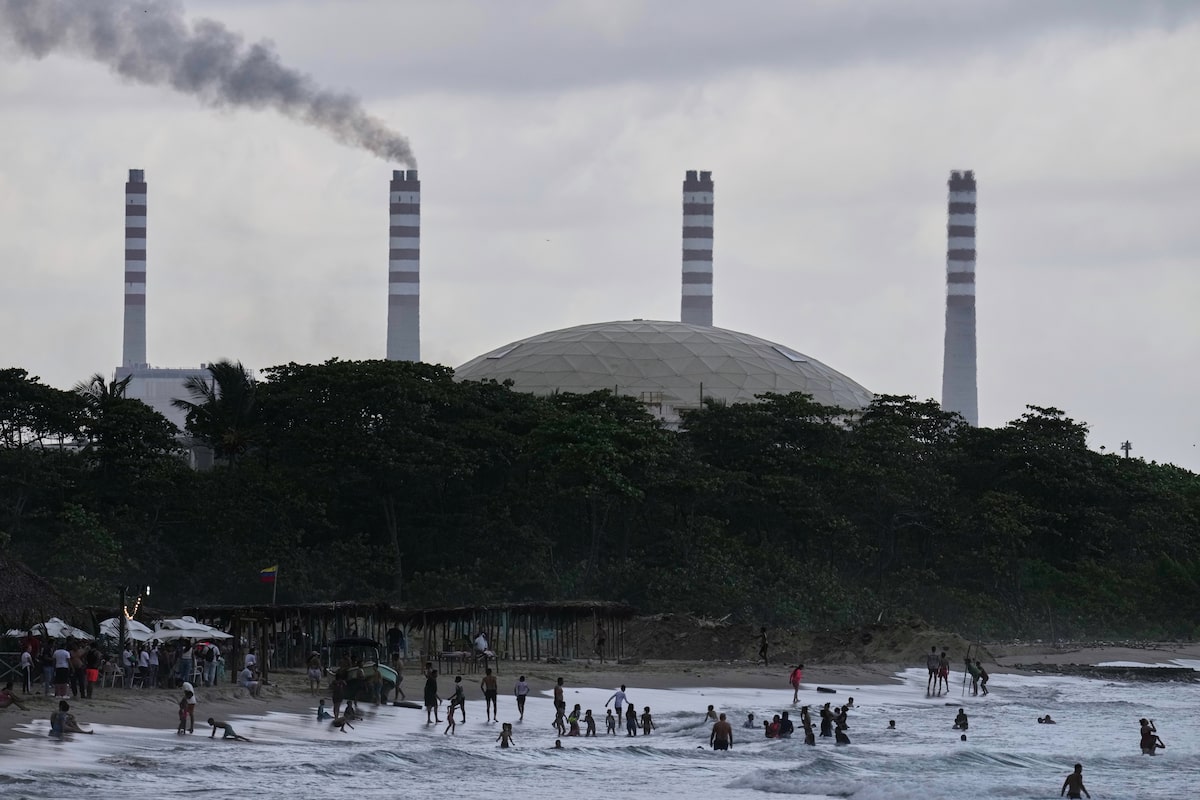
The El Palito refinery in Puerto Cabello, Venezuela, in December.Matias Delacroix/The Associated Press
Shawn Barber is a retired foreign service officer and ambassador. He is the former head of the economic security task force at Public Safety Canada.
The removal of Nicolás Maduro by U.S. forces Saturday morning ended one of the Western Hemisphere’s longest-running political standoffs – and opened a question with direct consequences for Canada’s economic security. If the Venezuelan oil sector, with the help of U.S. energy giants, can be revitalized so that Venezuela once again becomes a major heavy crude exporter, what will the implications be for Canada’s oil patch?
Canada’s role as the largest energy supplier to the U.S. market is unlikely to be threatened in the short to medium term by the events now unfolding in Venezuela. But the potential for those events to reshape U.S. oil markets in the long term is real. For a trading nation like Canada, protecting our economic security means this is a risk we cannot ignore.
What the U.S. attack on Venezuela could mean for oil and Canadian crude exports
During the late 1990s it was Venezuela, not Canada, that was the largest exporter of crude oil to the United States. For decades it supplied the heavy, sulfur-rich oil to U.S. refineries needed to produce diesel, asphalt and other industrial fuels. In fact, many of the refineries on the U.S. Gulf Coast and in the Midwest to which Canadian heavy crude is now sent were originally built to process oil from Venezuela.
The rise of the Chavez/Maduro regime starting in 1999 brought about U.S. sanctions on Venezuela which, together with mismanagement and a lack of investment, sent oil production, and with it exports to the U.S., into steep decline. While it has the world’s largest oil reserves, today Venezuela exports only about one million barrels per day, most of which is sold to China.
Can Venezuela once again become a major player in global oil markets? U.S. President Donald Trump thinks so. “We’re going to have our very large United States oil companies – the biggest anywhere in the world – go in, spend billions of dollars, fix the badly broken infrastructure, the oil infrastructure, and start making money for the country,” Mr. Trump said on Saturday.
So far the U.S. oil majors haven’t exactly jumped on the bandwagon. The only U.S. company still pumping oil in Venezuela is Chevron, which resumed shipments of Venezuelan crude to Gulf Coast refineries in 2023. Even it has been non-committal.
If we assume, and that’s a big if, that the U.S. is going run things in Venezuela for the foreseeable future, it’s reasonable to expect that sanctions will be lifted and the regulatory and investment regime will be made friendly to U.S. companies.
But will the country be stable enough to attract the billions of dollars of investment needed to rebuild its capacity to be a major producer? Even if it did it, how quickly could it get there?
Some estimates suggest that a return to a pre-sanctions level production of 2 to 2.5-million barrels per day might be possible after four to five years of sustained investment. Under that scenario what are the stakes for Canada?
According to the Canada Energy Regulator, in 2024 crude oil accounted for about $140 billion in Canadian exports, most of which went to the United States. Oil is our single largest export earner. Could rising volumes of Venezuelan heavy oil extracted and exported by U.S. energy giants see Canada’s U.S. market share decline?
At least in the short term, the principal impact is likely to be downward pressure on the price Canada heavy crude can command in the U.S. market. Canadian producers with narrow margins would be most exposed. The highest risk would be that U.S. Gulf Coast refineries begin to shift to cheaper Venezuelan crude. U.S. midwestern refineries are more integrated with Canadian pipeline supplies and have less flexible sourcing making the penetration of Venezuelan crude at scale unlikely.
While a key Canadian advantage will continue to be our reputation as a reliable, low-risk supplier, Venezuelan crude discounted to regain U.S. market share could be a real threat. So how do we manage the risk to our largest export sector?
We must continue to diversify the markets for our crude oil. This might mean more urgency for a second pipeline to tidewater, even if downward price pressure on crude might make the economics of another pipeline even more challenging than it appears now.
In a more competitive market scenario, cost discipline will also be key if price discounts widen between Canadian and Venezuelan crude. Finally, longer-term partnerships and contracts with U.S. refineries become more important in a more competitive U.S. oil market.