This is the first in a series of articles exploring how key foreign and security issues are politicized, and the costs this carries for South Korea’s national interest. – Ed.
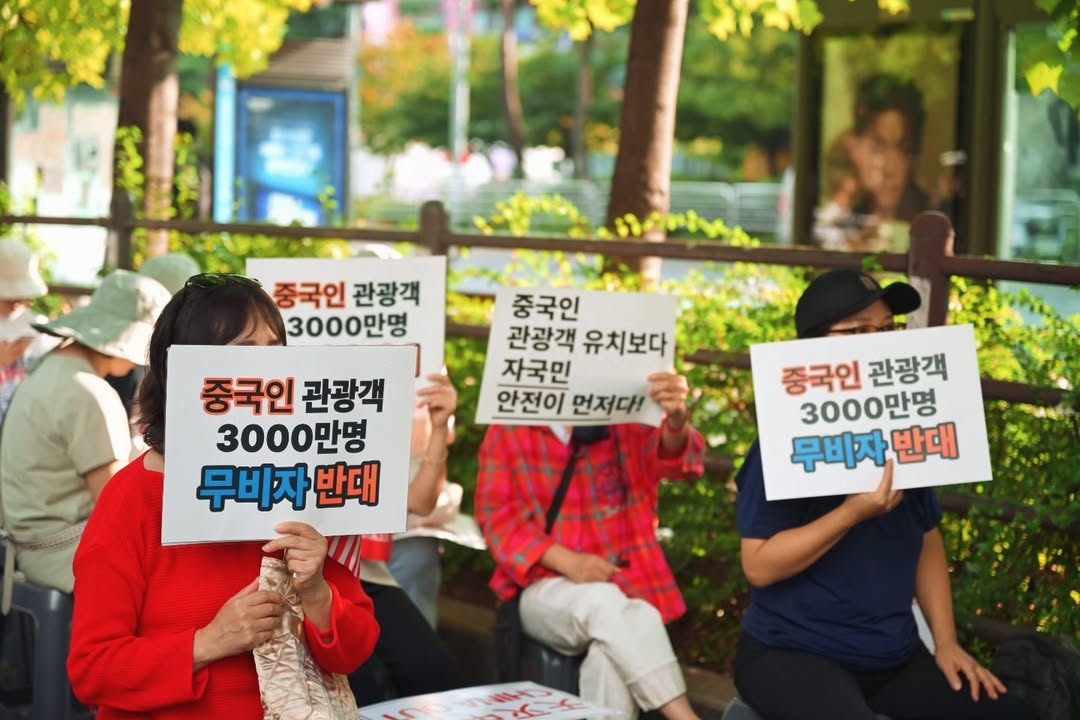 Protesters hold up signs that read “Oppose visa-free entry for 30 million Chinese tourists” and “Koreans’ safety comes before attracting Chinese tourists,” at an anti-China rally protesting visa-free entry for Chinese tourists near the National Assembly in Yeongdeungpo-gu, western Seoul, September 2025. (Instagram @gazeofyouth)
 Last October, South Korea saw a surge in anti-China street rallies, complete with “Korea for Koreans” placards, “China out” chants and MAGA-style symbolism, fanning public anxiety and political division. However, the rallies spotlighted a deeper challenge for South Korea: the politicization of foreign policy, where international issues are increasingly folded into domestic political mobilization.
Foreign media reports at the time described the demonstrations as escalating at an especially sensitive moment — just days before South Korea hosted the Asia-Pacific Economic Cooperation summit in Gyeongju from Oct. 31 to Nov. 1 and as Chinese President Xi Jinping was set to attend related events.
In response, South Korean President Lee Jae Myung publicly warned that the protests were “self-destructive,” saying they could damage national interests and South Korea’s international image, while Chinese Ambassador Dai Bing criticized what he described as fabricated narratives such as “Chinese election interference” being used for domestic political purposes.
The episode underscores a growing pattern in which diplomacy — and public sentiment toward foreign countries — is being weaponized in partisan conflict, with ripple effects for policy flexibility and crisis management, according to experts.
Ryu Ji-won, director of the Institute for Korea-China Relations at Wonkwang University, described the most worrisome trend in today’s South Korea–China debate as not the government-to-government disputes themselves but “the spread of hostility at the civilian level and the politicization of public sentiment.”
“Anti-China sentiment circulating primarily in online spaces is repeatedly amplified by specific diplomatic and security issues and economic frictions, and is increasingly becoming structurally embedded in everyday perceptions,” Ryu told The Korea Herald. “Beyond short-term deterioration in public opinion, this trend is likely, in the long run, to narrow the scope of diplomatic options and weaken policy flexibility.”
Ryu traced the sentiment to a “complex interaction” of cultural and historical tensions, economic anxiety and uncertainty from shifts in the international order — and emphasized that the phenomenon is not unique to South Korea. In a region where strategic competition is sharpening, he argued, leaders’ tendency to overreact to their most fervent supporters is increasingly spilling over into foreign relations, hardening the emotional terrain that diplomacy must navigate.
“Of course, a single summit or symposium cannot resolve issues of civilian hostility and emotional antagonism in the short term,” he said. “However, the essence of diplomacy lies not in eliminating conflict altogether, but in managing it so that it does not spiral in uncontrollable directions.”
While negative sentiment about China, and its relations with Korea, is often associated with conservatives, anti-Japan sentiments flare up periodically, and traditionally the liberals have been accused of using this sentiment for their agenda.
But such political ploys are not limited to one side. A frequently cited example is former conservative President Lee Myung-bak’s visit on Aug. 10, 2012, to Dokdo, a long-disputed set of islets between South Korea and Japan. This marked the first time a sitting South Korean president set foot on the territory amid domestic political pressure and worsening relations with Tokyo.
Despite Japan’s formal request a day earlier to cancel the visit, Lee proceeded, triggering a sharp downturn in bilateral relations. The episode was followed by stalled negotiations on security and economic cooperation, including setbacks in talks on a military intelligence-sharing pact and the eventual suspension of a bilateral currency swap arrangement.
While the visit was broadly welcomed by the South Korean public, critics later argued that it yielded few tangible diplomatic gains and instead illustrated how territorial and historical issues can be leveraged for domestic political consolidation, at the cost of long-term diplomatic flexibility.
Political commentator Park Sang-byeong offered a blunter diagnosis, describing the trend as “the use of hatred as a political tool to mobilize supporters through polarization,” adding that it can be seen as “behavior driven by factional interests rather than national interest.”
Park’s point goes to the heart of what policy analysts often call the politicization of foreign policy: When external issues are reframed as identity politics at home, incentives shift toward escalation rather than calibration — and the cost is often paid in reduced diplomatic room to maneuver.
South Korea’s debate over how — or whether — to speak publicly about sensitive regional contingencies has repeatedly surfaced in campaign politics.
During the April 2024 general election campaign, Lee Jae Myung — then leader of the Democratic Party of Korea, now President — drew criticism after remarks that were widely interpreted as downplaying the strategic stakes of a Taiwan Strait crisis.
In March 2024, Lee said, “What does it matter to us what happens in the Taiwan Strait?” adding, “Isn’t it enough that we just live well ourselves?” He went on to ask, “Why provoke China?” before clasping his hands and saying in Chinese: “Just say ‘xiexie’ — to Taiwan too, just ‘xiexie’ — and that should be enough.”
The remarks were defended by some supporters as a call for strategic restraint, but critics argued they illustrated the risks of election-driven messaging on issues that demand bipartisan discipline and long-term consistency.
Competing narratives and overseas messaging wars
The politicization dynamic is not confined to domestic actors. It is also amplified by competing overseas narratives seeking to shape perceptions inside South Korea.
A Global Times opinion piece published Feb. 10, last year, for instance, argued that “China interference” claims were a “political farce” orchestrated by South Korean far-right conservatives, portraying anti-China rhetoric as an opportunistic diversion from domestic governance failures and urging Seoul not to link internal politics to China “for no reason.”
For South Korean policymakers, such external commentary — regardless of how it is received — adds another layer to the problem: When foreign policy becomes a domestic wedge issue, it also becomes a more attractive target for external framing and counter-framing campaigns.
Foreign media coverage has also highlighted how the post-crisis environment accelerated a new style of right-wing youth mobilization. One report described rallies organized by a youth group calling itself Freedom University, depicting it as digitally organized and rapidly growing, using aggressive social media campaigns and populist messaging, while adopting slogans like “Korea for Koreans” and “Chinese Communist Party out.”
A separate foreign report similarly portrayed Freedom University rallies as drawing thousands of attendees and presented the group’s embrace of US-style MAGA symbolism — including signs referencing US right-wing activist Charlie Kirk, who was assassinated in September last year — as part of a broader transnational culture-war aesthetic.
Domestically, the concern is not merely the rhetoric itself, but the speed at which it spreads and hardens into “everyday perceptions,” as Ryu described — particularly when online narratives and street politics reinforce each other.
Ryu argued that South Korea occupies a “distinctive position” in East Asia: While located at the center of US–China strategic competition, it maintains communication channels with China, Japan and Russia, and can sometimes play the role of mediator as well as stakeholder.
That position, he said, makes consistency and predictability especially valuable — because South Korea’s choices can shape the wider regional order, not only bilateral ties.
The policy implication is straightforward: If public hostility becomes structurally embedded and repeatedly politicized, future administrations may find it harder to pursue pragmatic adjustments — even when those adjustments serve national interests — because any recalibration risks being framed as betrayal, appeasement or ideological surrender.
Even proponents of tougher stances toward Beijing often acknowledge a line between legitimate policy debate and identity-based demonization. The dilemma is that once “China” becomes a proxy in domestic political identity, it becomes harder to restore the basic conditions for diplomacy: controlled competition, managed conflict and a widened space for coexistence — the “mature diplomacy” Ryu called for.
As election cycles intensify and regional flashpoints persist, South Korea’s central challenge may be less about choosing between Washington and Beijing than ensuring its foreign policy is not continually rewritten as a tool of domestic polarization — at the expense of strategic flexibility when it is needed most.
mkjung@heraldcorp.com