

Since the advent of the World Wide Web in 1994, technology has advanced by leaps and bounds, with significant implications for employers and individual workers. What was dubbed a ‘fourth industrial revolution’ revived earlier Keynesian predictions of widespread technology-driven unemployment.
For example, in 2013 Carl Benedikt Frey and Michael Osborne claimed that 47% of US jobs were at high risk of being automated within the next 20 years. In the UK, the auditing and consultancy firm Deloitte suggested that 20-25% of jobs in the UK would disappear as the pace of automation increased exponentially. Many even predicted a ‘jobless future’ and ‘the end of work’.
Yet, a curious discrepancy between predictions of work and empirical evidence has materialised: the two are heading in different directions. While predictions forecast a world without work, the empirical evidence reveals that a higher percentage of people are in work and that work remains important for many reasons.
I remember how, when I surreptitiously introduced the first computer at Air Malta, the chairman had summoned me and told me that it was not permitted, as the Prime Minister of the time believed it would lead to unemployment. I nodded and then promptly ignored the warning. So did the chairman, thank God.
Over the last decade, we witnessed a phenomenal transformation of the labour market as thousands of workers, including a large number of women, found jobs. Unemployment has plummeted. The demand for services has forced us to open the market to foreign nationals. Despite technological advances, we haven’t been able to deploy large numbers of robots to do simple jobs.
The booming jobs market has banished the old saying that “there are a thousand dogs for each job” and allowed us to start discussing the quality of work as an essential complement to the availability of jobs.
Workers, their representatives, and some good employers, have expanded their views to include well-being at the workplace. They look not only at objective aspects, such as rates of accidents or absences, but also at subjective features like pressure and stress. Employees are strongly interested in opportunities to progress and develop as professionals, job complexity, skills used, and whether they have a voice. This is forcing policymakers to widen their focus.
From the wider perspective of society, job quality is not just a crucial determinant of the well-being of individual workers and their households. It can also be an important driver of increased labour force participation, productivity and overall economic performance.
What, however, are good quality jobs? The International Labour Organisation describes them as having three dimensions, namely promoting the quality of earnings, reducing labour market insecurity, and promoting good working conditions and a healthy society.
Earnings quality relates to earnings ̶ both their average levels as well as their distribution ̶ as they contribute directly to material well-being. Innumerable studies have shown that for a given level of average earnings, life satisfaction tends to be higher the more equal its distribution. There is a saturation effect here, in that life satisfaction rises at a decreasing rate as earnings rise whilst people tend to dislike excessive inequality in society.
Secondly, job security appears to be a causal factor of individual well-being. For example, both the European Social Survey (ESS) and the International Social Survey Programme (ISSP) rank job security consistently as the most important item in almost all countries for which data are available. This is because the effects of job insecurity may also impact firms’ profits by reducing worker retention rates and constrain investment in firm-specific skills and productivity. Another adverse effect on society at large would be through shaping people’s political views, increasing social unrest, sapping consumer confidence, and changing saving behaviour.
Thirdly, the quality of work environment (QWE) captures non-economic aspects of employment. Rather than just receiving good salaries or having good career prospects, workers also want a chance to fulfil their ambitions, to feel useful in society and build self-esteem. They ask if the working environment is conducive to personal fulfilment, features working-time arrangements, fosters workplace relationships, and has opportunities for training.
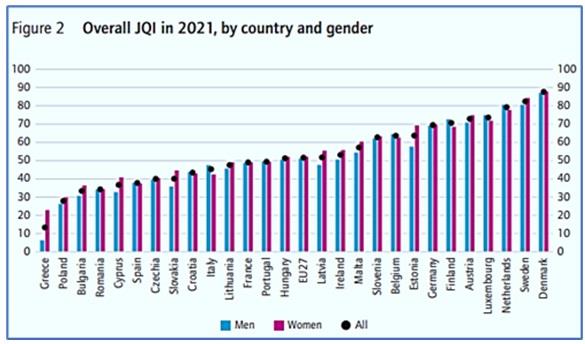
Where do Maltese jobs stand relative to jobs in the rest of Europe? An idea can be obtained from the European Job Quality Index published by the European Trade Union Institute. The latest figures available show that JQI in Malta is just under 60% compared to just over 50% in the EU. Women tend to have a higher JQI than men in the EU, but particularly so in Malta. We are miles ahead of Greece but way below Denmark. The JQI delves into more detailed sub-categories. Interested readers can click on this link: ETUI-JQI
For example, one aspect explored by the ETUI index is that of depression attributable to job strain, job insecurity, bullying, effort-reward imbalance, and long working hours. Malta ranks exceptionally well, placing third lowest in the extent of this health outcome (Greece being the worst and Bulgaria the best). In 2015, the main components of depression were job strain, bullying, effort-reward imbalance, and job insecurity in that order of magnitude. One other interesting finding was that Malta has the lowest rate of coronary/ischaemic heart disease due to psychosocial work factors – 7.5% versus 18.7% in Greece and 11.5% in the EU.
Early last year, Misco presented the results of its first-ever National Employee Engagement Survey ̶ a nation-wide study that provides insights into how employees feel about their employment, how they view their work environment and how they generally feel at the workplace. Respondents were asked about their perception of overall corporate culture, trust and team spirit, communication at work, their relationship with management, the work environment and wellness, opportunities for work-life balance, skills and abilities, learning and development.
The survey showed that 85% of respondents see a clear link between their work and the company’s results; 89% agree that they have a good understanding of their company’s core values; and 80% are generally satisfied with their employment. Another way of looking at it was that 78% “look forward to coming to work,” while another 82% agree that their workplace offers them a safe environment.
Asked about the qualities they find important when choosing a job, an outright 77% mentioned a good salary; 60% said good working conditions, 34% mentioned good working hours; and 30% referred to growth opportunities. Only 27% mentioned job security, while 23% mentioned family-friendly measures. Other qualities chosen included a non-stressful job (15%); an opportunity to take initiatives (11%); work with positive social contribution (11%); and job responsibility (6%).
Commenting on the survey, Misco’s Nadine Cilia said that an engaged workforce is the foundation of any company’s success. She encouraged employers to explore areas such as management relationships, work-life balance, and learning opportunities that can help them create an organisational culture that not only meets professional needs but also enhances their people’s overall job satisfaction.
Employers won’t be able to close that gap on their own by changing their human resources policies and practices one by one. Strong public policies will play a key role in driving lasting change, either by offering employers incentives to improve job quality or requiring them to take steps that result in the creation of new quality jobs.
Frans Camilleri is an economist. He studied at Oxford and University of East Anglia, is a former corporate head at Air Malta, and has served on various public and private boards.