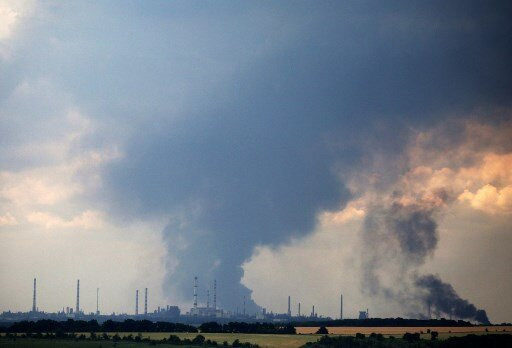
One night after Christmas, Russia launched its largest missile and drone strike against Ukraine in months, hurling 500+ kamikaze drones and 40+ cruise, ballistic, and hypersonic missiles almost exclusively at Kyiv and its surrounding regions.
That Kremlin attack was designed to crush Ukraine’s central power grid and Ukrainians’ will to resist. It was preceded, on Dec. 23-24, with an assault by more than 635 drones and 35+ missiles, hitting and forcing power outages in cities across the country, including Kyiv, Zhytomyr, Rivne, Ternopil, Vinnytsia, Odesa, Chernihiv, Ivano-Frankivsk, and Lviv.
Follow our coverage of the war on the @Kyivpost_official.
There are now scheduled blackouts in most Ukrainian cities. Meanwhile, in the opposite direction of that flood of Russian metal and explosives, Ukrainians have been hitting back – and according to them – more systematically than the Russians.
Overnight Thursday-Friday, dozens of Ukrainian robot aircraft buzzed their way through hundreds of kilometers into Russian airspace in another fairly typical night’s operations – part of a campaign aiming to cripple Russia’s energy production industry and break down as much of the power grid in western Russia as possible.
In Russia’s Samara region, near the town of Novokuibyshev late Thursday evening, residents heard at least ten explosions lasting into the early hours of Friday morning. Sunrise and clear skies showed three columns of black-gray smoke rising from the city’s oil refinery and firemen responding to the scene. Social media video, unverified, showed an explosion in the vicinity of the refinery’s main cracking tower in the pre-dawn light. Ukraine’s military later announced that it had conducted a successful drone strike more than 1,000 kilometers (621 miles) inside the Russian Federation.

Other Topics of Interest
Putin’s Threats to Europe: Anatomy of a Great Deception
Putin’s bluff relies on his opponent not looking at the cards, as he seeks to turn Europe’s insecurity into his own projection of strength.
Even deeper inside Russian territory in the Volga River region near the city of Kazan – some 1,200 kilometers (747 miles) from likely Ukrainian launch sites – local Russian news Thursday night reported explosions and air defense engagements in the vicinity of the city’s oil refinery operated by KazanOrgsintez. Sunrise showed two fires burning. Some social media reported explosions in the sky, possibly indicating air defense engagements, while mobile phone service was shut down in sections of the city around the refinery. A statement from the Tartarstan defense command said “defense measures were in effect” to prevent “enemy drone operations” and that citizens should stay away from windows.
Unconfirmed comment on some local social media claimed that Russian air defenses had missed everything, and now, once again, the city refinery was on fire.
Ukrainian incursion into Russian airspace wasn’t just limited that night to Russia’s provinces. In Moscow, overnight Thursday-Friday, at least 20 Ukrainian drones penetrated air space over the Russian capital. The Moscow city mayor’s office announced the destruction of 18 drones approaching the Russian capital, and “temporary” lockdowns of Moscow’s main domestic air hubs Domodedovo and Zhukovsky airports. Residents reported mobile internet outages in several areas across the city.
Drone strikes Dec. 30-31 had shut off power and heating in Moscow’s Ramenskoe suburb, leaving somewhere between 100,000 residents (the official Russian figure blaming not drones but a short-circuited transformer) or 600,000 residents (a Russian internet estimate blaming Ukrainian drones and widely repeated in Ukrainian media) in a blackout for hours.
Ukraine’s independent NV magazine on Friday published satellite overflight images of Russia’s Rosreserv oil storage base, in the central Yaroslav region, less than 24 hours after Ukrainian drones hit that facility. Overnight Dec. 31-Jan. 1, local officials confirmed the Ukrainian attack, but claimed all attacking Ukrainian aircraft had been shot down.
The NV report and satellite images published along with it sharply contradicted Russian official claims, calling the damage “substantial and significant.” Overhead imagery showed two fuel storage reservoirs completely burnt out in fresh fires, and possible scorch and fire damage to adjacent storage sites in the south-western section of the fuel base. Kyiv Post’s review of the satellite imagery and overhead imagery recorded by NASA’s FIRMS worldwide fire-tracking network likewise found strong evidence of effective hits scored by Ukrainian drones that night.
Russia’s Liudinovo oil storage base in Kaluga region, hit the same night as the Yarsolav facility, was set on fire “massively” by Ukrainian drone strikes as per FIRMS imagery, but reconnaissance photographs the next day were of insufficient quality to determine the extent of damage, the NV report said.
Major Robert Brovdi, commander of Ukraine’s Unmanned Systems Forces (USF), in kill claims published on Friday, said Ukrainian drones in strikes on Dec. 31 and Jan. 1 struck and “turned into scrap” a rare Russian Tor and two Buk anti-aircraft systems (NATO designators respectively, SA-11 “Gadfly” and SA-15 “Gauntlet”) in strikes in the southern Hulyaipole sector. USF-published strike video buttressed the claims, but Kyiv Post could not confirm them independently.
According to USF official counts, exclusive of relatively short-range drone strikes hitting tactical targets like Russian tanks and individual soldiers, in the seven days since the Kremlin mass strike aiming to take down the Kyiv power grid, “friendly” (a USF term) Ukrainian drones have “visited” (another USF term) everything from critical energy infrastructure, to military headquarters, to ammunition dumps, to logistics hubs to rear area troop concentrations.On Dec. 26, per USF data, the following were hit: the headquarters of Russia’s elite 14th Spetsnaz commando brigade; a secret site used by the Russian navy to operate sea drones on the Black Sea; an oil refinery in Volgograd; a central air defense radar in Crimea; and military maintenance bases in occupied Donetsk region.
Russian sources generally confirmed the presence of Ukrainian aircraft in the area but admitted no damage and usually asserted all the Ukrainian drones were shot down. USF video showing drones boring in to hit targets at geo-located points on the map contradicted some of that.
The drumbeat of Ukrainian drone strikes, per those official Ukrainian statistics, seem to at least match the relentlessness of the Kremlin’s, and include:
Dec. 27: Oil refinery in VolgogradDec 28: Syrzan oil refinery, Samara region – a follow-up strike to an attack earlier in the month. The Volgograd facility was also hit again, as was an oil loading and storage site on Russia’s Black Sea shore, in the port of Tuapse. Dec. 30-31: Oil refinery north of Moscow, ammunition warehouse in Donetsk region, fuel storage site in Luhansk region, and air defense site in Donetsk region.
On Dec. 30, the Bloomberg news agency reported that Ukrainian strikes against Russian energy infrastructure had hit a wartime high with 24 separate attacks over that month alone.
According to Kyiv Post counts tracking Ukraine’s bombardment campaign against Russia since its launch in late July, Ukrainian drones or missiles have hit major Russian energy infrastructure or air defenses protecting it at least 273 times.
It was, probably, the fifth time Ukrainian drones had set both refineries on fire since August.