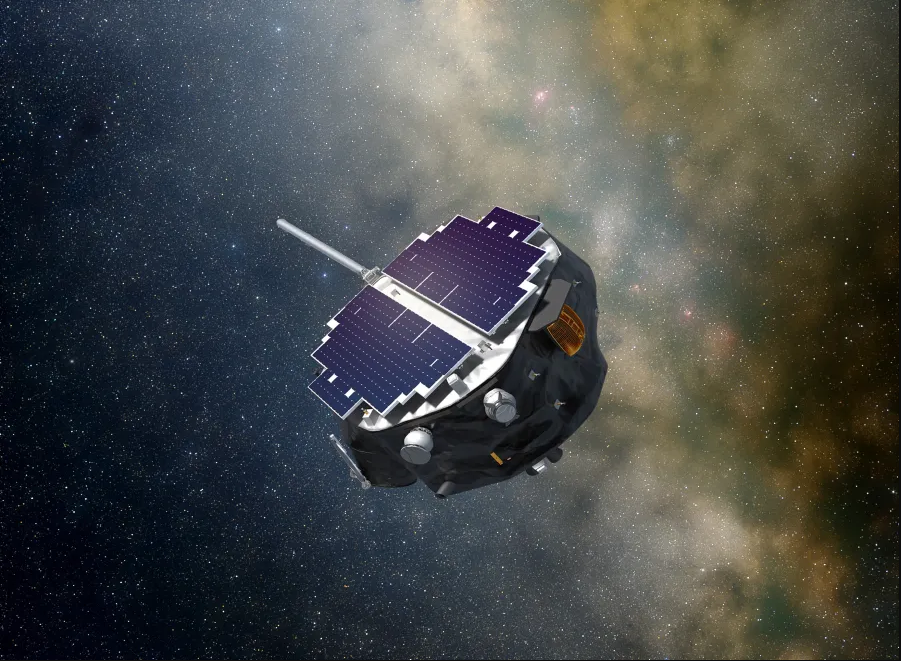
Researchers at Imperial College London have achieved a major breakthrough in space science. Their magnetometer has successfully recorded its first measurements aboard NASA’s Interstellar Mapping and Acceleration Probe.
This “first light” moment confirms that all 10 instruments on the IMAP spacecraft are working as planned. For the Imperial-led Magnetometer, known as MAG, it marks the true start of the mission.
NASA launched IMAP in September 2025 from Cape Canaveral. The spacecraft now travels steadily away from Earth.
Exploring the Solar System’s Invisible Boundary
IMAP aims to map the heliosphere. This vast bubble forms as the solar wind streams out from the Sun. It protects the Solar System from much of interstellar radiation.
Scientists still have many questions about how this boundary behaves. IMAP will help answer them.
The spacecraft is heading towards Lagrange Point 1, around one million miles from Earth. From this stable location, IMAP will send data back within minutes.
Magnetometer Captures Its First Signals
Imperial’s MAG instrument measures magnetic fields surrounding the spacecraft. These fields control how charged particles move through space.
The first data set already shows the magnetic signature of a solar-wind shockwave. This early success confirms that the instrument performs exactly as designed.
Helen O’Brien, the instrument manager, said seeing the first data arrive brought huge relief. Years of testing led to this moment, with no chance to fix problems once in space.
Supporting Space Weather Forecasts on Earth
MAG does more than support scientific discovery. It also contributes to space weather monitoring. The instrument delivers measurements in near real time. These readings help scientists track solar disturbances that can disrupt satellites, power grids and communication systems on Earth.
Professor Tim Horbury, the instrument’s science lead, said the data already reveals activity across a wide range of scales. The measurements range from tiny magnetic fluctuations to massive solar eruptions moving towards Earth.
A Strong UK Role in a Global Mission
The UK Space Agency provided £4.2 million to support UK involvement in IMAP. This funding included the development of the MAG instrument.
Imperial led the design and construction of the magnetometer. The team worked closely with partners at Princeton University and the University of Lancashire.
IMAP also carries other instruments, including SWAPI and CoDICE. Together, they will reveal how particles from the Sun and beyond gain extreme energy.
Continuing Imperial’s Space Science Legacy
IMAP will reach its final position in early 2026. It will then begin its full science mission.
For Imperial researchers, first light marks the beginning of a rich new data stream. The mission builds on the university’s long history in space science, following work on Solar Orbiter, JUICE and Cluster.
With MAG now proven in space, Imperial has once again shown its strength in building instruments that uncover the forces shaping our cosmic neighbourhood.