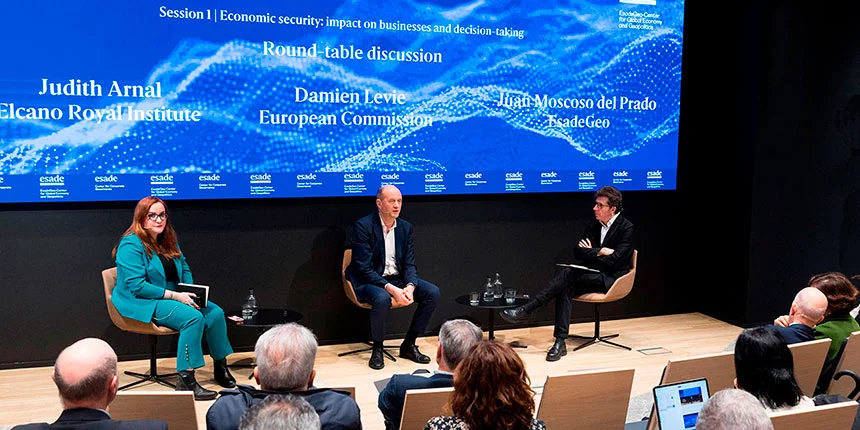
Damien Levie, economic security advisor to the EU Commission Directorate-General for Trade: “The world order based on collaboration has been replaced by confrontational economics in which the theft of technologies, hostile investments and export controls are no longer exceptions to the rule”
“We must adapt and implement a new economic security strategy for the European Union (EU)”, said Damien Levie, advisor to the DG of Trade of the European Commission, the keynote speaker in the conference ‘Economic security: impact on businesses and decision-taking’ organized this morning in Madrid by the Corporate Governance Center of Esade and EsadeGeo. Levie warned that “we face a scenario of unprecedented challenges,” explaining that “the world order underpinned by collaboration has been replaced by an order based on confrontational economics. “Technology theft, hostile investments and export controls are no longer exceptions to the rule, but commonplace taxation and competition tools, and the EU has a lot of assets to safeguard.”
Three different powers, three different challenges
This new world order entails major challenges originating mostly in three countries: Russia, China and the United States. As regards Russia, Levie insisted that the war in Ukraine “is the greatest attempt to redraw borders since the First World War” and that its consequences for Europe will be “deep and far-reaching.”
He then issued a warning about China’s growing self-sufficiency: “China relies less and less on the world, but the world relies more and more on China,” adding that that the United States “has redefined its economic relations with the whole world” and “has shifted from laws to agreements.”
Development of initiatives, safeguards and collaboration
The economic security advisor of the DG of Trade of the European Commission emphasised that, in response to these challenges, the EU has increased its budget to two trillion euros (1.26% of the EU’s GDP) which will be earmarked for developments mainly in the spheres of defence, technology and sustainability; but also for safeguards for markets, research and exports; and to foster collaboration. “We are working to bolster free trade by strengthening relations with Mercosur, India, Indonesia, and the United Arab Emirates,” he concluded.
The session in which Damien Levie participated marked the start of the 3rd lecture series ‘Geopolitics on board agendas’, organized by the Esade Corporate Governance Center and EsadeGeo, with a view to addressing how boards of directors can integrate geopolitical trends into their companies’ strategies. Judith Arnal, senior research fellow at the Elcano Royal Institute and an independent member of the board of directors of the Bank of Spain, also participated, highlighting that “the business world has been concerned about geopolitics for some time, but there is no one-size-fits-all approach: it depends on who the company’s owners are, what sector it belongs to and where it is located.”
The event was opened by Mario Lara, director of Esade Madrid and the Esade Center for Corporate Governance, and Emma Fernández, an independent director and member of the advisory board of the Esade Center for Corporate Governance. The discussion was chaired by Juan Moscoso del Prado, a senior fellow at EsadeGeo.