Dr Ifraín Pérez had been checking the news on his phone since the early hours. All day, the capture of the Venezuelan president, Nicolás Maduro, had been the main subject of conversation in his neighbourhood in Havana. “It’s really pretty unpleasant news – for Cuba and the world,” he said late on Saturday.
Pérez, 62, served twice in Venezuela as part of Cuban medical missions, from 2005 to 2011 and from 2013 to 2016. “I’m worried because I know many Venezuelans. I have a great affinity with that people because of what I lived through with them,” he said.
“The most important thing is to achieve stability and that President Nicolás Maduro go back to his nation.”
After the US attacked Venezuela and captured its longtime president on Saturday, allies including Russia and Iran were quick to criticise the strikes as a violation of sovereignty.
During a meeting called on Saturday morning, the Cuban president, Miguel Díaz-Canel, called the incident “an unacceptable, vulgar and barbarian kidnapping”. He said the US attack was an “act of state terrorism, comparable only to the crimes against humanity committed by Israeli Zionism in the Gaza Strip”.
But for the regime in Cuba, just 90 miles from Florida, the attack on Venezuela also evoked more immediate memories. US troops twice occupied Cuba in the 20th century, and after Fidel Castro’s 1959 revolution the CIA backed a string of attempts to topple the Communist government, including the disastrous Bay of Pigs invasion in 1961.
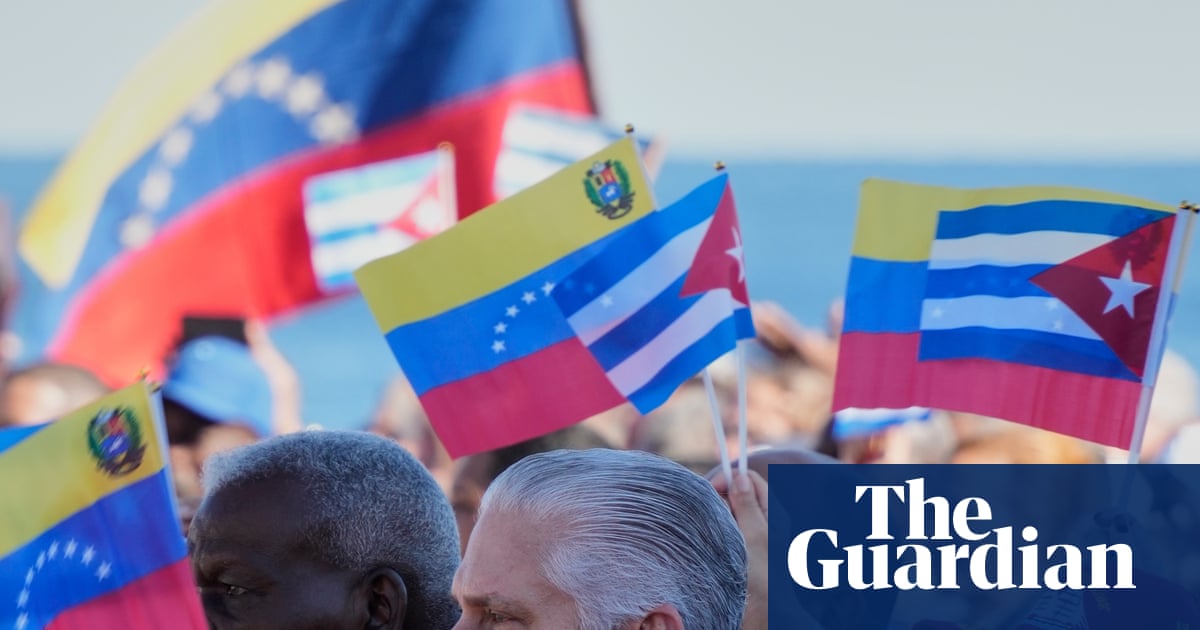
People attend an event held at the Anti-Imperialist Tribune in support of Venezuela in Havana on Saturday. Photograph: Ernesto Mastrascusa/EPA
Addressing reporters at Mar-a-Lago on Saturday, Trump said Cuba was “not doing very well”, adding that the country’s people had “suffered for many, many years”.
He added: “I think Cuba is going to be something we’ll end up talking about because Cuba is a failing nation right now. Very badly failing nation … We want to help the people in Cuba, but we want to also help the people that were forced out of Cuba and living in this country.”
The US secretary of state, Marco Rubio – the son of Cuban immigrants and a longstanding critic of the regime in the country – sent a clear warning shot to Díaz-Canel and his allies. “If I lived in Havana, and I was in the government, I’d be concerned – at least a little bit,” Rubio said.
Trump later appeared to row back on his earlier comments in an interview with the New York Post, saying he was not considering military action against Cuba. “No, Cuba is going to fall of its own volition. Cuba is doing very poorly,” Trump said.
The US capture of Maduro has removed a key ally for the Cuban government. A subsidised supply of Venezuelan oil has been crucial to keeping the island’s ageing electrical system functioning, despite a reduction in quantity in recent years.
Blackouts have become common in Cuba. In September its entire electrical grid failed, affecting nearly 10 million people, and over the past 14 months it has suffered a dozen nationwide outages. A malfunctioning energy network has not been helped by the US naval blockade on Venezuela, which has limited Maduro’s ability to keep its ally supplied with oil.
Daily, hours-long blackouts are the norm. “[Venezuela] helped us a lot, and now with this problem I don’t know where we’re going to end up,” said Reina María Arias, a retired 68-year-old.
A street without electricity in Havana last month. Power outages have plagued Cuba and could get worse without help from Venezuela. Photograph: Ernesto Mastrascusa/EPA
She said that on the bus she had taken earlier in the day everyone was talking about the situation. “People were saying that Americans don’t let anyone live in peace, that they have always had ambitions for Cuba, and now it’s Venezuela.”
In Havana, fuel shortages have become apparent as cars form long queues at gas stations. Raúl Menéndez, a 40-year-old self-employed worker, predicted that butane gas and oil for transportation would only become scarcer.
At a pro-Maduro event across the street from the US embassy on Saturday, the Cuban president declared his country’s continuing loyalty to its ally. “For Venezuela, and of course for Cuba too, we are willing to give even our own blood,” said Díaz-Canel. Similar acts of solidarity took place across the country.
But despite the official condemnation and private fears, opinions among Cubans are far from unanimous.
“Some people say [the US forces] should come here too, to take Díaz-Canel away,” said María Karla, a 26-year-old housekeeper. “But there is no opposition here to take charge of the country, nor is there any [opposition] leader. So it would be totally crazy, and I don’t think that’s going to happen here.”