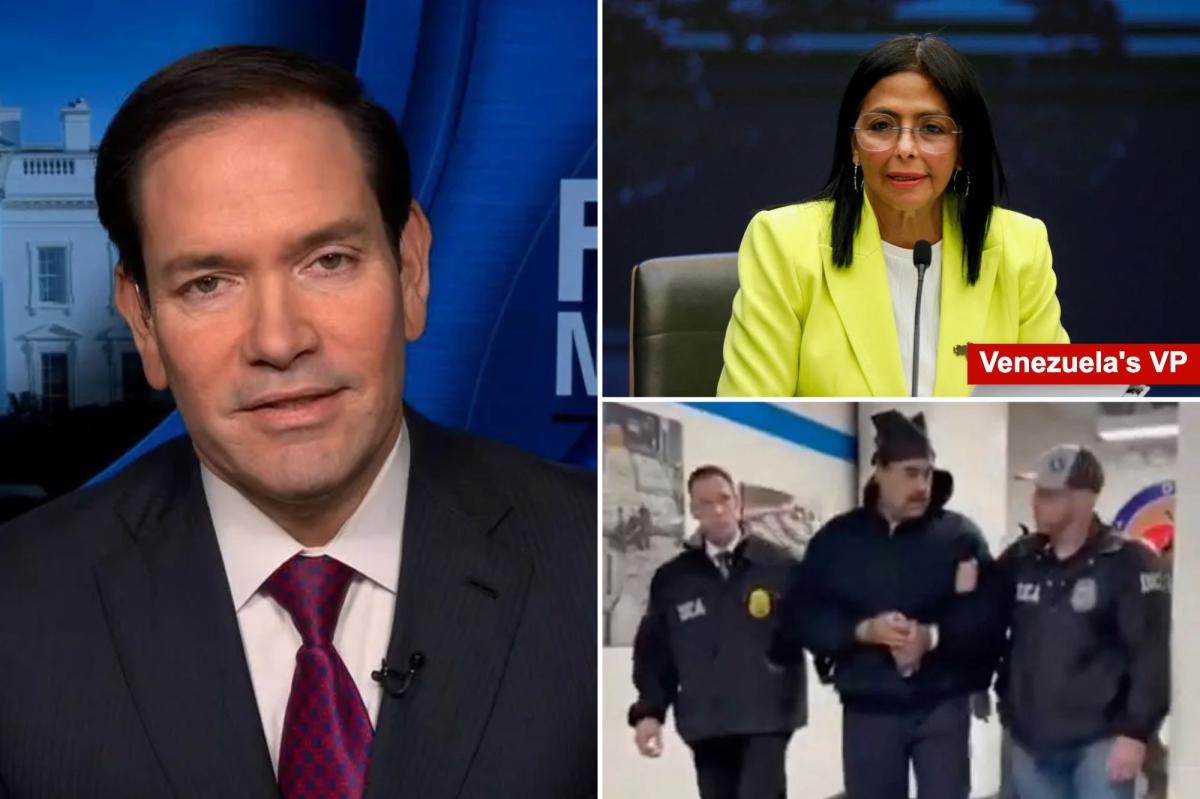
Acting Venezuela President Delcy Rodriguez is not the country’s legitimate leader, US Secretary of State Marco Rubio said Sunday.
Rubio spoke with Rodriguez — Venezuela’s reportedly ruthlessly ambitious vice president who was sworn in to the top office Saturday — after the US conducted a daring military operation to capture dictator President Nicolas Maduro.
Venezuelan Vice President Delcy Rodriguez was sworn in as acting president after dictator Nicolas Maduro was captured by the US early Saturday. REUTERS
The secretary of state said the US will not outright support the Maduro crony staying in power, calling for elections to determine the next leader of the beleaguered South American country.
“This is not about the legitimate president. We don’t believe that this regime in place is legitimate via an election,” Rubio told ABC’s “This Week” on Sunday. “And that’s not just us. It’s 60-something countries around the world that have taken that view as well.
“Ultimately, legitimacy for their system of government will come about through a period of transition and real elections,” Rubio said. “It’s the reason why Maduro is not just an indicted drug trafficker. He [was an] illegitimate president. He was not the head of state.”
Rubio said the Trump administration plans to leverage its oil quarantine on Venezuela to force Caracas to make changes.
Here’s the latest on Nicolás Maduro’s capture:
“I cannot overstate how crippling this is for their future, [and] that, on the other hand, there’s an alternative to that … an oil industry that actually benefits the people,” the secretary of state said.
Whoever Venezuela’s next president is, they will have to dismantle the country’s ingrained socialist lefty structure at every level, while also tackling its criminal gangs, all while facing a collapsing economy.
The implications are massive, with Venezuela currently helping to prop up Cuba, Iran and Russia.
Who is currently in charge in Venezuela?
Rodriguez, 56, was sworn in as the nation’s acting leader Saturday.
She is a longtime socialist and ally of Maduro alongside her brother Jorge Rodriguez, who presides over Venezuela’s congress.
Follow The Post’s live coverage of US strikes on Venezuela and the capture of Nicolás Maduro
Rodriguez has been described as a ruthlessly ambitious and Machiavellian politician willing to do whatever is necessary to move up in the ranks, former colleagues and US officials told the Wall Street Journal.
She also maintains a close relationship with Cuba and its intelligence agency, which Maduro relied on to help rule the country and protect himself.
“It looks like she’s assuming the power vacuum, and it is actually in line with the Trump administration’s initial thoughts for why they could work with her, because she was seen as a powerful figure and able to increase oil production even under sanctions,” said Alex Plistsas, an ex-senior US intelligence official and Atlantic Council fellow, to The Post.
“I think there was an idea that she may be somebody who was not only effective, but somebody they could work with.”
But Rodriguez quickly reaffirmed her support for Maduro during a speech Saturday after his capture by US forces. The remarks led Trump to warn the newly appointed president that “If she doesn’t do what’s right, she is going to pay a very big price, probably bigger than Maduro,” The Atlantic reported.
How The Post covered Maduro’s capture.
Rubio also said the Maduro loyalist cannot serve as Venezuela’s interim leader and vowed that the US would not support her administration.
Instead, Rubio pushed for free elections to be held to determine the next leader of the country as the US and other nations never recognized Maduro’s 2024 win.
Who else is in charge?
While Maduro is in US custody, his backers, known as the Chavistas, or acolytes of late far-left Venezuelan President Hugo Chávez’s ideology, are still very much in control of Venezuela. Their grip on the country runs deeper than Rodriguez.
They include Maduro’s allies such as Interior Minister Diosdado Cabello and Defense Minister Vladimir Padrino López. The loyalists have publicly insisted that Maduro is still in charge of Venezuela despite his arrest.
US Secretary of State Marco Rubio addresses the precarious situation during a Sunday appearance on CBS News’ “Face The Nation.” CBS / Face the Nation
Cabello is particularly powerful as the leader of the country’s military and civilian counterintelligence agencies, which conduct espionage on citizens of Venezuela.
“It doesn’t appear that the strikes weaken the power structure of any of the existing institutions, meaning any of the cabinet departments or agencies that would report to the president, including the security services in the military,” Plistsas saidd.
Beyond Venezuela’s political structure, the country is also a hotbed of powerful cartel and gang activity, including the notoriously brutal Tren de Aragua.
“They’re certainly a prevalent force within the country,” Plistsas said.
Why opposition leader Maria Corina Machado has a hard road ahead
Many people are backing opposition leader and Nobel Prize winner María Corina Machado or Maduro’s 2024 opponent, Edmundo González, to take over, but Trump said Saturday he believes that Machado, at least, isn’t strong enough.
The statement prompted Ryan Berg, director of our Americas Program for the Center for Strategic and International Studies, to tell The Post, “Of all the things that were said yesterday at the press conference. It’s probably what I disagree with the most.
“She has all the legitimacy that she needs to be a leader within Venezuela, understanding she wasn’t elected in the last election because she was barred from running,” he said.
“Her replacement [Gonzalez] won in an unfree and unsure election, and they were able to prove that they won under some really difficult and repressive conditions.”
Machado had been barred by the Maduro regime from running as the standard-bearer for the opposition and ultimately had to pass the baton to González, who has since fled to Spain. Machado had fled Venezuela last month.
She seemingly attempted to flatter Trump by dedicating her Nobel Peace Prize — a prestigious honor that the US president aggressively sought — to him last year.
Maduro is seen inside the DEA’s New York headquarters Saturday night. X account of Rapid Response 47/AFP via Getty Images
Rodríguez could serve as a “stopgap” of sorts before Venezuela could transition to a democratic government.
The problem is there are concerns Rodríguez might not easily step aside at some point or play ball with the Trump administration.
Rubio demurred on Machado.
The secretary of state also tried to pour cold water on claims that the operation in Venezuela will result in a repeat of America’s prolonged war in the Middle East.
“The whole, you know, foreign policy apparatus thinks everything is Libya, everything is Iraq, everything is Afghanistan. This is not the Middle East,” he told “Face the Nation.”
“Our mission here is very different,” he added, stressing that the operation was to put an end to the Maduro regime, which he accused of having dealings with Iran and Hezbollah.
How Maduro’s fall will hurt Cuba, Iran and even Russia
Under Maduro’s predecessor Chavez, Venezuela used its vast oil and mineral reserves to build an anti-West alliance with Cuba, Iran, Russia and China.
Maduro’s shocking capture has sent a warning to some of Venezuela’s allied nations that their regimes may be toppled by the US, too.
Rubio and Trump have suggested that Havana, a long-time supporter of Maduro, is “in a lot of trouble” and may be next.
“If I lived in Havana and I was in the government, I’d be concerned,” Rubio said on NBC’s “Meet the Press.”
Similar threats were levied against Iran amid widespread protests over the fuel-rich nation’s ailing economy.
Trump had warned Tehran that it must not use deadly violence against the protesters just hours before ordering airstrikes in Caracas.
“The regime in Iran should pay close attention to what is happening in Venezuela,” Israel’s Yesh Atid leader said on X.
Maduro’s fall also sent shockwaves to Beijing and Moscow, who have benefitted from the economic alliance and find themselves even more isolated in the middle of their own regional conflicts.
The same goes for Hezbollah in Lebanon, which had been accused of using allies in Venezuela to launder money, move operatives and weapons, evade sanctions and traffic cocaine.
China would suffer the biggest fallout as Beijing has provided more than $30 billion in major arms to Caracas since 2000, according to the Stockholm International Peace Research Institute.