
Since the dawn of the nuclear age, the United States has served as the guardian of the global nuclear order by upholding norms against nuclear use, curbing nuclear proliferation, and entering agreements to limit its own arsenal. This order mitigated the dangers posed by nuclear weapons for 80 years. Now, though, its pillars have begun to crack, with the collapse of arms control between the United States and Russia; China’s breakneck nuclear expansion; and the fraying of the nonproliferation regime. Donald Trump’s return to the presidency is accelerating the fragmentation, as allies and partners question the credibility of U.S. security commitments and Washington contemplates whether it will continue to lead on nonproliferation globally.
In response, U.S. allies and partners are taking initial steps toward a post-American nuclear order—one that will raise new questions about the spread, use, and control of the world’s deadliest weapon.
Since the dawn of the nuclear age, the United States has served as the guardian of the global nuclear order by upholding norms against nuclear use, curbing nuclear proliferation, and entering agreements to limit its own arsenal. This order mitigated the dangers posed by nuclear weapons for 80 years. Now, though, its pillars have begun to crack, with the collapse of arms control between the United States and Russia; China’s breakneck nuclear expansion; and the fraying of the nonproliferation regime. Donald Trump’s return to the presidency is accelerating the fragmentation, as allies and partners question the credibility of U.S. security commitments and Washington contemplates whether it will continue to lead on nonproliferation globally.
In response, U.S. allies and partners are taking initial steps toward a post-American nuclear order—one that will raise new questions about the spread, use, and control of the world’s deadliest weapon.
Washington’s leadership of the global nuclear order is among the most consequential and least appreciated successes of the postwar era. In the years following World War II, world leaders assumed the inevitability of widespread nuclear proliferation. Speaking in 1960, then-U.S. Sen. John F. Kennedy predicted that there could be as many as 20 nuclear powers within four years. Yet, 65 years later, only nine countries have nuclear weapons.
The United States helped engineer this outcome through a combination of carrots and sticks. Alliances backed by nuclear security guarantees dampened proliferation incentives in Europe and Asia. Washington worked with Moscow to create a nuclear nonproliferation regime, centered on the Nuclear Nonproliferation Treaty (NPT), which legally restricted the spread of nuclear weapons. During the Cold War and after, the United States recruited nations around the world to counter proliferation through a complex system of sanctions, export controls, safeguards built into civil nuclear cooperation, and—in rare cases—the use of military force.
Yet today, the United States’ intent to continue serving as the backstop of the global nuclear order is deeply uncertain. European allies are questioning Washington’s commitment to collective defense after Trump—whose antipathy toward alliances is long-standing—last year indicated that the United States would only defend NATO allies that pay their “bills,” mused that NATO’s Article 5 has “numerous definitions,” and started to withdraw some U.S. troops from NATO’s eastern flank. The nonproliferation regime is foundering, with China and Russia openly flouting the snapback of U.N. sanctions on Iran. And Washington’s position on allied proliferation is squishy: As a presidential candidate, Trump argued that U.S. allies should acquire their own nuclear weapons, a stance shared by Undersecretary of Defense Elbridge Colby, who reportedly voiced support for South Korean nuclear proliferation before assuming his current role.
Against this backdrop, an emerging trend is taking shape: U.S. allies and partners are striking nuclear deals with one another to guarantee their security without the United States. The Pakistan-Saudi Arabia mutual defense pact is the most recent example. Since President Franklin D. Roosevelt and King Ibn Saud’s storied Suez Canal meeting in 1945, Washington and Riyadh have built and evolved a strong security partnership. In recent years, Saudi Arabia has ordered at least $129 billion in military equipment from the United States to combat the Islamic State, defeat the Houthis, counter Iranian influence, and combat terrorism in the Middle East. The U.S. military operates out of an air base near Riyadh. And Saudi Arabia is intently pursuing a mutual defense agreement with the United States. This push has proved unsuccessful thus far, though Trump named Riyadh a major non-NATO ally and signed a strategic defense agreement with Crown Prince Mohammed bin Salman last November—thereby deepening security cooperation but stopping well short of a commitment to Saudi Arabia’s defense.
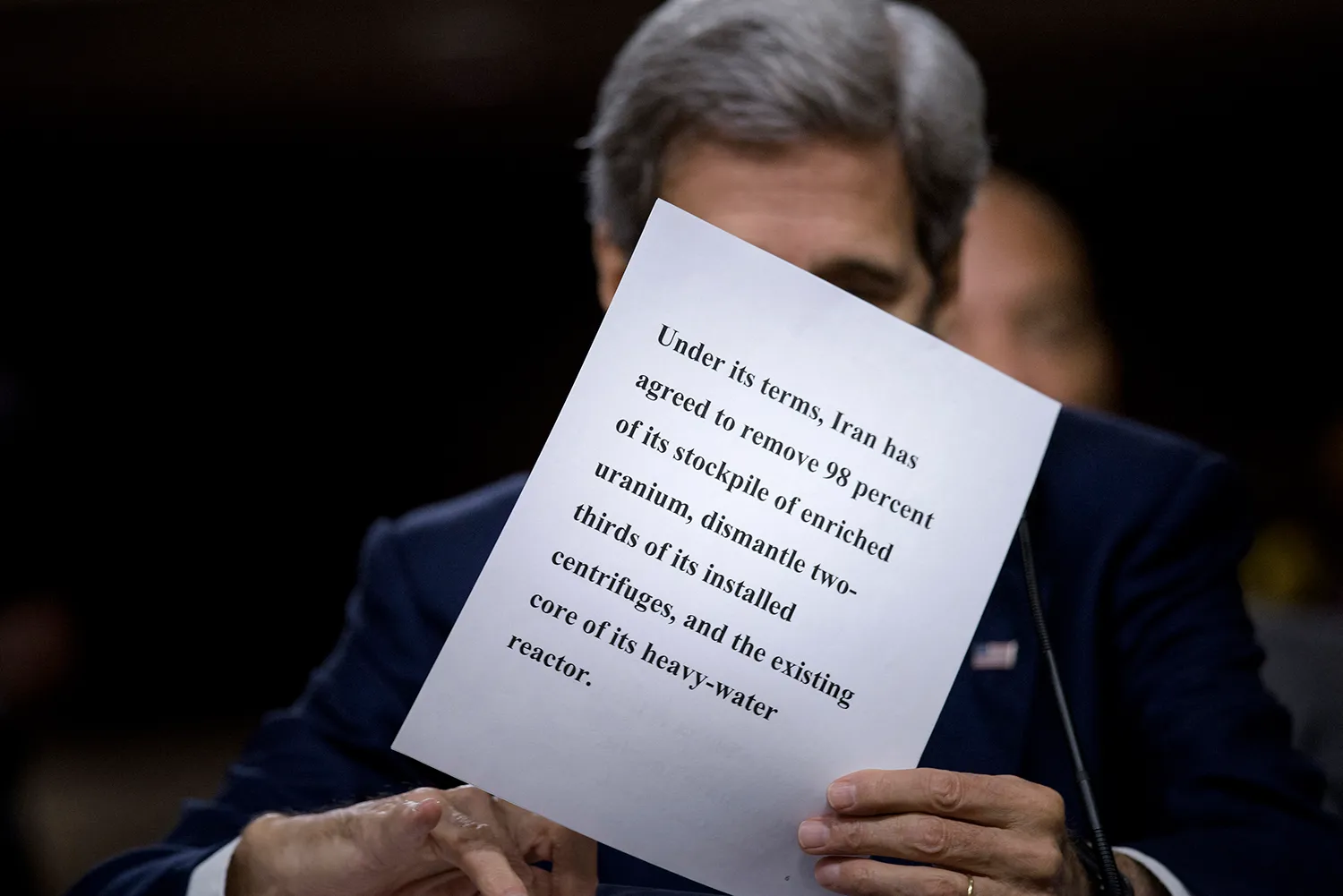
A man with gray is partially obscured by a paper with words about the Iran nuclear deal on it.
U.S. Secretary of State John Kerry organizes his papers on the Iran nuclear deal during a hearing in Washington on July 23, 2015. Brendan Smialowski/AFP via Getty Images
In the absence of a U.S. security guarantee and amid continued concerns about Iranian nuclear ambitions, Saudi Arabia has turned to Pakistan—a longtime destination of Saudi financial support. In September 2025, Riyadh and Islamabad announced a strategic mutual defense pact. A Saudi official described the pact to the Financial Times as a “comprehensive defence agreement that will utilise all defensive and military means deemed necessary”—implying that nuclear weapons are within scope. While the deal does not change the command or control of Pakistan’s weapons, it reminds any Saudi adversaries that the kingdom has powerful friends beyond the United States. For Pakistan, the pact signals an expansion of the role of its nuclear arsenal. Pakistani officials have long maintained that the purpose of their country’s nuclear weapons was to deter nuclear-armed India, not to address other regional or global security challenges. Now, “any aggression against either country shall be considered an aggression against both” Pakistan and Saudi Arabia, as the Pakistani prime minister’s office put it.
In Europe, security cooperation in the form of U.S. extended deterrence policies has helped limit proliferation and deter Russian aggression since 1945. Historically, the United States has been NATO’s nuclear guarantor, with nuclear sharing and basing agreements and a commitment to Article 5 to defend any member against aggression. But last year, the United Kingdom and France—both NATO members and independent nuclear states themselves—announced the Northwood Declaration, establishing a nuclear steering group and committing to coordinate their nuclear weapons policies.
Poland, on the periphery of NATO and without nuclear weapons of its own, signed a security treaty with France last May, pledging military support and cooperation on civil nuclear technology amid growing debate in Warsaw about its own nuclear options. Meanwhile, European Union members are renewing their conversations about an EU solidarity clause, and German Chancellor Friedrich Merz is pushing for discussion of a European deterrent independent of the United States. While Trump has not withdrawn support for NATO, European states are taking precautionary steps toward parallel structures to enable autonomy in case Washington’s nuclear commitment fades.
Taken together, these new agreements are hedges against uncertainty about the future of U.S. foreign policy. If U.S. security commitments endure, they represent an added layer of security and defense cooperation among states that already have strong ties. But if the United States becomes a less reliable security guarantor, the new nuclear pacts could be the beginning of a new, post-American nuclear order—one that presents daunting new risks.
Most salient is the question of nuclear proliferation: Do recent nuclear pacts indicate that a proliferation wave is already upon us—or might they foreshadow a new playbook for shoring up security as the United States retreats? Either could prove accurate. By forging pacts with nuclear states, allies and partners without nuclear weapons may see secondary security guarantees as an insurance policy against U.S. abandonment. Rather than running the risks associated with developing an indigenous nuclear weapons capability, vulnerable partners such as Saudi Arabia and Poland are choosing to buttress deterrence by recruiting new nuclear patrons.
These pacts could also prove to be way stations to nuclear proliferation, however. They may evolve into frameworks for sharing nuclear weapons technology or create security umbrellas that allow new states to develop indigenous nuclear weapons programs without fear of preemptive attack. Short of that outcome, the new pacts create arrangements that could give nonnuclear nations a larger role in nuclear employment, as both a matter of decision-making and delivery. For now, the new nuclear pacts seem designed for flexibility: The agreements immediately add deterrence benefits and could also evolve into more expansive arrangements as needs dictate and details evolve.
Even if the new nuclear pacts do not result in new nuclear states, additional extended deterrence commitments could prompt existing nuclear states to expand and diversify their arsenals—a phenomenon known as vertical proliferation. Whereas Pakistan has historically framed its nuclear doctrine in terms of deterring India, the requirements of credibly extending a nuclear security guarantee to Saudi Arabia could be used to justify both a larger arsenal and, more consequentially, longer-range delivery systems. India would likely reciprocate. France, for its part, is not a part of NATO’s nuclear sharing arrangements and has long defined its nuclear doctrine in terms of its own vital interests—though President Emmanuel Macron is likely to update French declaratory policy in a speech early this year. A new approach to European extended deterrence could change not only the French and British nuclear posture but also nuclear force structure and perhaps delivery and decision-making procedures as well.
New nuclear patrons will also need to establish the credibility of their extended deterrence commitments. U.S. extended deterrence policies have always raised questions of whether a U.S. president would trade New York for Paris, Seoul, Warsaw, or Tokyo. As additional nuclear powers get into the extended deterrence business, they will face similar credibility questions. How, for example, will Islamabad convince Saudi Arabia’s regional rivals that it would consider using nuclear weapons on Riyadh’s behalf? Whether through nuclear signaling, joint exercises, or future forward deployments, any such measures could create new miscalculation risks during peacetime; during crisis or conflict, new entanglements could create unexpected escalation.
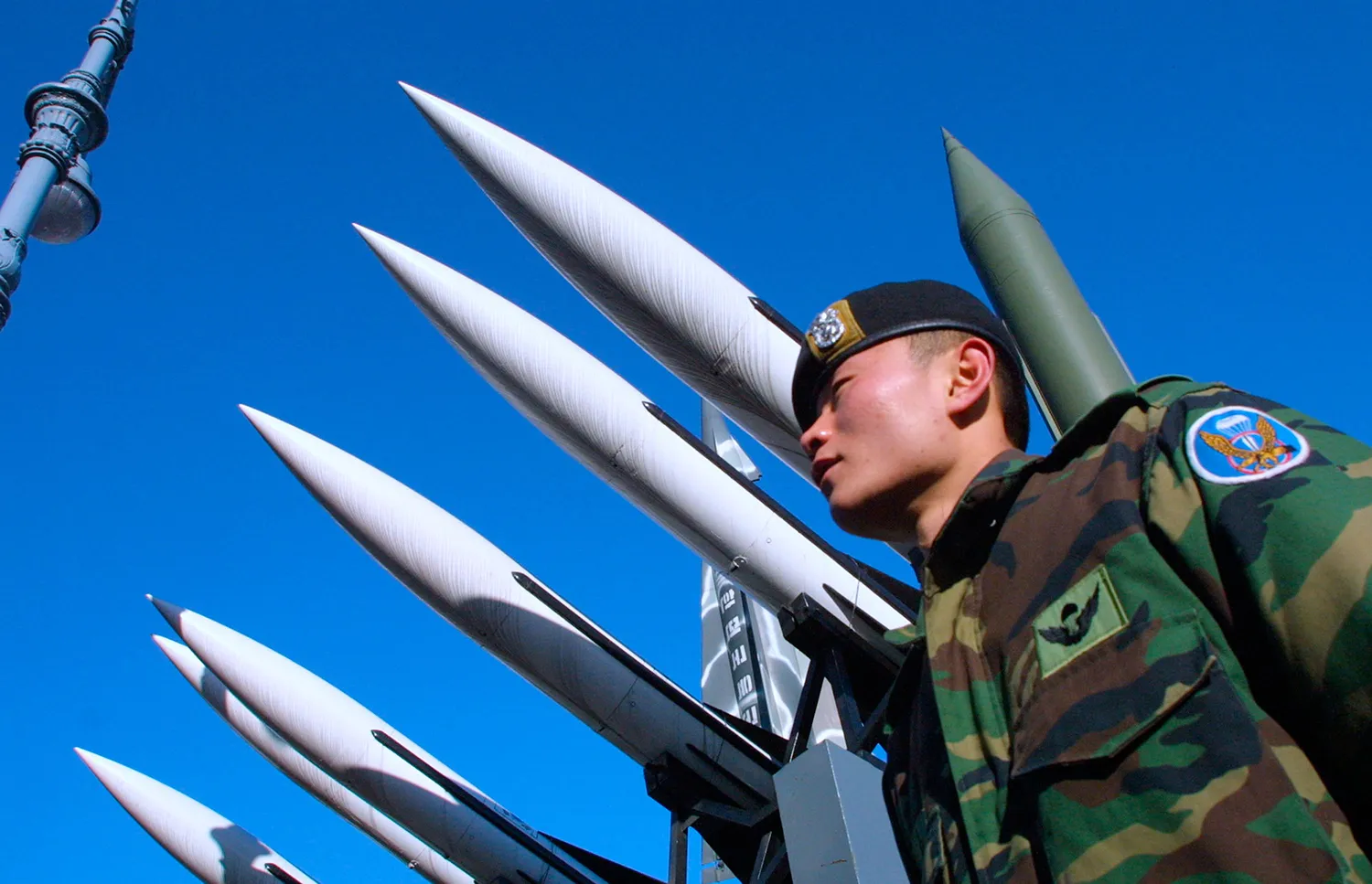
A soldier stands in front of a monument made of missiles.
A South Korean soldier stands under a display of North and South Korean missiles in Seoul on Dec. 12, 2002.Chung Sung-Jun/Getty Images
Nuclear policies tend to move slowly—which makes last year’s shifts so remarkable. But the sluggish pace of change also presents opportunities for U.S. policymakers. If the Trump administration aims to prevent allied proliferation, it has ample tools at its disposal. Washington could shore up the credibility of its alliance commitments in Europe and the Indo-Pacific. Though some trust is irreparably lost, Trump’s statements in Tokyo and Seoul last October, and at the NATO summit last summer, reassured jittery allies. Upcoming decisions on the United States’ global military posture present opportunities to convince allies that Washington remains serious about its role as guarantor of allied security.
Recent signals of support for South Korean nuclear enrichment and reprocessing raised questions about the Trump administration’s position on allied proliferation. Without alternative nuclear guarantors in the Indo-Pacific, Washington’s allies in Tokyo and Seoul may believe they need their own nuclear stockpiles. Clear declaratory policy opposing allied proliferation with reassurances of U.S. extended deterrence commitments would help alleviate confusion about where the administration stands. The White House could also reinvigorate nuclear diplomacy toward Iran, supporting the NPT as the basis of the universal nonproliferation regime.
But the Trump administration may have other plans. If the president supports, or is willing to tolerate, the prospect of nuclear proliferation by allies, a post-American nuclear order may materialize quickly, building on last year’s new nuclear pacts and extending beyond them. Such an outcome would rapidly accelerate Trump’s push to shift defense burdens to allies by diminishing their reliance on U.S. conventional and nuclear deterrence. But in doing so, it would also undercut the United States’ influence over allied policies while creating significant new nuclear risks.
If mismanaged, nuclear proliferation by allies and partners could destabilize vital regions, spur new nuclear arms races, and exacerbate nuclear security challenges among an expanding number of nuclear states. Added to these risks is the potential for new nuclear explosive tests around the world in response to a U.S. restart, which the Trump administration has said it may pursue.
The prior nuclear order, flawed as it was, bound the instability that Kennedy warned about 65 years ago. Trump told the United Nations last September that nuclear weapons “are so powerful that we just can’t ever use them.” In a new era, Washington may be less capable of guarding against just that.