
When U.S. President Donald Trump decided in 2025 to withdraw, again, from the Paris Agreement on climate change, it was not a surprise to anyone. What’s more surprising is China’s decision to stay in when it has every excuse to walk away. After all, the United States is the largest historical emitter of greenhouse gases and remains the second-largest emitter today after China. In the alternate history in which China had withdrawn, members of Congress would certainly have called for the United States to do the same.
So why does China stay in? And could it step up, even, now that the United States has abdicated global leadership on reducing carbon emissions?
The first reason China stays in the Paris Agreement is because its leaders take the facts at face value. Debates about the science of climate change, and specifically whether greenhouses gases are causing it, never took hold among a Communist Party leadership teeming with scientists and engineers. From at least the 1990s, when I first interviewed officials there, the Chinese government took the risks of climate change seriously and, in particular, the threats resulting from major floods, extreme heat, and sea-level rise in China’s low-lying and economically critical Pearl River Delta region.
Over the same period in the United States, debates raged—more in the popular press and political circles than in scientific journals—about whether greenhouse gases actually trapped heat, whether the global average temperature was rising, and whether the ever more apparent impacts were attributable to the use of fossil fuels and the release of certain chemicals versus natural phenomena such as sunspots.
Once these debates were overwhelmed by the irrefutable connection between the inexorable growth of heat-trapping greenhouse gases and rising temperatures, sea-level rise, and more frequent incidents of extreme weather, the discourse in the United States shifted again. This time, it became about the economic costs of mitigating climate change, rather than the costs of climate change itself, which have piled up.
In 2024, the last year data was collected by the U.S. government, there were 27 weather- and climate-related disaster events in the United States with losses exceeding $1 billion, for a total of $183 billion in damages that year alone. Cumulatively from 1980 to 2024, total damages tallied at $2.9 trillion, on top of the impossible-to-quantify human costs of nearly 17,000 premature deaths.
Interestingly, Chinese officials also never bought the argument maintained by some U.S. politicians that reducing emissions would cause economic harm. To the contrary, they saw clean technology as an industry of the 21st century, and that is why, back in 2010, the Chinese government designated “new energy,” “new-energy vehicles,” and “energy-efficient and emerging technologies” as three of its seven strategic emerging industries.
The Chinese government’s position is even more surprising because while the state owns all of the major fossil fuel companies in China, many of the clean tech companies are privately owned or partially owned by local governments. This means that the central government will lose the revenue it currently enjoys from fossil fuel production and usage if its state-owned firms do not innovate and transform themselves into clean energy companies.
At this point, one could argue that given China’s current global dominance in clean tech exports, it is in its self-interest to ensure the Paris Agreement endures because today Chinese firms hold many of the solutions to the climate crisis. In 2024, China accounted for 80 percent of global solar photovoltaic modules and battery cell manufacturing. And according to the International Energy Agency, China accounted for 40 percent of global electric vehicle exports that year, whereas the United States remained a net importer of EVs. Back in 2014, I argued that China may have been de facto pursuing a form of green mercantilism, even if this was not its original intention. In fact, China’s original goal was one that Americans and citizens everywhere would recognize: to create good jobs in profitable industries that are likely to grow in a climate-constrained future. This is the second reason China stays in.
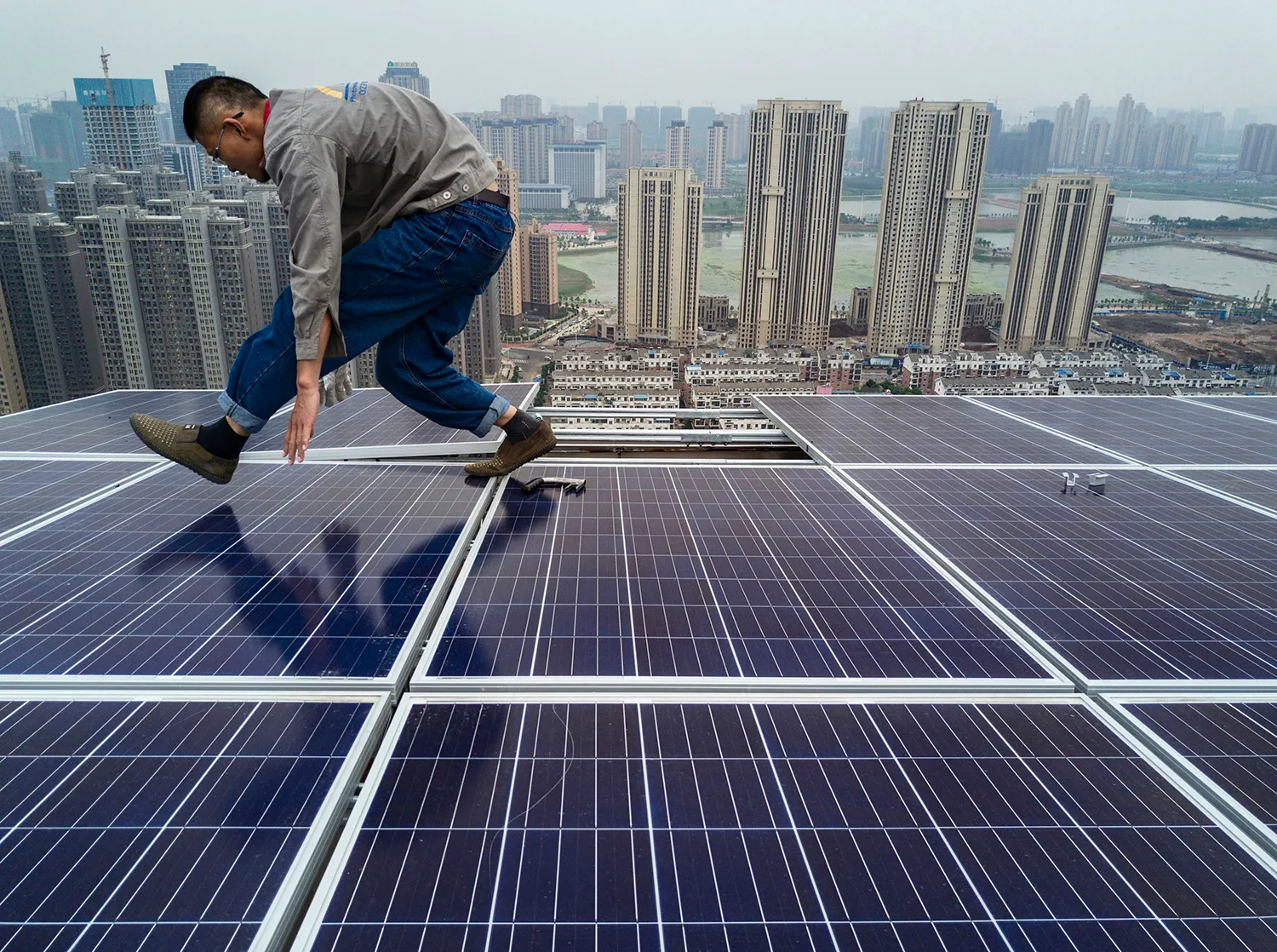
A man bends over as he walks atop solar panels atop a tall building with other skyscrapers in the background.
A man works on a solar panel project on the roof of a 47-story building in a development in Wuhan, China, on May 15, 2017. Kevin Frayer/Getty Images
The third major reason that China has stayed in the Paris Agreement is that it recognizes that it bears a major responsibility for reducing emissions as the world’s top emitter (not cumulatively, as the United States is still in first place by that metric). It knows it would face major criticism from industrialized and developing countries alike if it were to withdraw from the Paris Agreement at this stage. (Of course, such criticism bounces off Trump like hail on a metal roof.)
But just because China has three very good reasons to stick with Paris, does that mean it will fill the vacuum left by U.S. leadership in the broader fight to combat climate change? And if not China, then who will?
These are important questions because time is not our friend. According to the Intergovernmental Panel on Climate Change, achieving a likely (greater or equal to 66 percent) chance of limiting global warming to 1.5 degrees Celsius above preindustrial levels requires global carbon emissions to fall by about 45 percent by 2030 (relative to 2010 levels) and reach net zero in the next 25 years or so. In contrast, a likely chance of limiting warming to 2 degrees requires global carbon emissions to decline by roughly 25 percent by 2030 and reach net zero around the early 2070s.
The many years of delay and putting off the inevitable have made the task much harder in some ways for the generation coming of age today. The good news is that investments have paid off and the world has most of the technology it needs, at affordable prices, to get most of the way there already. The barrier is that political will is lacking globally, and the Trump administration is a big reason why.
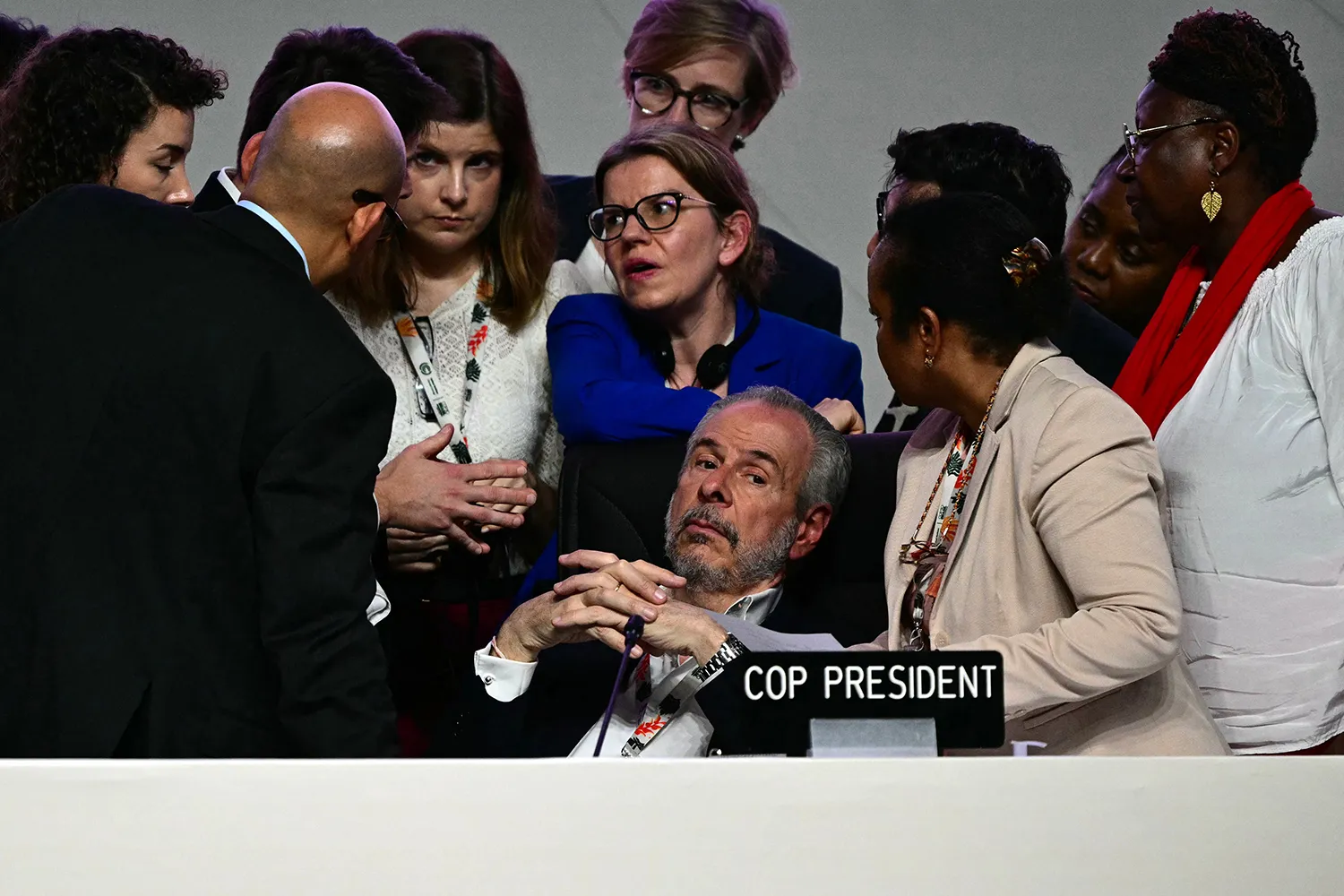
A man seated with his hands folded behind a “COP President” sign with multiple people clustered behind him talking.
COP30 President André Corrêa do Lago listens to his advisors at the U.N. Climate Change Conference in Belem, Brazil, on Nov. 22, 2025. Pablo Porciuncula/AFP via Getty Images
While it’s difficult to quantitatively measure the impact of the loss of U.S. leadership, one has only to compare and contrast the momentum between November 2014-15, in the run-up to the drafting of the Paris Agreement, and November 2024-25, ahead of the 2025 United Nations Climate Change Conference—known as COP30—to see how much ambition has waned since Trump’s reelection in 2024. In November 2014, U.S. President Barack Obama and Chinese President Xi Jinping jointly announced their intended nationally determined contributions, or NDCs, at which point China committed for the first time to limit and peak its emissions by 2030 and the United States to reductions of greenhouse gases by 26-28 percent below 2005 levels by 2025.
The differences in timing and magnitude reflected the reality that China’s per capita emissions were far lower (and still are) and that the United States was by far the largest historical emitter. After the joint announcement, other countries scrambled to submit their NDCs well in advance of the Paris negotiations so that by the time of the actual summit at the end of 2015, the targets themselves had already been essentially finalized.
This virtuous cycle of ambition back in 2015 has now turned into a near-vicious cycle of delay and weaker ambition. Ahead of COP30 in Belém, Brazil, even the European Union and China submitted their NDCs at the last minute, although both had announced nonbinding targets earlier in the fall. China’s target, while notable for being the first to cover its post-emissions peak, was anemic and not in line with its ultimate goal of carbon neutrality by 2060. Climate Action Tracker, an independent think tank, rated it “highly insufficient.”
At the start of COP30, 83 countries had still not submitted their updated NDCs, which is required to complete the global stocktake, the process enshrined in the Paris Agreement that every five years reviews the adequacy of national commitments against the global goals of the agreement. By the end of the COP, 79 countries had still failed to hand in their new NDCs, according to Climate Watch, a shocking and unprecedented outcome given that the stocktaking process was due to be completed at COP30. While no one was surprised by the lack of advance submission by oil producers Iran and Saudi Arabia—or even Argentina under President Javier Milei, a Trump acolyte—it was disappointing that India, Mexico, and South Korea were delayed in theirs. India, the world’s third-largest emitter, inexplicably deferred its NDC announcement to after the COP. Failure to submit an NDC before the start of a COP is a sign of apathy, but failure to submit at all during a COP is tantamount to a breakdown in the stocktaking process.
On a more positive note, Mexico, which had been among the first to present an NDC ahead of Paris, introduced during the COP an absolute emissions cap for 2035 and sector-specific emissions goals for the first time as well as affirmed a net-zero goal by 2050. South Korea also surprised many with its announcement that it would cut emissions by 53-61 percent from 2018 levels by 2035 and commit to phasing out the use of unabated coal. The latter pledge was remarkable because coal accounts for approximately one-third of the country’s electricity generation. (Unfortunately, it did not provide a target date.)
Also encouraging was the EU’s impressive commitment to a 90 percent reduction below 1990 levels by 2040. Due to its current challenge of shifting away from Russian gas, Europe struggled to agree on its nearer-term 2035 target but in the end submitted what was still a very strong target range. The EU’s 2040 target was adopted by the Council of the EU and will be put forward as an amendment to the European Climate Law. Any target that is enshrined in domestic law is especially robust because it becomes more binding and enforceable than is possible in an international agreement.
Yet, aside from Seoul’s new ambition and Brussels’s inexorable march toward net zero, global momentum on emissions reductions has clearly ebbed, and ambition has faltered.
Another major disappointment from COP30 relates to mobilizing climate finance to help developing countries pursue low-carbon development and to become more resilient to climate impacts. At the COP, previously agreed goals were reiterated, a new accountability framework was presented, and a road map presented, but precious few new climate finance commitments were actually made. The Brazilians proposed a new $125 billion blended finance facility that would incentivize countries to keep tropical forests such as the Amazon standing through a pay-for-performance mechanism, but pledges from just a few countries at the COP came to only $6.7 billion. Neither China nor the United States pledged any support to Brazil’s signature initiative.
Finally, rogue nations were once again empowered to disrupt the negotiations, egged on by the pro-fossil fuel Trump administration. Reverting to obstructive behavior not seen for more than a decade, Saudi Arabia and Russia led countries in objecting to a road map for the transition away from fossil fuels—a goal already agreed on two years ago at COP28 in Dubai. Indeed, their objections overwhelmed the support from 80-plus countries for such a road map and a parallel one championed by Brazilian President Luiz Inácio Lula da Silva on halting deforestation. Because the climate negotiations operate by consensus, a single country can prevent agreement on a decision or an outcome.

A man walks along the coast in a moody foggy landscapel
A person walks along sea defenses in the Welsh village of Fairbourne on Jan. 3, 2020. The coastal area in the United Kingdom is under threat from erosion amid rising seas caused by climate change. Christopher Furlong/Getty Images
Despite the malaise many felt at the conclusion of the climate negotiations in Brazil, all is not lost.
Pre-Paris, we were headed to a world of 4-5 degrees Celsius warming, and today, scientists’ best estimate is that with current national-level policies around the world, we’re looking at 2.8 degrees. While that may not seem like a huge difference, it is. Warming of 2 degrees is expected to lead to an average global sea-level rise of 20 centimeters, for example. At 4 degrees warming, more than 80 percent of global coastlines would exceed a median global sea-level rise of 0.6-2 meters, leading to chronic flooding and the displacement of millions of people from low-lying cities such as Guangzhou, Miami, Mumbai, and New Orleans. Limiting warming to 2 degrees gives individual citizens, cities, states, and countries the possibility of adapting to these profound changes, at least in relatively prosperous countries.
Innovation and market formation policies have together reduced the costs and improved the performance of clean tech, making it much easier and less expensive to reduce emissions today than 20 years ago. The prices of wind, solar, EVs, heat pumps, and grid-level storage have fallen to levels that are now accessible to regular people the world over. In the first half of 2025, renewable energy generated more electricity worldwide than coal for the first time. Some countries in Europe, including Germany and the United Kingdom, have managed to reduce their emissions by 30-50 percent below 1990 levels—compared with just 3 percent in the United States—using a mix of market-based policies such as emissions trading and carbon levies, fiscal tools such as tax incentives, and regulatory measures.
The difference between Europe’s progress on emissions and the United States’ is largely due to the pendulum swings in U.S. climate and energy policy that have occurred as the country has lurched from Democratic to Republican control and back. These swings have slowed U.S. progress in reducing emissions and undermined U.S. clean tech firms and investors counting on stable policies.
The divergence between the two parties started in the late 1990s, when House Speaker Newt Gingrich’s Republican “revolution” shifted Washington rightward. Environmental conservation was embraced by conservatives such as President George H.W. Bush, who signed the original Framework Convention on Climate Change in 1992. His son George W. Bush, who entered the White House in 2001, rejected the 1997 Kyoto Protocol, although he continued investments in clean energy innovation and signed the 2005 Energy Policy Act, which expanded tax incentives for nuclear, carbon capture and storage, and clean tech. Under Obama, new regulations were promulgated that were later repealed by Trump in his first term. And then President Joe Biden reinstated and strengthened them, passing the Inflation Reduction Act and Infrastructure Investment and Jobs Act.
Most recently, Trump once again is reversing Biden-era regulatory policies, repealing most of the provisions of the two major laws he passed, and proposing to drastically cut government investments in energy research and development. The pendulum swings are getting bigger. Nonetheless, prior investments in innovation, market forces, and business momentum may overwhelm Trump’s commitment to fossil fuels. Renewable energy accounted for more than 90 percent of new capacity additions in the United States in 2024 and was on track to do so again in 2025. According to the financial advisory firm Lazard, even after Trump’s reelection and without subsidies, renewable energy is the “most cost-competitive form of generation” in the United States.
The truth is that, with the United States being the second-largest emitter on Earth, it’s still necessary for Washington to do its fair share to reduce emissions. But beyond the sheer size of its emissions, the United States can play a disruptive force in the global arena if it encourages—or even bullies—countries to buy its fossil fuels, particularly coal and oil. By setting a poor example at home in repealing policies that were reducing emissions and causing a renaissance in U.S. clean tech manufacturing, it can induce other countries to ignore or abandon their own emissions reduction and climate finance commitments.
Europe is likely to continue to set a good example for the rest of the world in terms of its own emissions reductions and the stability of its policies. As Russia’s war in Ukraine continues and Europe steps up spending on national security, it will be difficult for it to mobilize much more climate finance than it is already committed to. Also, many countries have interpreted Europe’s planned carbon border adjustment mechanism as protectionism, even though it is attempting to address the competitiveness concerns of its own firms. This core friction will make it difficult for Europe and China together to fill the vacuum of U.S. leadership.
So, if nobody can quite take the place of the United States, what will happen to the fight against climate change?
While China’s latest emissions reduction goals were disappointing, it is likely to want to bask in the quiet approval of other countries that appreciate it is staying the course after the U.S. withdrawal. Meanwhile, it will continue to scoop up ever more global market share in solar, wind, and EVs as the United States walls itself off from the global clean tech trade. Based on its behavior at COP30 and the lack of results coming out of that conference, it seems increasingly clear that China is ready to lead in trade and in the marketplace but not in global climate negotiations. The new energy economy is taking over, and its momentum is propelling China forward, but Beijing is not leading with its NDC, nor is it committing to fill the void in multilateral climate finance that has opened with the U.S. withdrawal.
Moreover, China’s clean tech leadership is likely to be challenged because other industrialized and developing countries want to enjoy the fruits of green growth, including job creation and economic growth. If China floods the global market with inexpensive green technologies, countries that are trying to build their own clean tech industries will erect their own tariffs on China, just as the Trump administration and to a lesser extent Europe have done, with the goal of protecting domestic infant industries. We are starting to see such a trend emerge, with India first imposing countervailing anti-subsidy and safeguard duties on Chinese wind and solar in 2016 and 2018, respectively, and in September 2025 proposing three-year anti-dumping tariffs on Chinese solar cells and modules.
The question then is whether or not U.S. firms and workers are prepared to offer clean tech alternatives to Chinese suppliers; whether new clean tech firms will arise in major emerging economies such as Brazil, India, Indonesia, and South Africa; or whether the main existing clean tech challengers to China—namely, Germany, Japan, and South Korea—will band together to challenge Beijing’s dominance.
The clean tech race is on, but without leadership from the United States, global climate governance is likely to stay dysfunctional for at least the next three years.