‘We have not received any help from government authorities nor any organizations so far,’ says woman from Pakistan
Jan 05, 2026
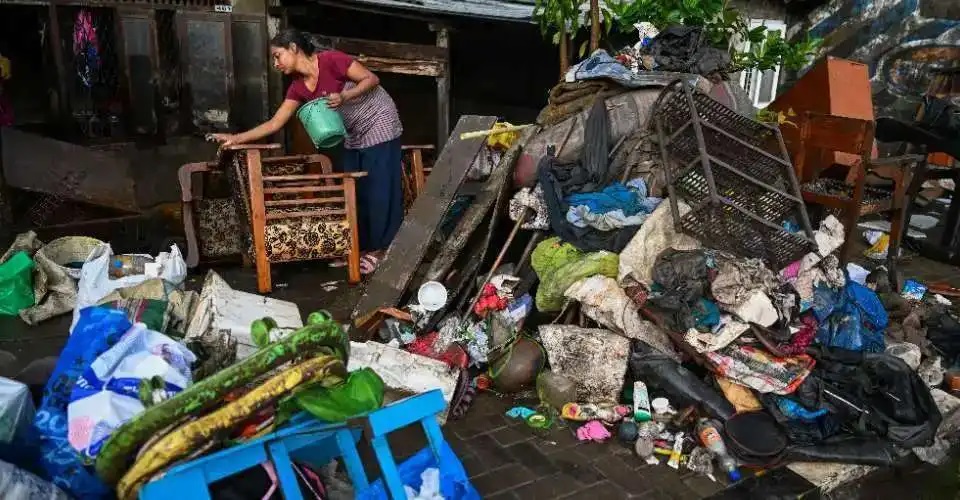
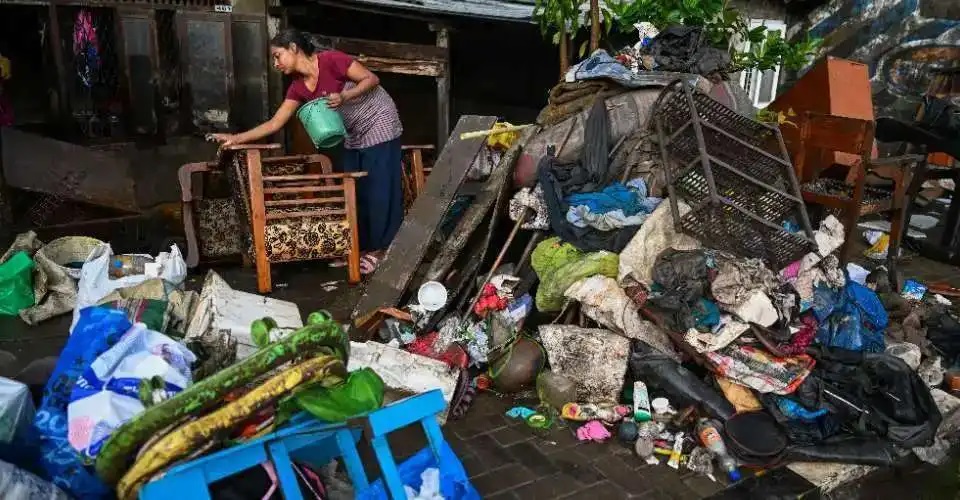
A woman removes remnants of her belongings from an inundated house following flash floods in the aftermath of Cyclone Ditwah, in Wellampitiya on the outskirts of Colombo on Dec. 5, 2025. (Photo: AFP)
By Rubatheesan Sandran
Rifat Fareedun has been living for over three years now in a rented house in Negombo, a coastal town located some 35 kilometers from Sri Lanka’s capital Colombo.
The 40-year-old refugee from Pakistan was displaced a second time when Cyclone Ditwah hit the island nation in the Indian Ocean in late November. Over a week later, she, along with her neighbors, returned to find their homes filled with debris and mud.
Her family, which includes her husband and two teenage daughters, is still struggling to put their household in order.
“We have not received any help from government authorities nor any organizations so far,” Fareedun told UCA News. “We have to depend on ourselves and relatives. It is very difficult.”
Like Fareedun and her family, hundreds of foreign refugees living in Sri Lanka find themselves struggling to recover in the aftermath of Cyclone Ditwah.
Many are surviving on meager donations of dry rations and other essential items from local religious outfits or non-governmental organizations (NGOs).
At least 180 refugee and asylum-seeking families were affected by Cyclone Ditwah, which brought severe flooding to Negombo and its surrounding areas, where a large number of them reside.
The cyclone caused loss of informal income sources, damage to homes, destruction of essential household items, and disruption to children’s education.
On Dec. 12, a small group of civil society activists visited some of the affected refugee families and asylum seekers in Negombo with some essential items and dry ration packages.
Ruki Fernando, a human rights activist involved in collecting donations and distributing them to the refugees, noted that compared to locals, refugees received less support from both the government and civil society groups.
The refugee families were not even listed among the cyclone-affected people, for whom the Sri Lankan government announced monetary relief of 25,000 rupees (US$80.83) for cleaning homes and 50,000 rupees as livelihood support.
This, it seems, was because almost all of them are supported by the United Nations agencies and NGOs.
“The refugee families should have naturally qualified for government aid as it was meant for house occupants, rather than houseowners,” Fernando told UCA News.
However, with no aid coming their way, the refugee families were left to their own devices.
Sri Lanka has long been a temporary refuge for individuals like Fareedun and her family, fleeing persecution from their countries.
But the latest circumstances caused by natural disasters like cyclones, heavy rains, and floods, have made their survival increasingly precarious in the island nation.
“For families of refugees and asylum seekers, who are already living on the margins, the impact of Cyclone Ditwah has compounded their hardship and pushed them into even deeper levels of vulnerability,” Fernando noted.
The human rights activist has issued a public appeal, urging Sri Lankans to donate funds and material goods to help refugees and asylum seekers in their country.
Sri Lanka is not a State Party to the 1951 Refugee Convention or its 1967 Protocol, which form the basis of the United Nations High Commissioner for Refugees (UNHCR)’s work and the bedrock of international refugee law.
There exists an agreement signed by its government enabling UNHCR to carry out its activities in the country.
But the UNHCR’s decision to close its office in Sri Lanka by the end of 2024 and shift to a liaison presence has significantly increased uncertainty within the refugee and asylum seeker community now.
Monthly subsistence allowances and educational support for refugee children have also been withdrawn, including for families who have been in Sri Lanka for over a decade.
As a result, refugees and asylum seekers who were already struggling to meet basic needs such as housing, food, healthcare, and education now face even greater insecurity.
Cyclone Ditwah made landfall on November 28 before moving back over the Bay of Bengal, triggering some of the most severe flooding Sri Lanka has seen since the early 2000s.
The unfolding disaster took the lives of 643 people, and over 200 are still reported missing, according to the government-run Disaster Management Centre (DMC).
An estimated 2.3 million people — more than half of them women — were living in areas flooded by cyclone, a new geospatial analysis from the United Nations Development Programme (UNDP) said.
More than 180,000 people from over 51,000 families were sheltered in 1,094 government-run safety centers as search and rescue efforts continued.
Amid such a gigantic disaster, the refugees and asylum seekers like Fareedun were completely forgotten — they are not even part of the statistics.–ucanews.com