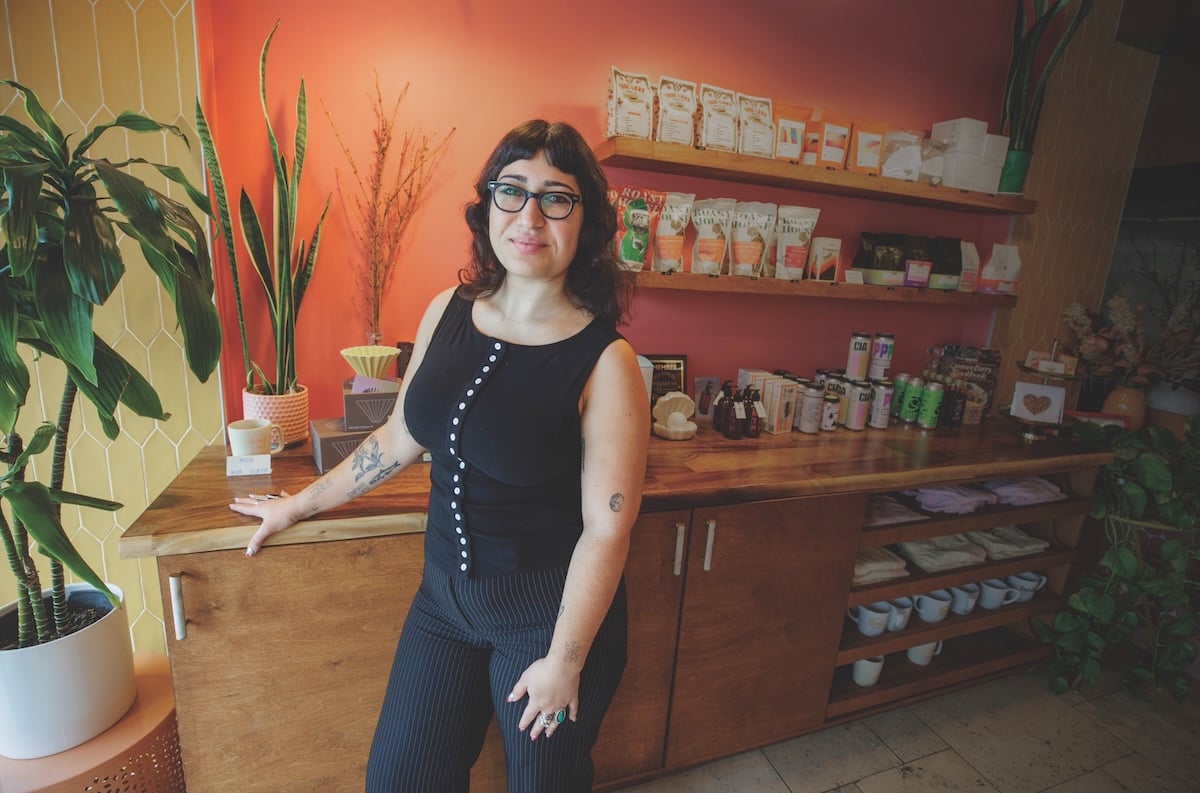
After a turbulent election year, Chef Sandra Cordero Berends looked forward to focusing on her Spanish tapas bar Xuntos in Santa Monica, after closing Gasolina Café in Woodland Hills. Then, the same day she announced her plans, wildfires swept across her neighborhood and shut down her business.
Berends was walking back from the Annenberg Community Beach House when she saw the smoke rising from Pacific Palisades last January.
“We were right there at the beach, and we just saw that smoke getting bigger and bigger so fast,” Berends said. “It was a scary time.”
The fire soon spread to a few blocks away from Xuntos, and Berends had to close shop early that day. Despite experiencing two previous fires – including the Woolsey Fire in 2018, which devastated 96,949 acres of land and misplaced 295,000 people – and evacuating twice from her home, the restaurateur was still feeling the profound impact of the Palisades Fire, emotionally and business-wise.
The sentiment is shared by many local vendors hit by the January wildfires, which ripped through Pacific Palisades and Altadena, killing at least 31 people and destroying more than 16,000 structures on its way.
The fires displaced about 150,000 residents, and with their homes gone, so did their purchases at local businesses. This caused a ripple effect throughout Los Angeles – as many businesses had to halt their operations, suspend payrolls and in some extreme cases close for good.
The fires also demolished or damaged 1,907 brick-and-mortar stores and disrupted 39,000 businesses with 230,000 employees.
“Most businesses were inside the fire perimeters, and up to half of the exposed businesses were destroyed,” a research report from UCLA’s Latino Policy and Politics Institute and Center for Neighborhood Knowledge found.
“Microbusinesses account for most losses because they dominate the local base,” the report continued.
“Small businesses are the backbone of our local economies, yet they are often invisible in disaster recovery,” said Silvia González, director of research at Latino Policy and Politics Institute.
They are not invisible to their community, however. At least not to DoorDash Inc., whose business relies on local retailers and restaurants to thrive together.
To help businesses recover, the food delivery company awarded $200,000 in grants to 20 L.A. businesses in May through their Local Business Disaster Relief Fund, with additional recipients announced in December. The grant has provided more than $2.7 million to over 250 local businesses across the nation since 2021.
“For DoorDash to be successful, all of our stakeholders need to be successful. If merchants can’t succeed, if they can’t recover from a disaster, then DoorDash will not succeed, right?” said Sueli Shaw, head of social impact at DoorDash. “When disaster strikes, we’re committed to standing by them.”
Hello, You’re Welcome, a family-owned coffee-and-doughnut shop from Pasadena, was one of the initial recipients in May.
“I think it’s really great that they’re putting the money that they make from restaurants back into these communities,” said Chef Leah Delyte Di Bernardo, who owns the shop with sister Joanne Di Bernardo and runs it with daughter Gigi Di Bernardo, “It’s actually an essential, really great way for them to give back.”
The coffee-and-doughnut shop had to close for a few weeks after the Eaton Fire, then reopened for only a few hours a day for two more months. The Di Bernardos still decided to pay their employees full-time wages, though the work hours were greatly shortened.
This was where the $10,000 DoorDash grant swooped in to help.
During the height of the fire, the doughnut shop still found itself a valuable member of the community. The Di Bernardos, who opened the shop in 2022 right as the Covid-19 pandemic came to an end, were helping residents handle their mail and distribute donations as much as they could.
“We just put all that love and care right out into our community, and we’re getting it back, and that’s really cool,” Leah Delyte Di Bernardo said almost a year later. “We don’t blink twice when others are in need.”
Xuntos also got the grant, which it used to support its team and stay afloat as the fires consumed nearby neighborhoods. Berends, who used to collaborate with charities like World Central Kitchen Inc. to make meals for medical workers during the pandemic, sprang right into action again the night after she saw the fire to support her community, one firefighter at a time.
“Right away, I called World Central Kitchen, and I was like, who needs help? Who needs to be fed?” said Berends. “I don’t like to sit around and wait to see what’s (going to) happen.”
The tapas bar ended up feeding both firefighters and evacuees who lost their homes, offering free meals for anyone between 12 p.m. and 3 p.m. each day. Berends was thankful. The program kept her staff employed and helped grow the community back.
“It was very touching,” Berends said on the experience. “And it was great to be of service.”
Xuntos is now thriving a year later. Berends shared plans for “getting out of this survival mode,” which include new items on the menu and collaborations with other local chefs on holidays.
The city has also offered similar grants to small businesses, such as the L.A. Region Small Business and Worker Relief Funds from the Los Angeles County Department of Economic Opportunity. Since January, the funds have awarded $17.7 million to 2,181 small businesses and nonprofits, plus $5.7 million to 2,892 workers.
“Fire survivors deserve nothing less than a full and fair recovery, and these funds reflect Los Angeles County’s commitment to just that,” Supervisor Lindsey Horvath, author for the motion to create the funds, said. “With $23.4 million in grants, we ensured that every eligible small business, nonprofit and worker had access to meaningful relief to move forward.”
The new year seems to bring new hopes, too. Although foot traffic has not returned to pre-fire levels, Berends is hopeful yet again going into the new year. She was happy to see a lighter spirit in people as business slowly bounced back. While full recovery will take more time, she has already noticed “a little bit of energy shift.”
The Di Bernardos were in a similarly festive spirit. Although revenue is yet to return to normal, the duo shared their gratitude for the community.
“I think for me going into [2026], I really would love to see all of us be a bit more grounded with one another, and be more responsible with the care for each other,” Leah Delyte Di Bernardo said. “By working together is how you get through tougher times.”