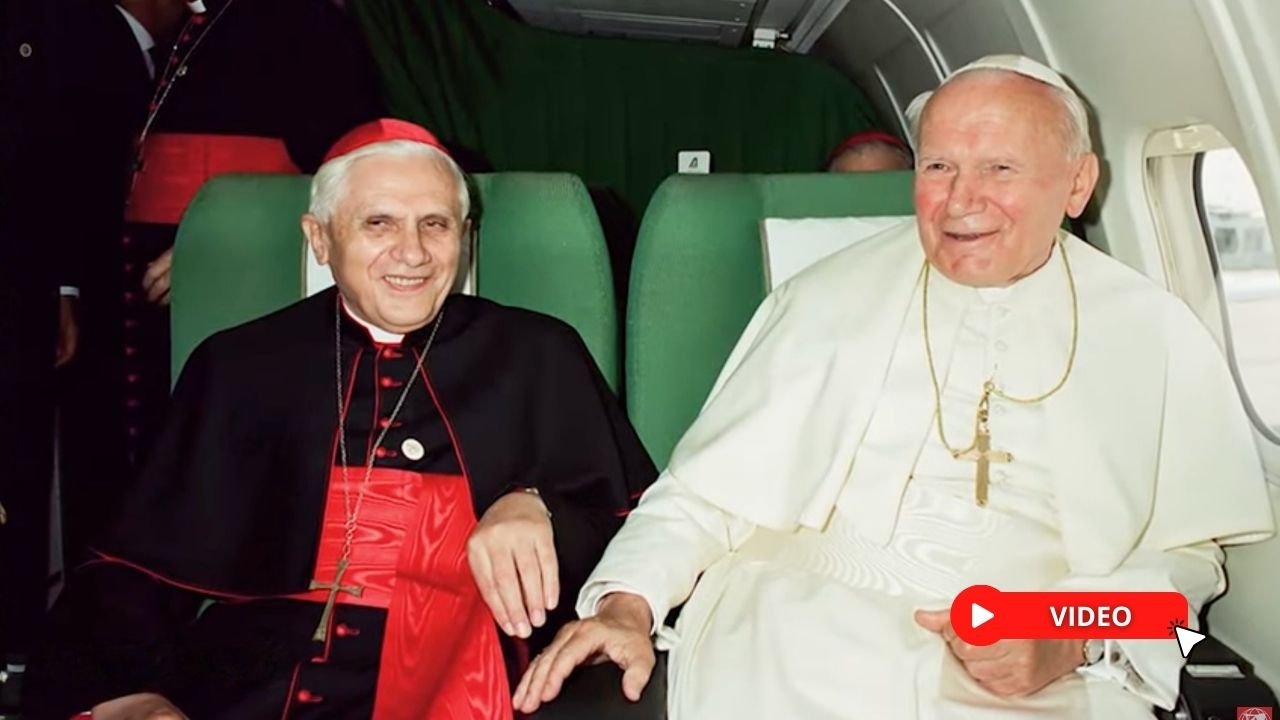
Even after the death of Pope Benedict XVI, interest in his pontificate and theology remains strong. This enduring legacy was clearly visible in July 2024, when theologians, clergy, and faithful gathered in the Bavarian town of Altötting for the second “Benedict XVI Forum.” The town, home to Germany’s most important Marian shrine, lies not far from the birthplace of Joseph Ratzinger, making it a fitting setting for reflection on his life and work.
Legacy of Pope Benedict XVIA Conscientious Obligation to Remember
One of the central figures at the forum was Archbishop Georg Gänswein, the former private secretary of Pope Benedict XVI. When asked why it was so important for him to be present in Altötting, Archbishop Gänswein responded candidly.
“Your question surprises me!” he said.
For him, participating in the forum was not merely symbolic, but a moral duty. As Archbishop Gänswein explained, “For me, it is a conscientious obligation to pass on what I experienced with him, what he left behind in terms of heritage and treasures. Because this is a great gift for Catholics, for the Church, for the people.”
The conference was organized by the association Fundatio Christiana Virtus, in cooperation with the Diocese of Passau. According to Professor Ralph Weimann, the aim was to make Pope Benedict’s theological vision accessible to today’s world.
“The reason for the conference which we are having here at Altötting is to remember the great heritage of Pope Benedict XVI,” Weimann said. “He wrote the bestseller called Introduction to Christianity and we’ve modified the title a little bit, calling it Guidance towards Christianity. People need guidance nowadays and that’s what we try to offer based on the writings of Joseph Ratzinger / Pope Benedict XVI.”
Faith, Prayer, and a Humble Life
Among the speakers was Cardinal Kurt Koch, Prefect of the Dicastery for Promoting Christian Unity, who reflected on Benedict XVI not only as a theologian, but as a man of faith.
“I miss him very well because he was a very, very kind person,” Cardinal Koch said. “He was a person with a very deep faith and he was a very intelligent theologian. And these three characteristics in one person is characteristic for Pope Benedict.”
The forum also sought to mirror Benedict’s own rhythm of life. Father Markus Graulich, Under Secretary of the Dicastery for Legislative Texts, explained that prayer was an essential part of the gathering.
“He celebrated mass every day, prayed the breviary,” Fr. Graulich said, “and so we wanted to reflect that also during the Congress, that there are times of prayer and times of discussion and times of conferences.”
Beyond theology, participants shared personal memories that revealed Benedict’s humility. Father Martin Trimpe, a former student of Professor Ratzinger, recalled his first encounters with him in the 1960s.
“I started studying theology in Münster in the summer semester of 1965 / 1966 and that’s when I got to know him,” Fr. Trimpe said. “I was very impressed by him. I noticed that he never hissed for applause. He was a man who arrived very simply on a bicycle and had an old briefcase. You could really tell that it was important to him to open up the faith to us.”
Personal Memories and an Enduring Witness
Few people knew Joseph Ratzinger as closely as Sister Christine Felder, who supported him in his household in Rome beginning in 1988. She shared a memory that captured his desire for simplicity and quiet study.
“I was with him when he was Prefect of the Congregation for the Doctrine of the Faith for 10 years,” she recalled. “I thought to myself, this anniversary has to be highlighted somehow, it’s something special. I prepared a little dessert with the number 10 on it… but on this day he came home, saw the dessert with the number 10 on it and then he said: ‘Sister Christine, that’s no reason to celebrate!’”
She added that his response revealed how deeply he longed for a life focused on theology rather than public attention.
Recounting the night of Benedict’s election as pope, Sister Christine described the dramatic moment when white smoke rose over the Vatican.
“No, but I had suspected it,” she said when asked if she had been in St. Peter’s Square. “The cardinals come out, the announcement follows… Cardinal Protodeacon Jorge Arturo Medina begins and says the name ‘Josephum’—and at that moment we had a power failure in our house and I didn’t hear the surname!”
Later, when asked whether Benedict changed after his resignation, Sister Christine was clear.
“No, he wasn’t resentful or disappointed in any way,” she said. “Basically, he was a person whom I experienced in all phases of his life, from 1988 to the end, with great peace and contentment, or perhaps I should say with great trust in God.”
Participants at the forum agreed that Benedict XVI’s voice remains relevant today. As Fr. Markus Graulich noted, “Oh, there are several of his works that remain. They are surely reread in the next years to come. And there is his great testimony, his life.”
Pilgrims echoed this conviction. Anna Diouf, a German pilgrim, summarized Benedict’s legacy in simple terms.
“I think his legacy is a deep theology that shows us that reason and faith are not opposed to each other,” she said, “and that our intellect, our brain, our head, our heart, our soul, that they all belong together.”
Even though Pope Benedict XVI spent his final years in seclusion as Pope Emeritus, his witness has not faded. Through his writings, his life, and the memories of those who knew him, his legacy continues to speak—quietly, deeply, and enduringly—to the Church and the world.
Adapted by Jacob Stein