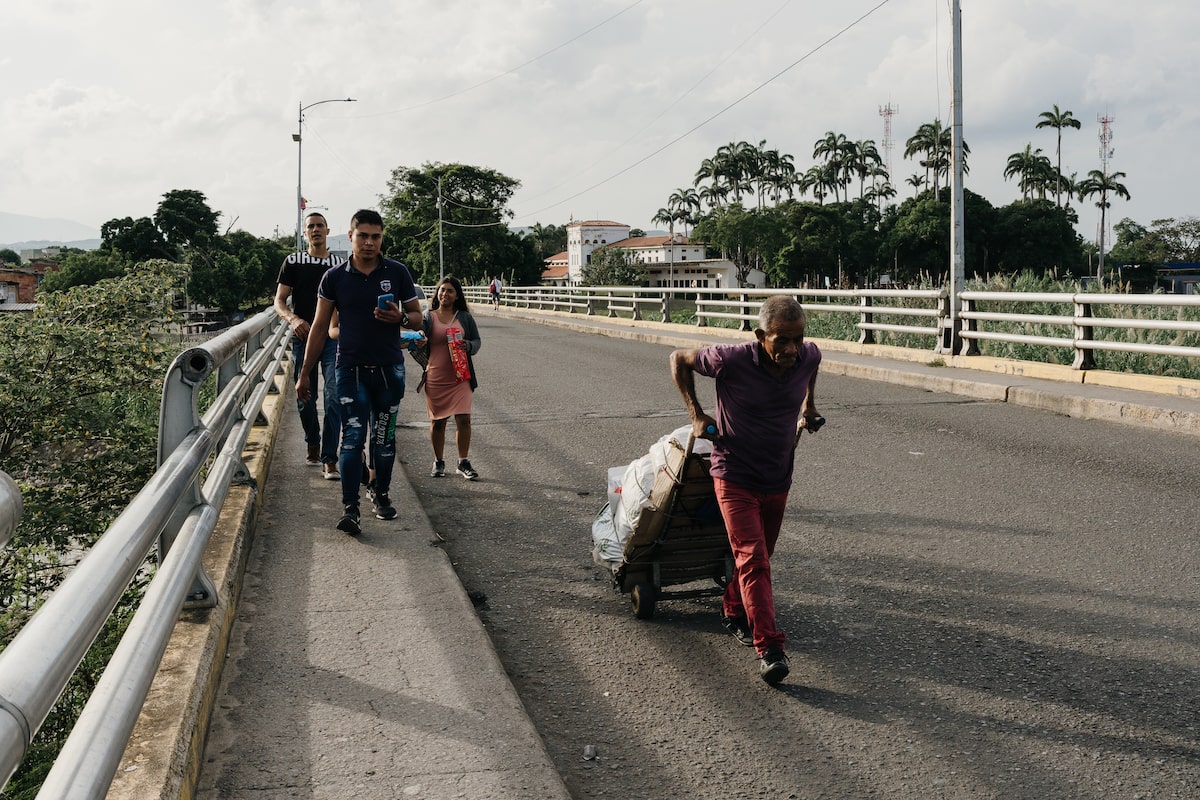
People cross from Venezuela into Colombia along the Simon Bolivar International Bridge in Cúcuta, Colombia, on Sunday.Yader Guzman/The Globe and Mail
Canada is likely to experience an influx of Venezuelans, including as asylum seekers, if the country slips into further instability after the forcing from office of Nicolás Maduro, experts in immigration and refugee policy are warning.
Toronto immigration lawyer Randy Hahn urged Ottawa to prepare for a possible influx of refugees, saying “political, economic or humanitarian crises throughout the world can translate to a stress to Canada’s immigration system.”
“Given the fluid and unpredictable circumstances in Venezuela, it would be prudent for Canadian immigration authorities to plan on the distinct possibility of an increased number of claimants from that country,” he said.
The economic and political instability in Venezuela over the last several years has already prompted the number of refugee claims from the country to increase significantly, Mr. Hahn added.
The Sunday Editorial: Venezuela’s fate is a warning for Canada
Fen Osler Hampson, president of the World Refugee & Migration Council and a professor of international relations at Carleton University, said U.S. President Donald Trump’s action in ordering the attack on Mr. Maduro as well as his clampdown on immigration and asylum claims may lead to Canada becoming a target destination for Venezuelans seeking to flee the country.
“Canada has a long, if uneven, history of stepping up when political violence in the Americas drives people from their homes, and Venezuela will be no exception if instability deepens,” he said.
In the last decade, tens of thousands of people of Venezuelan and Colombian origin have come to Canada through a mix of refugee, asylum and other immigration channels, he said.
At the end of September, 2025, the Immigration and Refugee Board, the independent tribunal that assesses asylum applications, had 2,977 claims from Venezuelans pending. Last year, about 600 new applications were referred to the IRB.
Canada could expect to see a greater influx, Prof. Hampson said, adding “Latin America’s crises have repeatedly come to Canada’s doorstep” and “Canada has a track record of opening the door, however reluctantly at first.”
Venezuelans living across Canada carry complex feelings about Maduro’s ouster
Between 1973 and 1978, Canada accepted close to 13,000 people fleeing the Pinochet dictatorship in Chile, he said. During the Central American civil wars of the 1980s, Canada took in roughly 20,000 refugees from the region. There have also been continuing arrivals from Haiti, Colombia and more recently Venezuela.
“If Venezuela tips into deeper instability, Canada should expect more refugee claims and asylum seekers, and likely higher numbers than in past Latin American crises because the United States has, in practice, shut most doors to asylum at its southern border, with possible knock‑on effects from Cuba given its dependence on Venezuelan energy under the shadow of the U.S. embargo,” he said in an e-mail.
Immigration lawyer Warda Shazadi Meighen of Landings LLP said the IRB will have to update the expert materials it consults when assessing refugee claims to reflect the dramatic developments in Venezuela. The board assesses refugee claims on an individual basis but the situation in the country, and the behaviour of the governing regime, can have a bearing on whether claims for asylum are granted or refused.
She said in 2003 and 2004, Canada had a special temporary pathway for permanent residence for Venezuelans.
“Each time there’s an issue globally, that has an impact on how we look at the whole picture,” she said.
Venezuelans in Canada cheer Maduro’s toppling, worry about what comes next
Professor Lori Wilkinson, the University of Manitoba’s Canada Research Chair in Migration Futures, said if Venezuela becomes more unstable, there is likely to be an increase in its citizens trying to come here.
But she said there is an obstacle to that taking place: The Safe Third Country Agreement with the U.S. would mean that most Venezuelans heading here via the United States would be turned away because, under the pact, they have to claim asylum in the first country they arrive in. She said most seeking to come here to claim asylum would probably try to fly but may not be granted a visa to come here.
She said if the situation in Venezuela deteriorates, Ottawa should look at re-establishing a special immigration program for Venezuelans.
Global Affairs said in a statement Sunday that it is “closely monitoring the situation in Venezuela and remains in contact with relevant partners.”
Canada’s embassy in Caracas, the Venezuelan capital, has been closed since 2019, limiting the ability to provide consular help to Canadians there.
“Canada stands ready to assist Canadians in Venezuela in need through our consular officials and embassy in Bogotá, Colombia,” said Clémence Grevey, a Global Affairs spokesperson.
How the Monroe Doctrine factors into Maduro’s arrest
But she said plans were not being made to evacuate Canadians or help them book flights.
“Assisted departures are an option of last resort, when all means of personal and commercial transportation have been exhausted,” she said.
She said Global Affairs is not aware of any Canadian citizens injured in the U.S. military action that accompanied the seizure of Venezuela’s president and his wife.
There were 795 Canadians registered with Global Affairs as living in Venezuela as of Jan. 4, but this may be an underestimate as registration is voluntary.
Ottawa updated its travel advice to Venezuela after this weekend’s developments. Global Affairs has been advising Canadians to avoid all travel to Venezuela since 2019.
The advice warns that the “current situation in Venezuela is tense and could escalate quickly. Borders and airspace could close at short notice. Several airlines have suspended flights to and from Venezuela, reducing options to leave the country.”
It is advising Canadians who do travel there to shelter in place and ensure sufficient supply of food, water and other necessities.