Data extracted on 8 December 2025.
Planned article update: March 2026.
Highlights
Between July and September 2025, 165 350 first-time asylum applicants (non-EU citizens) applied for international protection in the EU countries, a decrease of 25.9% compared with the same period in 2024.
Venezuelans lodged 18 595 applications between July and September 2025 and accounted for 11.2% of the total number of first-time asylum applicants in EU countries.
In September 2025, 1 775 unaccompanied minors applied for asylum for the first time in the EU, with the highest numbers coming from Eritrea, ahead of Afghanistan and Somalia.
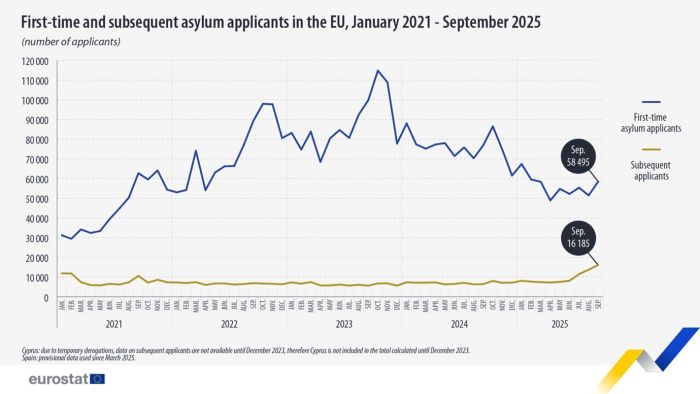
 First-time and subsequent asylum applicants in the EU, January 2021 – September 2025
Source: Eurostat migr_asyappctzm
This article describes recent developments in relation to the number of asylum applicants in the European Union (EU).
Main trends in the number of asylum applicants
The number of first-time asylum applicants (non-EU citizens) reached its peak in October 2023, when almost 115 000 people lodged applications for international protection. Since then, a decreasing trend in the numbers of first-time asylum applicants has been observed at the EU level (Figure 1).
Between July and September 2025, the number of first-time asylum applicants ranged from 55 390 people in July to 58 495 people in September, indicating a slight increase in applications.
On a quarterly basis, there were 165 350 first-time asylum applicants in the EU countries in Q3 2025, an increase of 6.0% compared with Q2 2025 (155 950). In relation to the same period in 2024, this represented a 25.9% decrease (down from 223 030).
In Q3 2025, there were 41 470 subsequent applicants, showing an increase of 80.3% compared with Q2 of 2025 (23 000). In relation to the same period in 2024, this represented a 108.5% increase (up from 19 890).
In September 2025, men aged 18-34 years accounted for 36.7% of the total number of first-time asylum applicants (Figure 2). Regarding children aged less than 14 years, 50.9% were boys and 49.0% were girls. Most children aged 14-17 years were boys (68.4%) and 31.5% were girls.
The EU total ratio of first-time asylum applicants in September 2025 was 13.0 per 100 000 people (Figure 3).
Compared with the population of each EU country, since June 2024, the highest number of first-time asylum applicants has been registered in Greece. In September 2025, the highest rates of first-time applicants per 100 000 people continued to be recorded in Greece (51.9), ahead of Cyprus (26.8) and Ireland (24.1).
Where do asylum applicants come from?
Venezuelans and Afghans remained the largest groups of people seeking asylum in September 2025.
Venezuelans lodged 6 760 applications, showing an increase of 30.5% compared with August 2025 (5 180). In relation to the same period in 2024, this represented a 23.1% increase (up from 5 490) (Figure 4). On a quarterly basis, Venezuelans lodged 18 595 applications between July and September 2025 and accounted for 11.2% of the total number of first-time asylum applicants in reporting EU countries.
Since mid-2023, the number of applications submitted by Afghans has generally been on a downward trend. However, in September 2025, Afghans lodged 6 460 applications representing a rise of 26.4% compared with September 2024 (5 110).
The third largest group of asylum applicants were Syrians, which lodged 3 135 applications in September 2025. Compared with September 2024, there was a sharp drop of 78.7% (14 725).
Where do asylum applicants make their application?
Spain, Italy, France and Germany continued to receive the highest number of first-time asylum applicants. In September 2025, these 4 countries accounted for 72.1% of all first-time applicants in the EU (Map 1).
Map 1: First-time asylum applications in reporting countries in September 2025
Source: Eurostat migr_asyappctzm
From May 2024, the number of first-time asylum applicants decreased compared with the same month of the previous year (Figure 5). The largest drop was recorded in April 2025 (36.7% less compared with April 2024).
Where do unaccompanied minors come from?
In September 2025, 1 775 unaccompanied minors applied for asylum for the first time in 1 of the 26 EU countries for which data is available. The highest numbers came from Eritrea (295 persons, or 16.6% of total), ahead of Afghanistan (230, or 13.0%) and Somalia (225, or 12.7%) (Figure 6).
Where do unaccompanied minors apply for asylum?
In September 2025, the Netherlands received the highest number of applications from unaccompanied minors (440 applications, 24.8% of the total). Germany, which came second, received 265 applications, followed by Spain with 235 applications (Figure 7).
Applications under the accelerated procedure
Since late 2023, France, Italy and Greece process the highest numbers of applications under an accelerated procedure.
In September 2025, France processed 4 545 such applications, ahead of Italy (4 475) and Greece (1 025).
Pending applications
In September 2025, Germany (325 150, 26.4% of the total) maintained the highest number of pending applications, ahead of Spain (262 175, 21.3%), Italy (214 795, 17.4%) and France (158 600, 12.9%) (Map 2).
At the EU level, there were 1.23 million applications awaiting decisions in September 2025 (Figure 9), an increase of 0.5% compared with August 2025. In relation to the same period in 2024, this represented an increase of 0.2%.
Map 2: Pending asylum applications at the end of September 2025
Source: Eurostat migr_asypenctzm
Data sources
The statistics are based on administrative sources and are provided to Eurostat by statistical authorities, ministries of the interior or related immigration agencies in the EU countries and EFTA countries.
Data on asylum applications are collected monthly. They are based entirely on relevant administrative sources, and are supplied in accordance with the provisions of Article 4 of Regulation (EC) 862/2007 on Community statistics on migration and international protection.
Statistics on asylum applicants considered to be unaccompanied minors presented in this article refer to the age accepted by the national authorities. However, this is before the age assessment procedure is carried out/completed (i.e. it refers to the age as claimed by the applicant).
Limitations on data availability affecting the information presented in this article:
Denmark: data on applications processed under the accelerated procedure, definition differs. Cyprus: due to temporary derogations data on subsequent applications and unaccompanied minors and applications were not available until December 2023, therefore Cyprus was not included in the EU aggregates calculated until December 2023. Spain: provisional data used since March 2025. Poland: data on unaccompanied minors are not available. EU aggregates have been computed based on available data. France: data for unaccompanied minors are estimated. Iceland: data are not available since July 2025.
Data presented in this publication are rounded to the nearest 5.
Context
The 1951 Geneva Convention relating to the status of refugees (as amended by the 1967 New York Protocol) has, for over 70 years, defined who is a refugee, and laid down a common approach towards refugees, which has been one of the cornerstones for the development of a common asylum system within the EU. Since 1999, the EU has worked towards creating a common European asylum regime in accordance with the Geneva Convention and other applicable international instruments. The Directorate-General Migration and Home Affairs (DG HOME) is responsible for developing EU policies on asylum.
The Pact on Migration and Asylum was adopted by the European Parliament in April 2024 and by the Council in May 2024. This Pact provides a comprehensive approach that delivers a common European response to migration. It allows the EU to manage migration in a fair and sustainable way, ensuring solidarity between countries while also providing certainty and clarity for people arriving in the EU and protecting their fundamental rights. The Pact on Migration and Asylum will ensure that countries share the effort responsibly, showing solidarity with the ones that protect our external borders and with those facing particular migratory pressure, while preventing irregular migration to the EU. The Pact also gives the EU and its countries the tools to react rapidly in situations of crisis, when countries are faced with large numbers of arrivals or when a third-country or non-State entity tries to instrumentalise migrants in order to destabilise the Union.
The main legal instruments on asylum are:
Eurodac Regulation (EU) 2024/1358 of the European Parliament and of the Council of 14 May 2024 on the establishment of ‘Eurodac’ for the comparison of biometric data in order to effectively apply Regulations (EU) 2024/1351 and (EU) 2024/1350 of the European Parliament and of the Council and Council Directive 2001/55/EC and to identify illegally staying third-country nationals and stateless persons and on requests for the comparison with Eurodac data by EU countries’ law enforcement authorities and Europol for law enforcement purposes, amending Regulations (EU) 2018/1240 and (EU) 2019/818 of the European Parliament and of the Council and repealing Regulation (EU) No 603/2013 of the European Parliament and of the Council; Screening Regulation (EU) 2024/1356 of the European Parliament and of the Council of 14 May 2024 introducing the screening of third-country nationals at the external borders and amending Regulations (EC) No 767/2008, (EU) 2017/2226, (EU) 2018/1240 and (EU) 2019/817; Qualification Regulation (EU) 2024/1347 of the European Parliament and of the Council of 14 May 2024 on standards for the qualification of third-country nationals or stateless persons as beneficiaries of international protection, for a uniform status for refugees or for persons eligible for subsidiary protection and for the content of the protection granted, amending Council Directive 2003/109/EC and repealing Directive 2011/95/EU of the European Parliament and of the Council;
In May 2010, the European Commission presented an action plan for unaccompanied minors (COM(2010) 213 final), who are regarded as the most exposed and vulnerable victims of migration. This plan aims to set up a coordinated approach and commits all EU countries to grant high standards of reception, protection and integration for unaccompanied minors. In December 2011, the European Commission adopted a Communication on ‘Enhanced intra-EU solidarity in the field of asylum‘ (COM(2011) 835 final). This provided proposals to reinforce practical, technical and financial cooperation, moving towards a better allocation of responsibilities and improved governance of the asylum system in the EU, namely through:
introducing an evaluation and early warning mechanism to detect and address emerging problems; making the supporting role of the European Union Agency for Asylum (EUAA) more effective; increasing the amount of funds available and making these more flexible, taking into account significant fluctuations in the number of asylum seekers; developing and encouraging the relocation of beneficiaries of international protection between different EU countries. Explore further Other articles Database Temporary protection (migr_asytp) Decisions granting temporary protection by citizenship, age and sex – quarterly data (migr_asytpfq) First instance decisions granting temporary protection by citizenship, age and sex – monthly data (migr_asytpfm) Beneficiaries of temporary protection at the end of the month by citizenship, age and sex – monthly data (migr_asytpsm) Decisions withdrawing temporary protection by citizenship and reason – quarterly data (migr_asytpwq) Temporary protection of unaccompanied minors (migr_asyumtp) Decisions granting temporary protection to unaccompanied minors by citizenship, age and sex – quarterly data (migr_asyumtpfq) Decisions granting temporary protection to unaccompanied minors by citizenship, age and sex – monthly data (migr_asyumtpfm) Unaccompanied minors benefiting from temporary protection at the end of the month by citizenship, age and sex – monthly data (migr_asyumtpsm) Decisions withdrawing temporary protection to unaccompanied minors by citizenship and reason – quarterly data (migr_asyumtpwq) Applications (migr_asyapp) Asylum applicants by type of applicant, citizenship, age and sex – annual aggregated data (migr_asyappctza) Asylum applicants by type of applicant, citizenship, age and sex – monthly data (migr_asyappctzm) Persons with asylum applications pending at the end of the month by citizenship, age and sex – monthly data (migr_asypenctzm) Asylum applications withdrawn by citizenship, age, sex and type of withdrawal – annual aggregated data (migr_asywitha) Asylum applications withdrawn by citizenship, age, sex and type of withdrawal – monthly data (migr_asywithm) Asylum applicants having had their applications processed under the accelerated procedure, by age, sex and citizenship – monthly data (migr_asyaccm) Applicants having benefited from material reception conditions at the end of the reference year – annual data (migr_asymrca) Applications of unaccompanied minors (migr_asyum) Asylum applicants considered to be unaccompanied minors by citizenship, age and sex – annual data (migr_asyunaa) Unaccompanied minor asylum applicants by type of applicant, citizenship, age and sex – annual aggregated data (migr_asyumacta) Unaccompanied minors with asylum applications pending at the end of the month by citizenship, age and sex – monthly data (migr_asyumpctm) Asylum applications of unaccompanied minors withdrawn by citizenship, age, sex and type of withdrawal – annual aggregated data (migr_asyumwita) Asylum applications of unaccompanied minors withdrawn by citizenship, age, sex and type of withdrawal – monthly data (migr_asyumwitm) Unaccompanied minor asylum applicants having had their applications processed under the accelerated procedure, by age, sex and citizenship – monthly data (migr_asyumaccm) Decisions on applications and resettlement (migr_asydec) First instance decisions on applications by citizenship, age and sex – annual aggregated data (migr_asydcfsta) First instance decisions on applications by citizenship, age and sex – quarterly data (migr_asydcftq) Decisions withdrawing status granted at first instance decision by type of status withdrawn, citizenship and reason – annual aggregated data (migr_asywitfsta) Decisions withdrawing status granted at first instance decision by type of status withdrawn, citizenship and reason – quarterly data (migr_asywitfstq) Final decisions in appeal or review on applications by citizenship, age and sex – annual data (migr_asydcfina) Decisions withdrawing status granted as final decision in appeal or review by type of status withdrawn – annual data (asywitfina) Resettled persons by age, sex and citizenship – annual data (rounded) (migr_asyresa) Resettled persons by age, sex, citizenship and country of previous residence – annual data (migr_asyrescra) Resettled persons by age, sex, citizenship and decision – annual data (migr_asyresda) Resettled persons by age, sex, citizenship and resettlement framework – annual data (migr_asyrelfa) Decisions on applications of unaccompanied minors and resettlement of unaccompanied minors (migr_asydum) First instance decisions on applications of unaccompanied minors by citizenship, age and sex – annual aggregated data (migr_asyumdcfa) First instance decisions on applications of unaccompanied minors by citizenship, age and sex – quarterly data (migr_asyumdcfq) Decisions withdrawing status granted at first instance decision to an unaccompanied minor by type of status withdrawn, citizenship and reason – annual aggregated data (migr_asyumwifa) Decisions withdrawing status granted at first instance decision to an unaccompanied minor by type of status withdrawn, citizenship and reason – quarterly data (migr_asyumwifq) Final decisions in appeal or review on applications of unaccompanied minors by citizenship, age and sex – annual data (migr_asyumdcfna) Decisions withdrawing status granted as final decision in appeal or review to unaccompanied minors by type of status withdrawn, citizenship and reason – annual data (migr_asyumwfna) Resettled unaccompanied minors by age, sex and citizenship – annual data (rounded) (migr_asyumresa) Thematic section Publications Selected datasets Asylum and new asylum applicants – monthly data (tps00189) Persons with asylum applications pending at the end of the month – monthly data (tps00190) Asylum and new asylum applicants – annual aggregated data (tps00191) First instance decisions on applications by type of decision – annual aggregated data (tps00192) Final decisions on applications – annual data (tps00193) Asylum applicants considered to be unaccompanied minors – annual data (tps00194) Resettled persons – annual data (tps00195) Methodology External links Visualisation