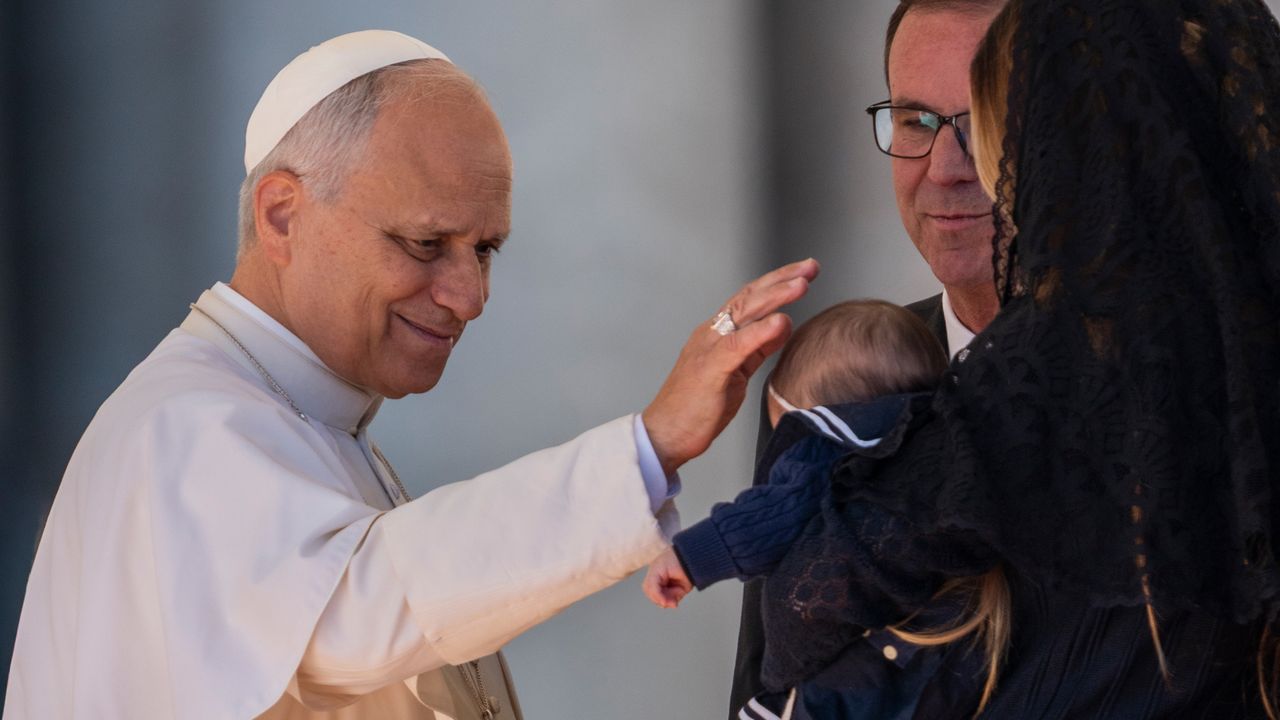
The summer had the feel of a soft opening to Leo’s pontificate, in part because many papal events had been arranged before he was elected. In Rome, he arrived by helicopter at the Jubilee of Youth, which drew about a million young Catholics to a park south of the city, and he presided over the canonization of the “first millennial saint,” Carlo Acutis, an Italian teen-ager known as “God’s influencer,” who, before his death, from leukemia, used digital media to promote Catholic values. Leo took part in a Vatican conference on the climate emergency, where Arnold Schwarzenegger, a guest speaker, called him an “action hero” because, as soon as he became Pope, he “ordered the Vatican to put solar panels on the buildings.” He met with people who had a wide range of viewpoints, including Ben Shapiro, the conservative podcaster; Henry Louis Gates, Jr., the host of the PBS series “Finding Your Roots,” who presented him with the Prevost family tree; Father James Martin, a Jesuit who advocates “building bridges” with L.G.B.T.Q. Catholics; and Cardinal Raymond Burke, a “rad-trad” advocate for the restoration of the Latin Mass.
Then, on September 30th, a news correspondent for EWTN, a Catholic broadcaster, asked Leo about a controversy in Chicago: the archbishop, Cardinal Blase Cupich, planned to give an award to Senator Dick Durbin for his long support of migrants’ rights. Traditionalists pointed out that Durbin, a Democrat, has also long supported abortion rights. The Pope replied, “Someone who says ‘I’m against abortion,’ but says, ‘I’m in favor of the death penalty’ is not really pro-life. Someone who says ‘I’m against abortion,’ but ‘I’m in agreement with the inhuman treatment of immigrants who are in the United States’—I don’t know if that’s pro-life. So they are very complex issues. I don’t know if anyone has all the truth on them, but I would ask first and foremost that there’d be greater respect for one another.”
Some saw those remarks as a rebuke of the White House (“Holy Smackdown,” the Daily Beast announced, “Pope Leo Trashes Trump’s Signature Policy”), others as Leo giving cover to Cardinal Cupich. (Because of the controversy, Durbin decided not to accept the award.) The website Where Peter Is, which focusses on the Papacy, saw it as a sign of “Leo’s unifying, de-escalation-oriented priorities.” It was, in other words, an instance of Leo going about the Papacy the way his brother said he would—playing it down the middle.
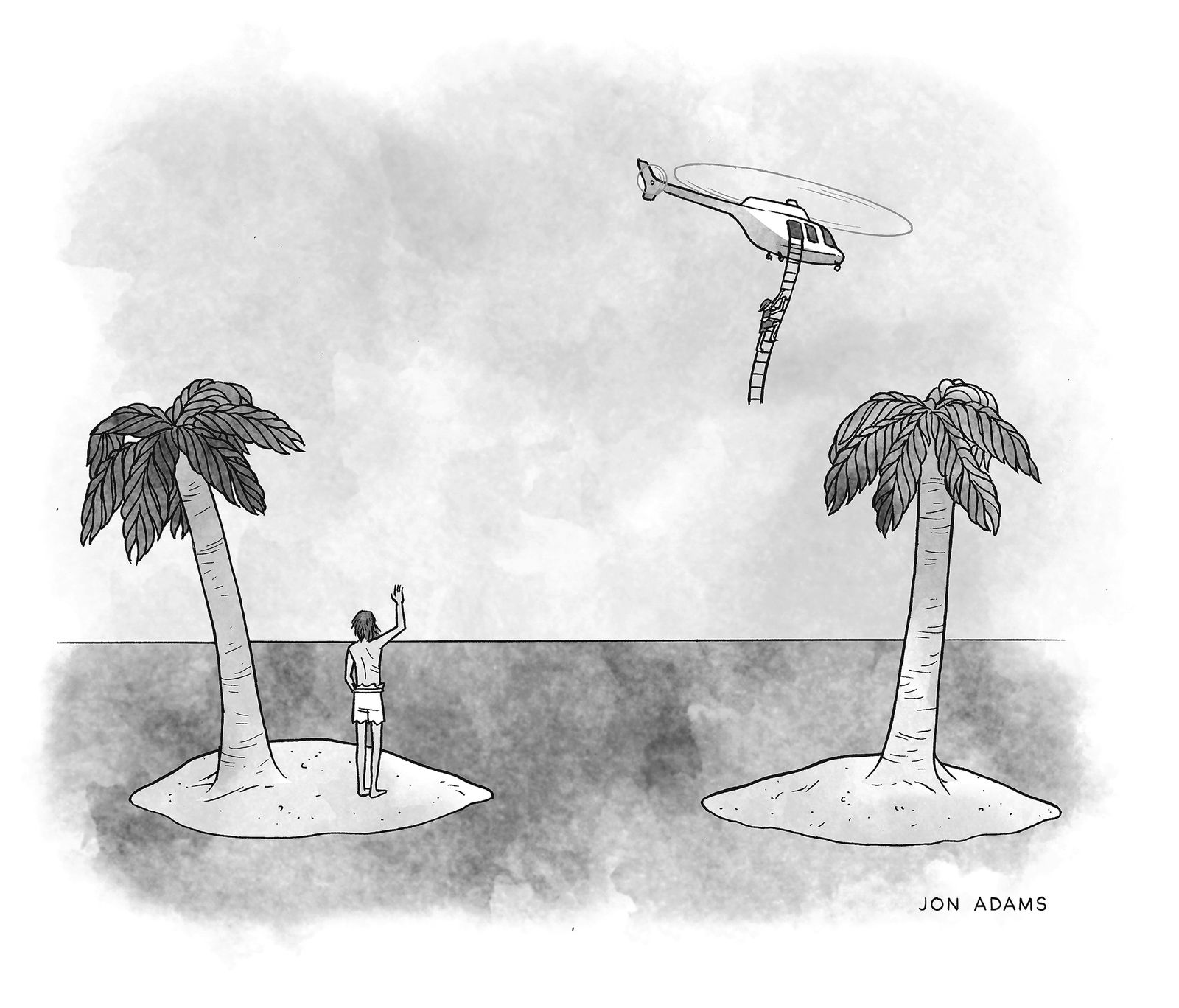
“I’m so happy for you.”
Cartoon by Jon Adams
“I’m just a month and a half into this new mission,” Leo told a friend in an e-mail in July. A man who a decade ago was presiding over pilgrimages in a remote Peruvian town is now leading a global religion with more than a billion followers, and will have to contend with rising authoritarianism and Christian nationalism, a Church divided between progressives and conservatives, clashes over immigration, grinding wars, and a climate crisis rapidly growing more intense. The Pope’s life, since he entered a seminary high school in 1969, as he turned fourteen, has been a series of assignments, each with clear objectives. The question now is: What is the papal mission, as he sees it?
In 1955, when Richard J. Daley, who went to Mass every morning, became the mayor of Chicago, there were 1.7 million Catholics among the city’s population of some four million people. Irish, Italian, German, and Polish communities each worshipped—in Latin—at their own churches, often within blocks of one another. Beginning in the nineteen-thirties, the archdiocese, led by Cardinal George Mundelein, had been allied with the Democratic Party and labor unions, and had promoted social activism through groups such as Young Christian Workers and the Catholic Interracial Council. During the postwar years, though, tens of thousands of white parishioners chose to move to new enclaves in the city and the suburbs as, owing to the Great Migration, the Black population, long sequestered on the South Side, grew and expanded into other neighborhoods.
Robert Prevost’s parents—Louis Prevost, from the South Side, and Mildred Martinez, from the North Side—met while pursuing graduate degrees in education at DePaul, a Catholic university in the Lincoln Park neighborhood. After marrying, they moved to Dolton, a mostly white suburb that was thriving along with the nearby steel mills and refineries. He worked as a school principal and superintendent; she was a librarian at Mendel Catholic, a high school run by the Augustinian order, a community founded in 1244 and named for St. Augustine, a fourth-century Bishop of Hippo and the author of “Confessions.”
The Prevosts raised their three sons in Dolton; Rob was born there in 1955. The boys rode bikes and played baseball with the kids on the block, John told reporters. They knew that their mother’s father had been born in Haiti, he said, but “we never really talked about it.” They were altar boys at St. Mary of the Assumption, often serving at six-thirty Mass before school, a diligence that the priests rewarded by taking them to Sox games. A Spanish Augustinian named Fidel Rodriguez, whom their father had met through a local charity effort involving migrant workers, sometimes came to supper, dressed in the black habit worn by members of the order. “He had quite an impact on me,” Robert Prevost said, years later. “I never forgot it, in terms of his sense of humor, his generosity, his willingness to serve these people who were, if you will, kind of down and out, and just the way he reached out to them.” Rob practiced celebrating the Mass by draping a sheet over an ironing board in the basement and consecrating Necco wafers. “He was going to be a priest,” John said. “Period. End of discussion.”