
Two years of preparation. Hundreds of mock rosters and meetings.
And then there comes the day when players get the call. Some because a lifelong dream came true. Others got the worst call of all.
The range of emotions facing Sweden coach Sam Hallam was at extremes last week.
“You go between heaven and hell in that process,” Hallam told The Athletic over the phone from Stockholm on Sunday. “You call some guys and you give them one of the worst calls they’ve had in their careers, maybe — that they’re not on the team. But then you get to call other guys to tell them they’re on the team.”
That part was tremendous. It all means so much. To the coaches, too.
Hallam himself can’t help but think ahead to what it’s going to be like coaching the Olympics in Milan.
“I would lie if I said there wasn’t any butterflies,” Hallam said. “With the Olympics every four years, you’re happy if you get one chance. That goes for me as a coach and my staff. That goes for the players, too. Most of our players have never played in the Olympics. Some are in the age where this may be the only chance in their career. So, I would say that we’re pumped. We know the opportunity that we’re given.
“As I told the players, ‘This is maybe the chance of a lifetime. Let’s be ready to be the best versions of ourselves for these two weeks.’”
Unlike other countries, in Sweden it’s the coach who makes the final roster decisions. Hallam said the process started two years ago at the IIHF World Championship. The Swedes had a pretty good team there, winning bronze, and started building a preliminary roadmap to Milan.
“And then with the 4 Nations just 11 months ago, the analysis from that was the true start for the Olympic team,” Hallam said. “All analysis from the 4 Nations was looking ahead to the Olympics, both in looking at how we play and what we need to maybe improve, and of course picking the team.”
Since start of the NHL season, Sweden general manager Josef Boumedienne and player personnel consultant Alexander Steen have combined with Hallam to split up NHL games to watch while also having weekly meetings, doing mock lineups, etc.
“It’s been a lot of work, but it’s probably one of the best things you can do in hockey, is taking a national team to the Olympics,” said Hallam, who has NHL coaching aspirations down the road.
What’s also evident is that as much as U.S. and Canadian team-builders have talked a lot about the 4 Nations Face-Off shaping their thought process, Sweden and Finland may have learned even more from the first best-on-best event in a decade, being reintroduced to hockey on smaller NHL ice.
“Coming into 4 Nations, we were coming in pretty blind, because we hadn’t had a system built for playing on the smaller ice for so many years,” Hallam confessed. “We were putting a system together that we know would work on the bigger ice, but we weren’t really sure what parts we needed to adapt for the NHL rink size. So we learned so much by our own system — what we needed to tweak.”
The Swedes were an overtime goal against Canada away from being in the championship game, so there was a lot they liked.
“We did some really good things in those games at 4 Nations, but we also think there’s another level,” Hallam said.
But it’s the technical part on the smaller ice that really hit home.
“System-wise, the forecheck,” Hallam said. “The neutral zone, it was so tight. It was so small. There was no room out there. It was so hard to make plays and find ice. So your forecheck needs to be really good.”
So how did that influence roster selection?
“I think it’s going to show more when you see how we set up our team in Milan,” Hallam said. “We learned a lot. Which kind of players we can use, maybe, in different roles. But I mean, I know Canada, U.S. and Finland learned a lot from that tournament, too. Just the pace of the game. Every player has to be ready to play in that high pace. If you lose a puck, it doesn’t matter what line you’re playing against — the player that stole the puck from you is going to be really good. So let’s make sure you have that puck discipline.”
Remember how low-scoring key games were at the Sochi Olympics in 2014, the last time NHL players participated? There is little free ice. It’s something that’s been apparent in what you hear from Team USA and Team Canada and certainly from Hallam. It clearly influenced the balance he sought on his roster.
“Absolutely,” Hallam said. “Maybe the most important balance part for us was making sure that we have a lot of forwards who can play center. As the tournament starts, if we have injuries, you can’t replace (injured players). You want to make sure you have a strong center-forward core, and I’m confident we have a group of six, seven guys who can play center for us. And we have some guys who usually play center who can play on the wing. Again, just to make sure that we have that stability and depth.”
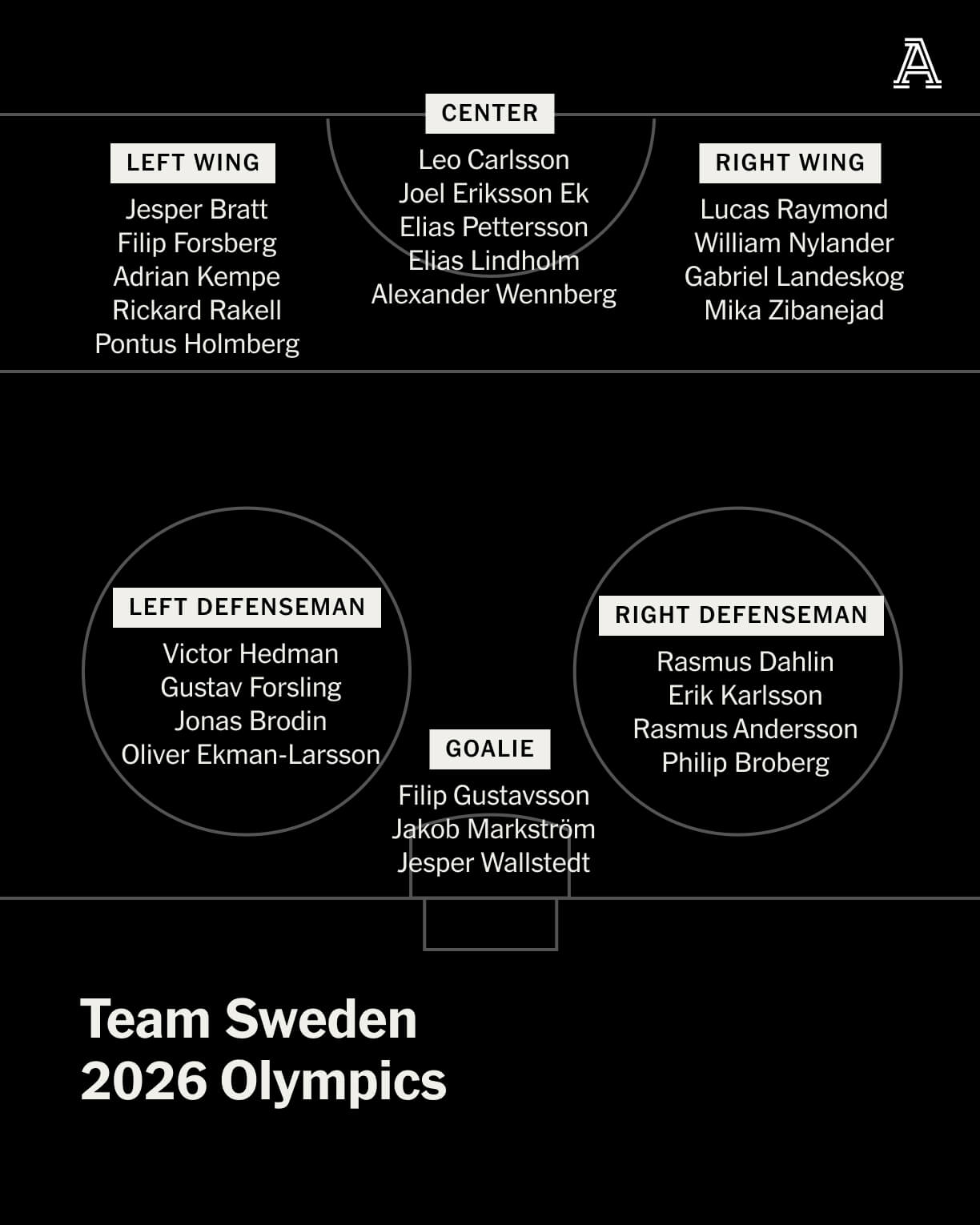
The omission of Mikael Backlund was mildly surprising up front, and certainly Marcus Johansson had a case, and there’s some surprise with the inclusion of Pontus Holmberg, but generally speaking the forward selections are pretty straightforward.
Overall, it’s a team with a lot of offensive firepower — led by Lucas Raymond, Leo Carlsson, Adrian Kempe and William Nylander — but as Hallam mentioned, there’s also an emphasis on players who are disciplined with the puck for the expected tight-checking games.
Sweden’s depth on the blue line led to the most difficult decisions. The Swedes are loaded with world-class defenders to choose from. Good players were going to be looked over. In this case, it was Mattias Ekholm, who made the 4 Nations roster, as well as fellow veteran Hampus Lindholm and 22-year-old Simon Edvinsson.
One can easily make the case for any of those three to be included. But Oliver Ekman-Larsson and Philip Broberg were instead the newcomers to the blue line from the 4 Nations.
“Oliver was very, very happy — thankful,” Hallam said. “But I don’t think the players should be thankful they were selected. Because every player has earned it.”
Broberg plays north of 23 minutes a night in St. Louis, where Steen gets to see him all the time. His growth was too hard to ignore for Sweden.
“He’s been out there some nights playing 26, 28 minutes,’’ Hallam said. “And he gets matched up against the best players in the world. What sticks out for me is just his movement for his size. How good he is on the one-on-ones defensively, and his discipline with the puck: how simple and quick he moves the puck.”
The flip side, as Hallam said, was calls with guys like Ekholm and Hampus Lindholm. So hard. But the truth is, either one could still end up in Milan if there are injuries between now and February.
That’s the delicate part of those phone calls was making sure players getting bad news understood they’re still one phone call away.
“That’s exactly part of the call: ‘Hey, I’ve got some really bad news, but I need to know really quickly if you’re ready to stay on the reserve list because you’re so close,’” Hallam said. “You mentioned two top guys there (Ekholm and Lindholm) — two top persons and personalities. We’re fortunate if I look at it the way I have to look at it in terms of what’s best for Team Sweden. I’m not saying who’s who on that list, but I’m fortunate to have so many good players on the ninth, 10th, 11th (defense) spot ready to call in.”
Then there’s the health of Victor Hedman, who missed a month earlier this season, came back for three games in early December and was sidelined again before undergoing elbow surgery Dec. 15.
He’s expected back in early February.
“Both he and Tampa are optimistic that he is going to play some games just before the Olympics,” Hallam said. “We know Victor as a person. He’s going to do everything he can do in his rehab, and he’s going to work really hard to be ready. The goal is that he will see some games before the Olympics if everything goes according to plan.”
Which is to say, it’s not 100 percent — and that would be an absolute travesty if Hedman couldn’t be ready for Milan. He has been so outspoken over the years about NHL players deserving the opportunity to get back to the Olympics.
Let’s hope Hedman is ready to go. And obviously, the Swedish Olympic team feels the same way, given what Hedman means on and off the ice.
“He’s such a role model,” Hallam said. “The way he talks. The way he conducts himself. I mean, the career he’s had — the success he’s had with his team and as an individual. But he’s still the most humble guy who loves to represent his country. We’re all hoping he’s ready to go.”
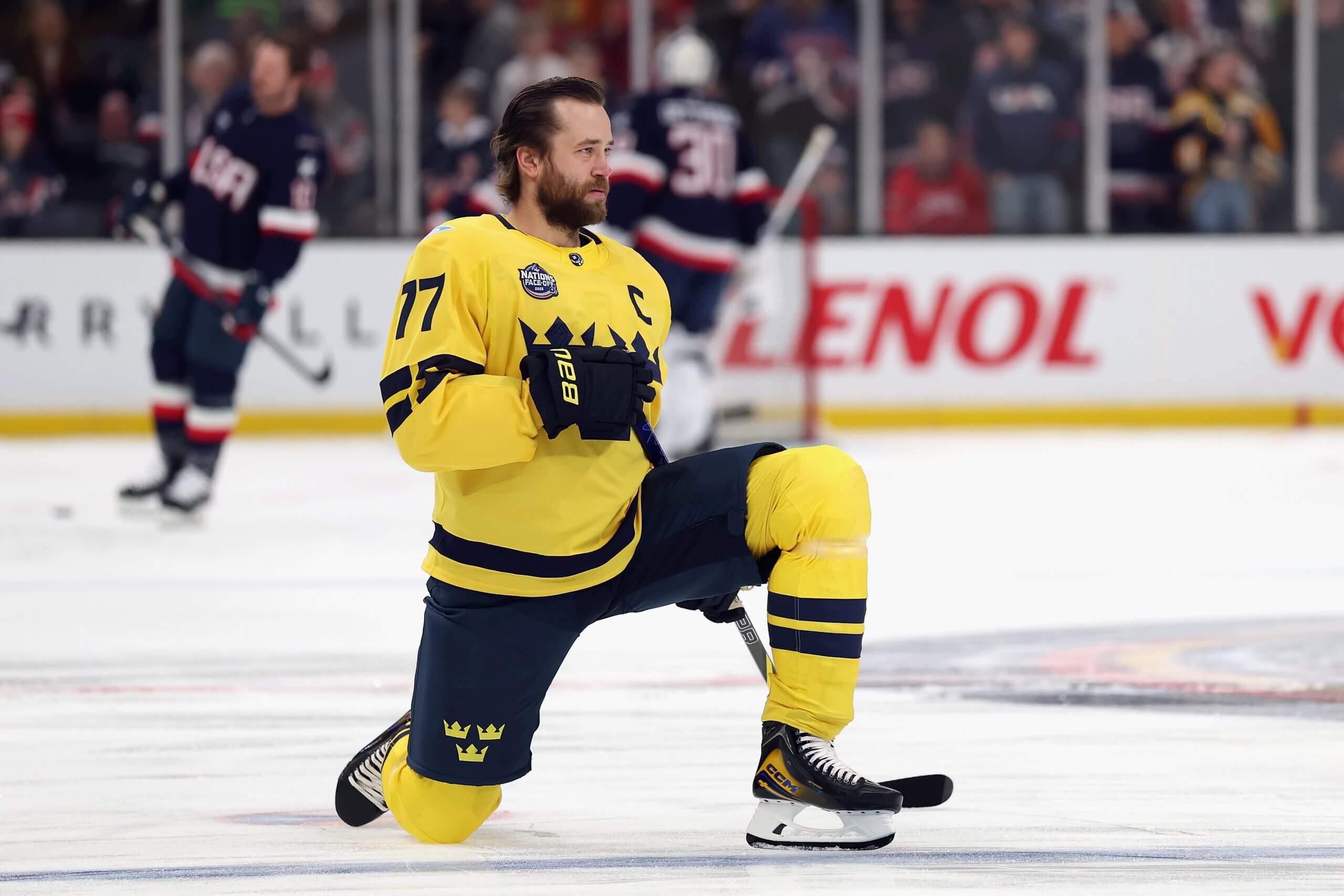
Sam Hallam said of currently injured Victor Hedman: “We’re all hoping he’s ready to go.” (Maddie Meyer / Getty Images)
In goal, it’s exciting to see Jesper Wallstedt selected along with veterans Filip Gustavsson and Jacob Markstrom. Wallstedt, 23, has come into his own with his first real NHL opportunity this season.
Hallam was clear, though, that he hasn’t decided who has the No. 1 job.
“We don’t know who is going to start,” he said. “I’m confident I can start each of them — all three of them. That’s the way we feel at the moment. We want to see who comes (to Milan) with the best flow in our mind.”
Asked specifically about Wallstedt, Hallam added: “We really like what Jesper is doing. It’s not surprising for us. He’s been a top goalie all throughout, from juniors all the way to the world stage. We were just waiting for him to get the (NHL) opportunity and be ready to take it. It’s also nice to have that young goalie who just comes in and has nothing to lose.”
All in all, it’s a very deep Swedish roster. I personally would have taken Ekholm, but either way, this is a team that legitimately can win gold in Milan.