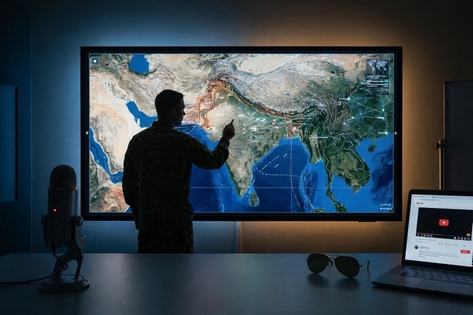
Over the last few years, there has been a sharp rise in India-based YouTube channels focused on defence and global affairs. This surge becomes especially visible during moments of geopolitical tension or crisis, whether it is the India-America trade deal, the Nepal crisis, Operation Sindhoor, or reports of Hindu persecution in Bangladesh.
Through sustained observation, a clear pattern emerges. The rise and fall of these channels’ viewership, the topics they prioritise, and even the audiences they cater to are closely aligned with the dominant geopolitical narrative of the moment.
Before the fall of Sheikh Hasina’s government in Bangladesh, there were very few, if any, channels consistently targeting Bangladesh or its extremist elements. A similar trend was visible with content related to the United States. Before the trade war narrative gained momentum, videos focused on America attracted relatively low viewership.
Earlier, countries like Pakistan, Qatar, and Turkey, particularly Pakistan and its army chief Asim Munir, dominated the discourse and generated strong engagement. Over time, however, the focus on Pakistan has noticeably declined, with attention shifting almost entirely towards Bangladesh. This raises an important question about who is driving the boom of these channels.
Ex-Servicemen Becoming YouTubers
What stands out is that a large number of these creators are defence personnel or former army officers who have transitioned into full-time YouTubers. A recent example is a channel called Trinetra, launched on 30 November 2025 and barely a month old, yet already crossing 6.5 lakh views. The channel is run by Colonel Ajay Raina, who had earlier appeared on several podcasts and platforms such as Jaipur Dialogues, Awaara Musafir, DEF Talks, and Vaad.
Another prominent case is the YouTube ecosystem built by Major Gaurav Arya. He operates multiple channels:
While the overall objective of these channels remains the same, each adopts a different content format. Despite these differences, the topics covered are often identical. Viewers frequently end up watching four to six videos every day posted on the same subject across these channels, indicating that format variation alone does not prevent repetition in consumption.
Major Gaurav Arya first came into the limelight after writing an open letter against Burhan Wani. This was followed by viral television appearances on The Newshour on Times Now when Arnab Goswami was the anchor, and on NDTV when Barkha Dutt hosted the show. His mannerism and speaking style immediately stood out to viewers and evoked a wide range of emotions.
Later, when Arnab Goswami launched Republic TV, Major Arya became a frequent guest and eventually hosted multiple individual shows on the channel before starting his own YouTube channel.
A similar trajectory can be seen in the case of Lucky Bisht, a former NSG commando who also claims to be a former spy. His appearance on Raj Shamani’s podcast has garnered 26 million views. His own YouTube channel, which became active only eight months ago, has already accumulated 109 million total views, largely centred around global affairs, Indian Army, and espionage-related narratives.
These are not isolated examples. Figures such as Gen D P Pandey, Lucky Bisht, and Major L S Chaudhary follow a broadly similar launch mechanism. The pattern is familiar: first ignite controversy or provoke attention by bashing terrorists, Pakistanis or Bangladeshis on traditional media or Twitter, then appear on a major podcast or TV show, project hyper-masculinity, recount tales of struggle, bravery, and sacrifice in the Indian Army, capture public attention, gain cross-platform visibility, build a loyal following, and eventually launch a personal YouTube channel.
Through a few informal conversations with people who regularly watch content by ex-army officers and self-proclaimed intelligence figures, a clear pattern emerged. Most were drawn not by detailed analysis, but by the way these speakers deliver their message. Many said they listen to these podcasts while travelling or keep them playing in the background during work.
What consistently stood out was the emotional effect. Viewers felt inspired and motivated after watching, increasing their respect for the Indian Army and a stronger sense of nationalist pride. This response was common even among those who do not see themselves as politically inclined.
EdTech Platforms’ Obsession with Geopolitical Content
A similar pattern can be observed in the EdTech ecosystem. In fact, EdTech platforms were among the first to recognise Indians’ fascination with global affairs. Channels run by Unacademy and Adda247 regularly upload content focused on international politics and defence. Any serious exam aspirant understands that such topics rarely feature directly in examinations, which is why these videos are not necessarily aimed at academic preparation.
Adda247 went a step further by launching a dedicated channels for UPSC as mentioned in the table:
Unacademy follows a similar strategy with channels such as Pathfinder with 1.29 million subscribers and World Affairs with 4.19 million subscribers. When compared to other Unacademy-run channels that do not focus on global affairs or defence, the difference is stark. Those channels have fewer subscribers and significantly lower engagement per subscriber. A simple YouTube search using the EdTech brand names clearly demonstrates this contrast.
Several EdTech platforms have now adopted this formula. For instance, Maheshan IAS initially struggled to cross 1K to 5K views per video when focusing on standard current affairs. After pivoting to global affairs content, the channel now uploads three videos daily, each averaging between 200K and 300K views.
There is an important nuance here. Audience loyalty tends to gravitate towards teachers who are able to evoke emotion. Videos by Kinjal Chaudhary on world affairs receive two to three times more views than similar content by other educators. This explains why Adda247 has an exclusivity contract with Prashant Dhawan. Success in this space is not determined solely by topic or format, but also by the brand value and goodwill carried by the creator.
Tutors Becoming YouTubers
Once these EdTech educators achieve substantial viewership, most choose not to go independent. The reason is straightforward. Independent channels rely almost entirely on ad monetisation, as brand deals in this niche are relatively rare. Remaining with EdTech platforms offers multiple income streams such as high fixed salaries, referral commissions from course sales, and a share of ad revenue.
From a creator’s perspective, having three revenue sources is far more stable than relying only on monetisation. An insider also mentioned that some brands approach these creators directly, which, if true, opens up an additional income avenue.
That said, there are exceptions. Ankit Awasthi is one such creator who has gone fully independent. He runs five channels:
Ankit Inspires (5.5M subscribers)
Apni Pathshala (2.7M subscribers)
Ankit Inspires Rajasthan (117K subscribers)
Ankit Awasthi Official (271K subscribers)
Ankit Awasthi Vlogs (98K subscribers)
Baatein Bazaar Ki (907K subscribers)
Notably, the objective, genre, and content style across most of these channels remain the same, with Baatein Bazaar Ki being the only exception, as it focuses primarily on stock markets. Other educators such as Khan Sir, Avadh Ojha, and Vikas Divyakirti also command millions of views per video.
One might assume that this phenomenon is limited to UPSC educators, but that assumption does not hold. Abhinay Maths attracts millions of views across platforms when offering political commentary. Similarly, Digraj Singh Rajput, a high school educator with 3.87 million subscribers, runs a separate political and documentary-focused channel called Social Brains, which has 585K subscribers.
The real differentiator is not the UPSC tag, but the existence of a loyal audience built over time through pedagogy. Such educators have greater flexibility to branch into new genres or even launch multiple channels with identical content objectives under different names.
It is also important to note that these teachers wield significant influence in shaping narratives and stoking outrage. Many protests around UPSC panels, unemployment, paper leaks, and delays in government job notifications are fuelled by their provocative videos, which actively mobilise and incite students to join protests on the ground.
While analysing the dashboard of a UPSC tutor’s channel, the identity of which is intentionally withheld for specific reason, it became evident that nearly 78 per cent of the traffic originated from YouTube’s Browse feature, primarily the homepage and subscription feed. This indicates that YouTube actively pushes their content to users.
Further insights revealed that thumbnails containing keywords such as Bangladesh, Bomb Blast, Operation XYZ, or Explosive, along with images of Ajit Doval, Yunus, or Amit Shah, resulted in significantly higher click-through rates. Demographic data showed that West Bengal accounted for the highest viewership, with Karnataka emerging as the only South Indian state among the top five audience sources. This suggests a strong appetite for Bangladesh-related content in West Bengal.
About 50 per cent of viewers belonged to the 25 to 34 age group, while nearly 80 per cent fell between 18 and 44 years.
Why the Boom?
Returning to the central theme of Indians’ obsession with defence and global politics, it becomes evident from comment sections that these videos attract not just students, but also rural audiences from the country’s hinterlands as well as urban viewers. Many comments contain spelling errors in English, and some struggle even to write Bharat Mata Ki Jai. At the same time, other comments written in fluent English suggest a more affluent background.
Prashant Kishor, in a casual conversation with Samdish, once remarked that Biharis are particularly interested in bakaiti, meaning what is happening across the world rather than in their own immediate lives. A similar idea appears in an A16Z newsletter titled Why Nerds Are More Clippable, which argues that nerds will eventually dominate content and narrative control. This aligns closely with the rising influence of defence personnel and educators speaking on political issues.
Many have recognised this emerging trend and moved swiftly to capitalise on it. For instance, Sumeet Jain, who claims to be a motivational speaker and business coach specialising in growth strategy, publishes three videos a day focused on global politics and all his thumbnails are clickbait. These videos routinely attract over a lakh views on average, and his channel has grown to around 592K subscribers.
Viewed through Marshall McLuhan’s Laws of Media, this trend becomes clearer. Behaviour is shaped not just by the medium, but also by growing audience interest in defence and global affairs, with YouTube emerging as the most compelling platform for consumption. YouTube amplifies emotional and identity-driven narratives while steadily sidelining traditional gatekeepers such as newspapers and televised debates.
At the same time, it revives familiar learning environments, particularly smart boards that resemble the blackboards many of us grew up with. This creates instant trust, nostalgia, and a sense of learning. This also explains why history and geopolitics outperform subjects like civics or mathematics. History offers stories, conflict, and emotion, while the others demand greater abstraction and cognitive effort.
As this ecosystem expands, analysis increasingly turns into performance and repetition, signalling that an obsolescence phase will eventually arrive. However, judging by current engagement and viewership trends, that phase does not appear imminent.