For the past 70 years, U.S. and South Korean armed forces have maintained the 1953 Korean Armistice Agreement, deterred aggression and provided a framework for peace and stability on the Korean peninsula. Doing this has required the collective might of the two countries and the placing of tens of thousands of service members and their equipment facing North Korea, locked in on their mutual adversary, like pieces on a chessboard.
This arrangement has worked for decades. But as the Indo-Pacific security situation has grown in size and complexity, there is a need to enable allied forces in South Korea, officially known as the Republic of Korea, or ROK, to transition to an omnidirectional approach. Projecting strength to the north while deploying troops on and off the peninsula is a complex challenge. There is a way to do this that strengthens the alliance, utilizes existing command structures, exercises contingency plans and does so at no additional cost. The U.S. Eighth Army, the senior U.S. Army headquarters in Korea, is making these adjustments by modifying the way it deploys forces on and off the Korean Peninsula.
Eighth Army is driving the changes to force rotations, rewriting the rules of the game and enabling its once single-focused gaze to widen. Among the changes, Eighth Army and South Korean armed forces are making minor adjustments to their approach in selecting critical missions.
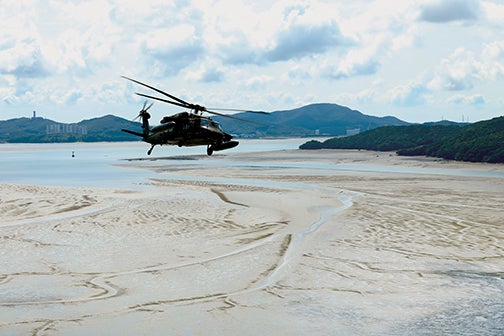
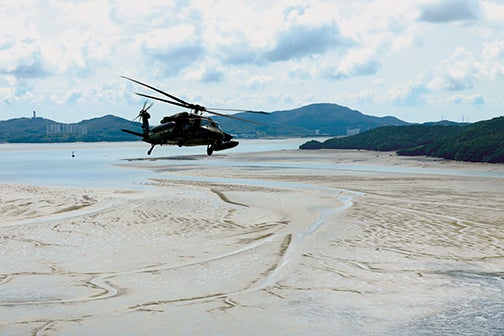 A UH-60 Black Hawk assigned to the 2nd Combat Aviation Brigade, 2nd Infantry Division/Republic of Korea-U.S. Combined Division, flies over the coast of South Korea during an exercise.
(U.S. Army/Staff Sgt. Brea DuBose)
Predictable Movements
Eighth Army conducts multiple rotational force deployments and readiness exercises annually and participates in regional training exercises to ensure peace on the Korean Peninsula. The movement of rotational forces and equipment has been viewed mainly as an administrative matter, with little consideration given to the broader region or enhancement of the alliance’s capabilities or ability to deploy forces, equipment and supplies throughout the region. This approach was predictable and saved money but did nothing to foster cooperation with South Korea’s army, provide support to the area or offer insights into alternate sea and airports. Conversely, it provided adversaries a predictable pattern of allied military movements.
In 2024, Eighth Army’s commander directed a review of force deployments, instructing the U.S. Army in Korea to operationalize rotational force transitions and diversify aerial and seaport embarkation locations. This change has led to numerous insights and adjustments in how the U.S. and South Korean armed forces operate, and has had a significant impact on their ability to conduct reception, staging, onward movement and integration and redeployment through an operationally focused mindset. While ensuring deterrence and increasing the operational readiness of the force, these changes have positively impacted the U.S. and ROK militaries.
Regional Deployment
The fundamental outcome of the modification to the scheme of maneuver is that the U.S. and South Korea can deploy forces regionally without jeopardizing the alliance or raising tension on the peninsula. The scope and scale of this operation are immense. Coordination between U.S. forces is difficult—integration with another country increases the complexity. Regardless of the challenges, the changes have enabled the coalition to deploy combat-configured troops and equipment quickly, while maintaining peace on the peninsula and contributing to the region’s security framework, making South Korea a key platform for global power projection.
Eighth Army, with guidance from its higher headquarters, U.S. Forces Korea, selects courses of action and possible scenarios to exercise. Then the Eighth Army staff begins the hard work of operationalizing the rotations, which includes establishing command relationships and standard operating procedures, integrating South Korean troops, selecting ports, coordinating boundaries and rehearsing before execution. Coordination within the U.S. military as well as with South Korean forces encompasses both horizontal and vertical collaboration in all warfighting functions, resulting in a force rotation showcasing the capabilities of both nations.
Key goals behind these changes include operationalizing transitions between force rotations, increased integration between both countries and diversifying points of embarkation. Taken together, these actions provide insight into future response options, strengthen the alliance and make the coalition strategically unpredictable.
Incorporating these changes into what was once considered routine movements during the armistice at little to no additional cost is what makes this an evolutionary change to security operations in the region. Force rotations now are driving interoperability, increased cooperation, higher security levels and the ability to respond to crises in the area without upsetting the security balance in Korea.
At the heart of the changes are operationalized transitions and reception, staging, onward movement and integration of forces coming to and leaving the peninsula, which includes ensuring the inbound force is in place with proper security and screening before the outbound force departs, as well as conducting communication and weapons checks before departure. Military units and headquarters of both countries at the tactical and operational level are rehearsing for potential conflict or contingency operations during force rotations when incoming and outgoing units can be vulnerable.
Working Together
Seamless military-to-military engagement and coordination are crucial to this operation, occurring at all stages and levels. It begins with selection of ports of entry and exit and encompasses everything from sea lines of communication deconfliction, port security, customs and immigration, onward movement of equipment, cross-boundary security coordination from port to fort, and continues when the unit assumes its battle positions. This level of cooperation between the two countries, conducting one of its most crucial missions—force deployments—helps ensure the alliance can respond to any contingency.
Similarly, the U.S. joint force in Korea is strengthened and exercised by this new maneuver scheme. Every central command, the U.S. Seventh Air Force, combined Naval Forces Korea, U.S. Navy Military Sealift Command-Korea, U.S. Transportation Command and U.S. Forces Korea, plays a crucial role in enabling Army force rotations. From synchronizing surface movements, sea lines of communication security and port operations to the 7th Air Force doing the same with personnel movements, the joint force receives crucial sets and repetitions that help build muscle memory and capabilities for potential conflicts.
Operationalizing rotational force deployments and diversifying ports of entry serve many purposes. They include:
Providing Eighth Army units and the joint force with valuable training in receiving and integrating combat forces, along with deploying them off the Korean Peninsula.
Strengthening the U.S.-ROK alliance through realistic force deployments off and on the peninsula by integrating each nation’s strategic, operational and tactical commands.
Presenting U.S. and ROK adversaries with multiple dilemmas, rendering them strategically unpredictable.
Aligning with U.S. national strategic guidance to enhance global power projection and enable allies to do the same.
Validating primary and alternate ports for contingency and flexible-response options.
Not only is Eighth Army learning valuable lessons from deployment and redeployment of units, but critical U.S. and ROK partners are as well. Like the U.S. joint force, South Korea’s armed forces are an integral part of the operation and continue to learn from the process, increasing their capabilities through future force rotations.
Deconflicting Logistics
During force rotations, the Regional Defense Divisions under the ROK Army’s 2nd Operational Command provide route security and deconfliction for onward movement.
The movement of U.S. equipment through Korea involves transitioning multiple ROK Army corps and boundaries, as well as coordinating with the Korean National Police Agency and ROK transportation command, which assigns routes and times and coordinates movement across the country. While this is happening, both countries track their own movements in real time using manual and digital platforms. Leadership of the South Korean and U.S. militaries is enhancing war-fighting skills while validating ports of entry and exit.
In future force rotations, the ROK Port Operations Group will establish a port and hand it over to the U.S. for deployment use. In past rotational deployments, the South Korean government used mobilized civilian aircraft to deploy and redeploy forces under the Mutual Airlift Support Agreement. Additionally, plans are in place to use Korean-flagged vessels to transport rotational forces between the U.S. mainland and South Korea. This seamless integration serves to strengthen the alliance, reduce friction and deliver equipment and supplies to the point of need.
Stronger Alliance
While deploying and redeploying combat-credible rotations into key areas hand-in-hand with America’s South Korean allies, it is not hard to see the U.S. and ROK armies are becoming a stronger alliance, more committed to maintaining the armistice, learning each other’s strengths and weaknesses and increasing their ability to deploy personnel, equipment and forces to any area in the Indo-Pacific to respond to crises.
These improvements change the nature of deployments from an administrative to an operationally focused approach.
Through careful planning and collaboration between the two countries’ armed forces, as well as vertical and horizontal integration within their respective troops, the alliance becomes stronger, new capabilities are acquired and the partnership becomes increasingly more relevant. All the while, costs remain the same as these operations require no additional land, forces or supplies.
* * *
Col. Ned Holt is a logistics officer serving in the logistics staff section for U.S. Eighth Army, Camp Humphreys, Korea. Previously, he commanded 10th Sustainment Group at Torii Station, Okinawa, and was a U.S. Army War College fellow at the Australian Strategic Policy Institute in Canberra, Australia. He deployed to Bosnia, Iraq, Afghanistan and Kuwait.