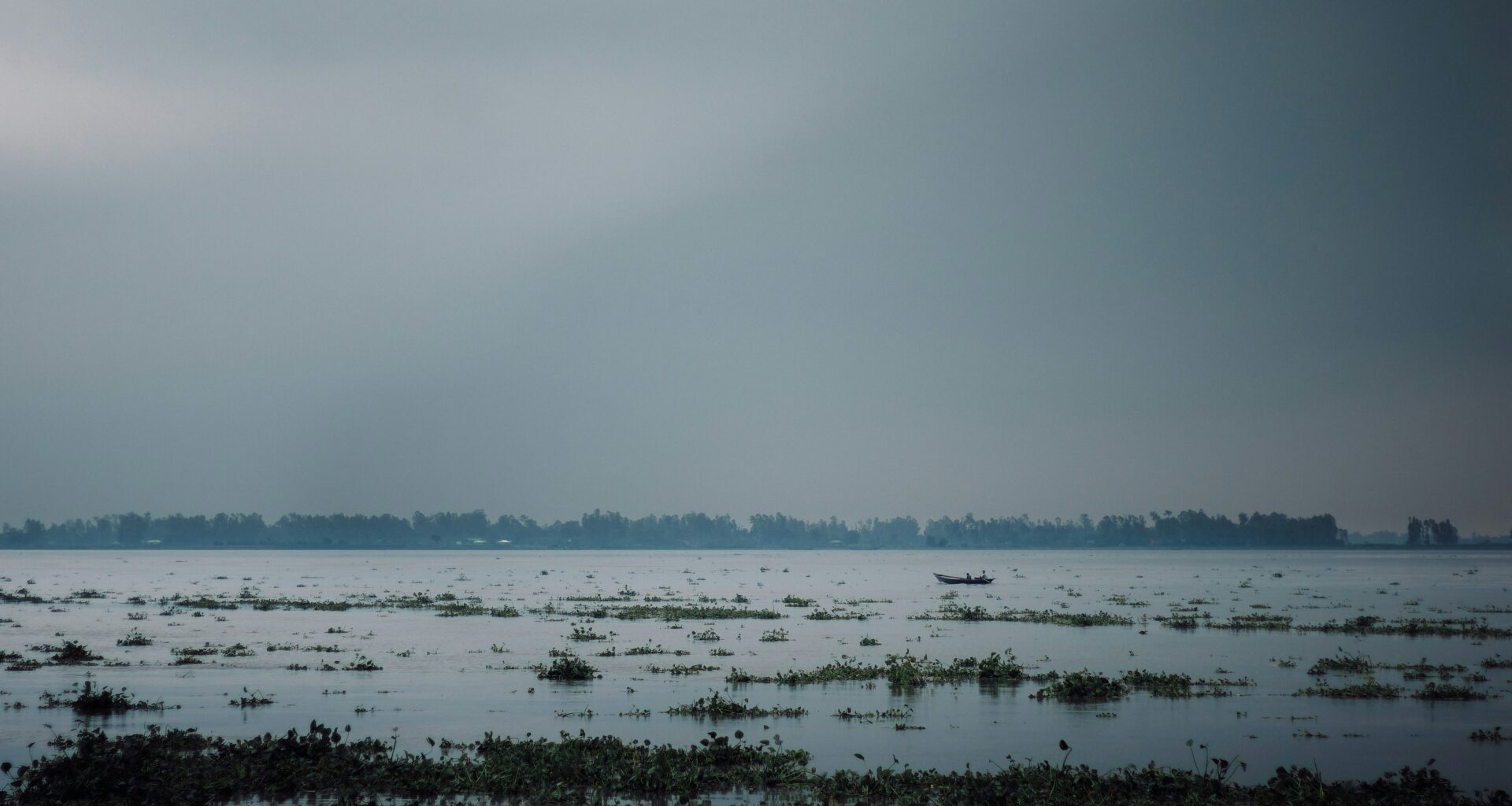
Zara had arrived from Myanmar just three months previously. Like many Rohingya, she and her new neighbors were not in an official UN refugee camp but in a makeshift community outside. While UN officials made efforts to move official camp residents into schools and other solid structures ahead of the cyclone, that wasn’t an option for these people outside of their aegis. Per Bangladesh government policy, the United Nations did not provide protection to these informal communities, and many residents there felt abandoned. “They are probably extra vulnerable to anything like this,” Shinji Kubo, the country representative for the UN refugee agency at the time, told me. In Bangladesh and 15 other climate-vulnerable countries, 40% of refugee settlements face a significant risk of flooding. For Zara, the overnight cyclone was yet another terror that left her panicked. She did not feel safe until the sun finally rose in the morning, she told me. But there was no time to rest. Once again, she had to rebuild.
As she did, she received little help from native Bangladeshis living nearby. Bangladeshis have often eyed Rohingya refugees skeptically, in part because the new arrivals have cut down vast forests for firewood, sometimes trekking for up to 16 hours to gather wood. Tensions between refugees and host communities over deforestation and other environmental issues are not uncommon, said Andrew Harper, a special advisor on climate action to the UN refugee agency, UNHCR. “Not only are refugees coming from countries which are impacted by climate change, this climate change — it’s not focused on a country; it’s regional. It’s often the host states that are also impacted as well,” he told me. “So they’re seeing a surge in the population on their territory, and this population comes with no resources, or generally very little in the way of resources and assets.” International organizations like his need to step in to help local communities, he said, to prevent tensions from escalating into conflict. “If you don’t protect the environment in which displaced people are, you cannot expect that host community to protect the refugees.” In Bangladesh, the influx of Rohingya prompted a series of reforestation initiatives.
The government has also shuttled tens of thousands of refugees to an island more than 100 miles away, called Bhasan Char. While ostensibly part of a plan to reduce overcrowding in and around the refugee camps and offer refugees an opportunity to start anew, the policy has come under fire. The island is extremely vulnerable to cyclones, and refugees are unable to come and go from it freely. The UNHCR has some oversight of the refugees’ conditions, but critics have all the same warned that it could become “a UN-supported prison island.”
The relocation illustrates a difficult tension at the heart of the international protection system. Most people forced to flee end up not far from where they started and often find safety only because of the generosity and solidarity of their neighbors. Yet these neighbors tend to be only marginally less insecure than the refugees themselves, and when weeks of displacement turn to years — especially as impacts of climate change grow worse — fatigue sets in. International support tends to fade as crises stretch on and the challenges morph from those associated with erecting tents and latrines into more complex ones involving opportunities for children to go to school and for adults to find work. How is a poor, climate-battered country expected to accommodate a million desperate people for a decade?
The tensions between Rohingya refugees and Bangladeshi locals are in some ways a microcosm of how climate change, migration, and conflict can intersect, creating a tailspin of crises that amplify one another.
On the other side of Asia, in Syria, a devastating drought lasting from 2007 to least until 2010 has been identified as a factor in the outbreak of civil war which left hundreds of thousands of civilians dead and roughly half of Syria’s population displaced. As the drought stretched on, tens of thousands of farmers lost all or most of their livestock. The country’s northeastern breadbasket dried up and crops were affected by a historically pernicious outbreak of the fungal disease wheat rust, which can also be traced to climate change. Poor farmers had virtually nothing to show for their harvests. Agricultural self-sufficiency had been a source of national pride, but for the first time in a decade the country needed to import large amounts of wheat. Dictator Bashar al-Assad’s regime had also cut food and fuel subsidies and declined to change course amid the drought, aggravating the situation.
“Increasingly, climate change is both magnifying the underlying drivers of conflict and striking the people fleeing war perniciously hard.”
In response, as many as 1.5 million people left their farms to move to cities. They went to slums and shantytowns, borrowed money where they could, and tried to restart their lives in the face of crime and corruption. They also competed for jobs and scarce public services with newly arrived Iraqi refugees who had fled the war in their own country. In 2010, a year before war broke out, about one-fifth of all residents of Syria’s cities were either refugees or internally displaced people from elsewhere in the country. Syria’s overall population was growing at a rapid rate around that time, especially in and around the cities, which were fast becoming hotbeds of frustration and desperation. In just about a decade, the population of towns outside cities like Aleppo ballooned from around 2,000 to nearly 400,000. As in countries worldwide, cities made big promises that they often did not fulfill, leaving many migrants disappointed and poor in a brand-new way. The result, according to researchers, was anger, particularly at the government. Underlying social tensions were ramped up and violence became more likely.
There are any number of ways in which a responsive, well-functioning government could have stepped in to ameliorate the situation. But Syria’s government failed to meaningfully respond to these climatic shocks in a way that might have helped people.
Increasingly, climate change is both magnifying the underlying drivers of conflict and striking the people fleeing war perniciously hard. Rarely is the fighting as extreme as in Syria, and climate change has not yet been a primary driver of a war between countries, although it could be someday. Climate-linked violence tends to be relatively low-level skirmishes between communities, militias, and local authorities. But history has repeatedly shown that if a government fails to respond to simmering tensions and low-level conflict, the challenges can escalate.
In certain situations, researchers have been able to quantify how specific increases in temperature and changes in precipitation are systematically correlated with greater likelihood of conflict. A meta-analysis of fifty-five studies found that one standard deviation increase in temperature increased the odds of conflict between groups by 11% and the odds of interpersonal conflict by 2%.
The chance of climate-induced violence is acute for communities who depend on agriculture, since climate change represents a radical economic threat. But violence is not inevitable, nor does it mean that people displaced by climate change are themselves security risks. Climate change on its own did not cause the Syrian revolution; rather, it was a proximate factor that exacerbated peoples’ grievances against the government, pointed out the regime’s years of policy failures, and illustrated leaders’ poor governance. The drought and the migration it inspired were a test of the Assad regime’s economic development policies and its capacity to respond to citizens in need; the regime failed spectacularly.
The same test is coming to other parts of the world. Are we ready?
Julian Hattem’s Shelter from the Storm: How Climate Change Is Creating a New Era of Migration will be published by The New Press on Jan. 6, 2026. This lightly adapted excerpt is reprinted here with the permission of the author and publisher.