David Paul Morris/Bloomberg
Processing Content
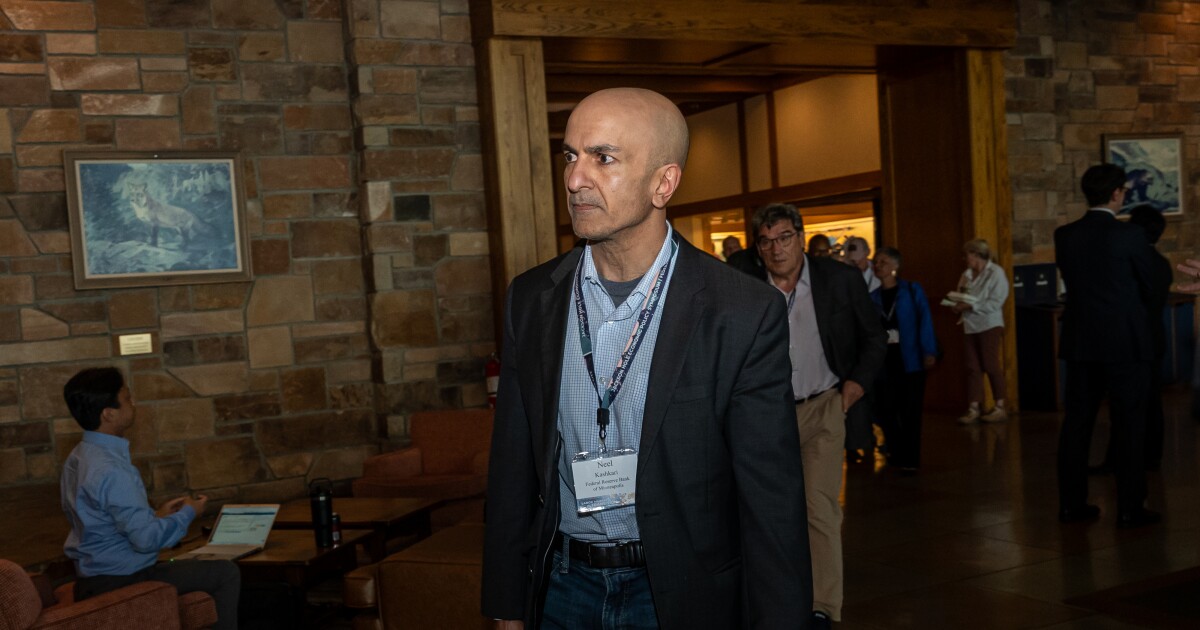
Key Insight: Minneapolis Fed President Neel Kashkari said the labor market is continuing to cool, though he wants to see additional data before deciding how monetary policy should proceed.Expert Quote: “My guess is we’re pretty close to neutral right now, and we just need to get more data to see which is the bigger force. Is it inflation, or is it the labor market?” —Minneapolis Federal Reserve President Neel KashkariWhat’s at stake: At the end of 2025, Fed Chair Jerome Powell implied that the central bank will hold steady on interest rates, saying the committee is “well positioned to wait to see how the economy evolves.”
Minneapolis Federal Reserve President Neel Kashkari said Monday he is more concerned about the labor market heading into the new year, even as inflation remains elevated.
Speaking on CNBC, Kashkari, now a voting member of the Federal Open Market Committee, said there is a “clear signal that the labor market is cooling,” though he emphasized that inflation is still “too high.”
“My guess is we’re pretty close to neutral right now, and we just need to get more data to see which is the bigger force,” Kashkari said. “Is it inflation, or is it the labor market? And then we can move from a neutral stance in whatever direction is necessary.”
Some key inflation and labor market indicators have been delayed or only partially released because of a 43-day government shutdown in late 2025, but available data shows inflation hovering near 3% and labor market data pointing to continued softening.
Kashkari said disinflation in housing services and slowing wage growth could help offset the inflationary effects of potential tariffs, which he noted could “take a few years to work their way through the system.”
“I’ve got a lot of confidence that housing services inflation is coming down,” he said. “Non-housing services tied to wage growth are slowly trending down, so it’s going to be a slow process.”
Meanwhile, regarding the labor market, Kashkari said he expects it to experience “low hiring, but low firing” in the year ahead.
During the second half of 2025, the Fed cut short-term interest rates by a total of 75 basis points, bringing the benchmark policy rate to a range of 3.5% to 3.75% in an effort to support the labor market. Fed Chair Jerome Powell signaled in December that the central bank would likely hold off on additional rate cuts in 2026 until the economic outlook becomes clearer.
Kashkari dismissed concerns Monday about potential political interference in the selection or removal of regional Fed presidents, saying such authority rests with boards governing each of the regional banks.
“I’m not concerned about that,” he said. “The Federal Reserve Act is built on the foundation of 12 independent Federal Reserve banks. All the presidents serve at the pleasure of our local boards of directors. That’s where the power is, not in Washington.”
All 12 regional Federal Reserve bank presidents were reappointed by the Fed’s Board of Governors in December, surprising some observers who had expected the process to become the next political flashpoint in the ongoing power struggle between the White House and the central bank. At a minimum, some had anticipated a higher number of dissents.
Kashkari also mentioned on CNBC that recent actions by the Trump administration aimed at removing Venezuela’s longtime leader, Nicolas Maduro, could affect the economy through oil prices, though he added that he does not “see it so far.”
“When Russia invaded Ukraine, it sent a commodity shock wave around the world,” Kashkari said. “That didn’t happen with Hamas attacking Israel. It hasn’t happened now with the U.S. and Venezuela, but that’s the mechanism that would directly affect the U.S. economy.”