Sign up for the Slatest to get the most insightful analysis, criticism, and advice out there, delivered to your inbox daily.
Two days after the U.S. military action that forced Nicolás Maduro out of power and into a New York courthouse, two big questions remain: What happens next in Venezuela—specifically, who’s in charge? And, related to that: Who’s in charge of U.S. foreign policy?
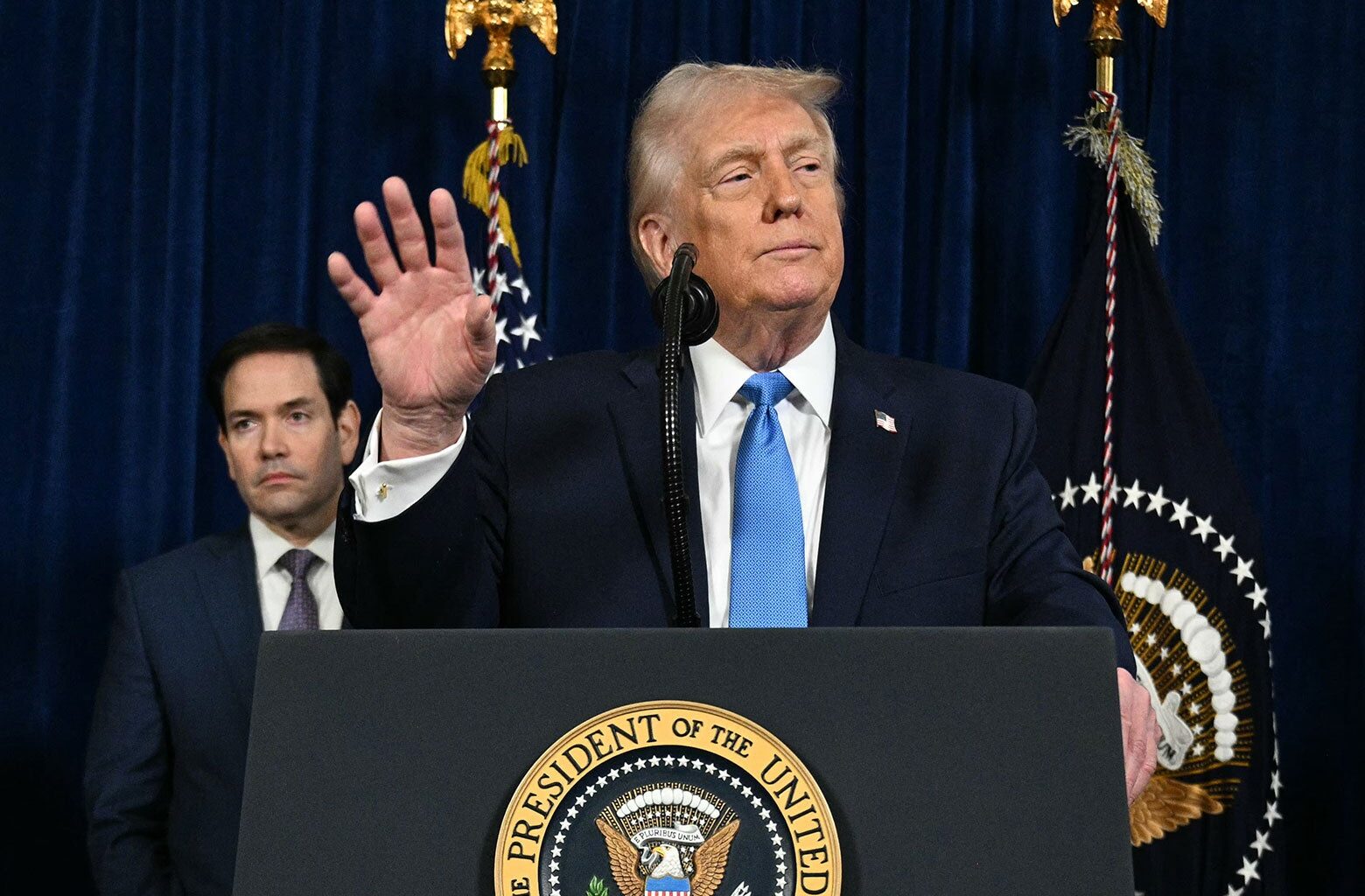
At his Saturday press conference, where he announced the nabbing of Maduro, President Donald Trump said—to widespread astonishment—that the United States will soon “run,” or even is now “running,” Venezuela.
The next morning, on NBC’s Meet the Press, in an only slightly less baffling moment, Marco Rubio, Trump’s secretary of state and national security adviser, backpedaled on his boss’ claim. Asked whether the U.S. will really run Venezuela, Rubio replied, “Yeah, I keep [seeing] people fixating on that.” He continued: “The bottom line is, we expect to see changes in Venezuela. … It’s not running the—it’s running policy, the policy with regards to this. We want Venezuela to move in a certain direction” that would be “good for the people of Venezuela … [and] in our national interest.”
These remarks are worth parsing.
First, there should be no mystery why people are “fixating” on Trump’s claim. It’s because, in the course of his Saturday press conference, the president said 12 times that he and a group of his choosing, including Rubio himself, would “run” Venezuela.
Second, there is a distinction between running a foreign country and influencing its direction, even when this influence stems from a U.S. naval armada that remains off Venezuelan shores and an explicit threat from Trump to send in a second, larger wave of U.S. troops to enforce our influence.
Hence the question: Who is running American foreign policy—the president or his chief foreign policy adviser?
The question isn’t trivial. First, the answer will shape what happens next in Venezuela—who governs, to whose benefit, and with what level of internal freedom and stability? Second, it could shape what lessons other countries—friends and foes—take from Operation Absolute Resolve, the quite large and impressive military action that unfolded in the wee hours on Saturday. Will Russian President Vladimir Putin see the claim of unabashed regional imperialism as a winking green light to his claim of control over Ukraine? Will Chinese President Xi Jinping infer the same about his claims over Taiwan? Will the mullahs of Tehran take it as grounds for fear of an impending U.S. attack? How seriously will Cuba’s leaders take Trump’s—and Rubio’s—warnings that as goes Caracas will soon go Havana, whether by U.S. attack or self-immolation?
Given the regional and global stakes, one might think that Trump and his team would have worked out a unified message to explain and justify this (to say the least) audacious military action. Instead, this is just another case in point that Trump’s actions often have no underlying strategy—which is to say, no clear idea of how to link means and ends: or, in this case, just what the desired ends are.
Some of those ends are clear, as Trump laid out on Saturday and as neither Rubio nor any of the other officials flanking him contradicted: the desire for sole domination of the Western hemisphere (as had been spelled out in his National Security Strategy document) and a desire for control of its oil and the wealth it produces.
Leaving aside the wisdom and legality of those goals, the press conference and Rubio’s subsequent caveat made clear that the administration has not thought through just how to obtain them—i.e., it’s clear they have no strategy.
If Trump is serious about “running” Venezuela, how, and through what agent, does he plan to do this? He said that Maduro’s former deputy, Delcy Rodríguez, who has now been sworn in as his interim successor, was an acceptable intermediary, and that Rubio is working with her. (Rodríguez herself, a longtime fiery Maduro associate who at first denounced the abduction, has since said she’s willing to “collaborate” with the U.S. to redevelop her country, though added, perhaps wishfully, that she wouldn’t let it become a U.S. colony.)
The same question applies if Rubio’s slightly less coercive notion of merely influencing the country’s policy applies. Maduro’s ministers remain in charge; the Venezuelan military retains ultimate power, offering security and oppression, assisted by at least 20,000 Cubans, many officers and some health care workers who have provided health care in exchange for Venezuelan oil. Will the military now be swayed toward northern-leaning sentiments, given the evaporation of the wages that Maduro provided and the continuing blockade of the country’s oil for as long as they refuse to budge? Some insiders were apparently bought off during the planning of the incursion. The CIA had recruited at least one person close to Maduro to keep track of his movements; it’s reasonable to assume that wasn’t the only spy.
Fred Kaplan
It’s Painfully Clear What Trump’s Attack on Venezuela Is All About
Read More
And what about the democratic opposition? Trump shoved aside any role in a new government for María Corina Machado, the movement’s leader, saying, “She doesn’t have respect in the country.” And he said nothing about the leader of her party, Edmundo González Urrutia, who legitimately won the 2024 election and who fled in exile to Spain after Maduro, who was soundly defeated, held on to power. Machado, who won the Nobel Peace Prize for her valiant struggle (perhaps to the bitterness of Trump, who many times said he deserved it), issued a statement, calling on Urrutia to be brought back to lead the country. Will the democrats on the streets and elsewhere second her demands, or will they simply bow down to the continued reign of Maduro’s team just because it will now be tempered a bit by influence from Washington and the big oil companies?
This too has broader implications. The United States cannot easily claim to be leader of “the free world,” or even a champion of democracy, if it ousts a dictator—a feat that many Venezuelans cheer—but then does nothing to help restore the real, freely elected president.
There is also something a bit fishy about the official rationale for the military operation, which was to bring a criminal fugitive to justice, given that the U.S. extracted him through means that were likely in violation of international law. Yes, a U.S. grand jury indicted Maduro for drug smuggling back in 2020, and in the wake of his abduction this weekend, the Justice Department filed additional charges—most of them legitimate. (I say “most,” rather than “all,” because one of them, possession of a machine gun, seems an odd charge to level against a foreign head of state, however illegitimate he might be.)
Which leads to one more broad point. The United States has had a pretty successful record of overthrowing foreign leaders but a pretty lousy one of imposing order, or accomplishing whatever outcomes it has desired, in the aftermath. (Some obvious cases in point: Iraq, Afghanistan, Libya, Guatemala, and—going back several decades but one with enormous implications later on and ever since—Iran.)
A reporter at Saturday’s press conference asked Trump about this mixed record with previous presidents. His reply was evasive to say the least:
With me, that’s not true. With me, we’ve had a perfect track record of winning. … If you look at [the assassination of Qasem] Soleimani, you look at [Abu Bakr] al-Baghdadi, you look at the Midnight Hammer [the air raid on Iranian nuclear targets] … we have essentially peace in the Middle East because of that. … So, with me, you’ve had a lot of victory. You’ve had only victories, you’ve had no losses.
Trump’s Venezuela Invasion Has Exposed One of His Biggest Lies
One of the Best New Year’s Resolutions You Can Make in 2026
There are several disturbing things about this passage, quite aside from the fact that “peace in the Middle East” remains, in many ways, aspirational. The most pertinent here is that Trump seems to believe that a dramatic tactically successful strike—the killing of a terrorist leader, the bombing of a nascent nuclear facility, the signing of a multiphase 20-point peace treaty (but the accomplishment of just the first phase), and now the extraction of a horrible dictator—amounts to a strategic victory and the fulfillment of an ambitious policy.
Trump doesn’t think he has to care about what happens next in Venezuela or what he needs to do to make it happen, to improve the odds of success or reduce the odds of catastrophe, however those terms are defined.
In Operation Absolute Resolve, the U.S. military showed itself to be, as it has several times in recent years, an agile, effective, supremely coordinated instrument of national power. Whose resolve it enforces, to what ends, is another matter. The policymaking machinery at the top of America’s power structure is appallingly adrift.

Sign up for Slate’s evening newsletter.