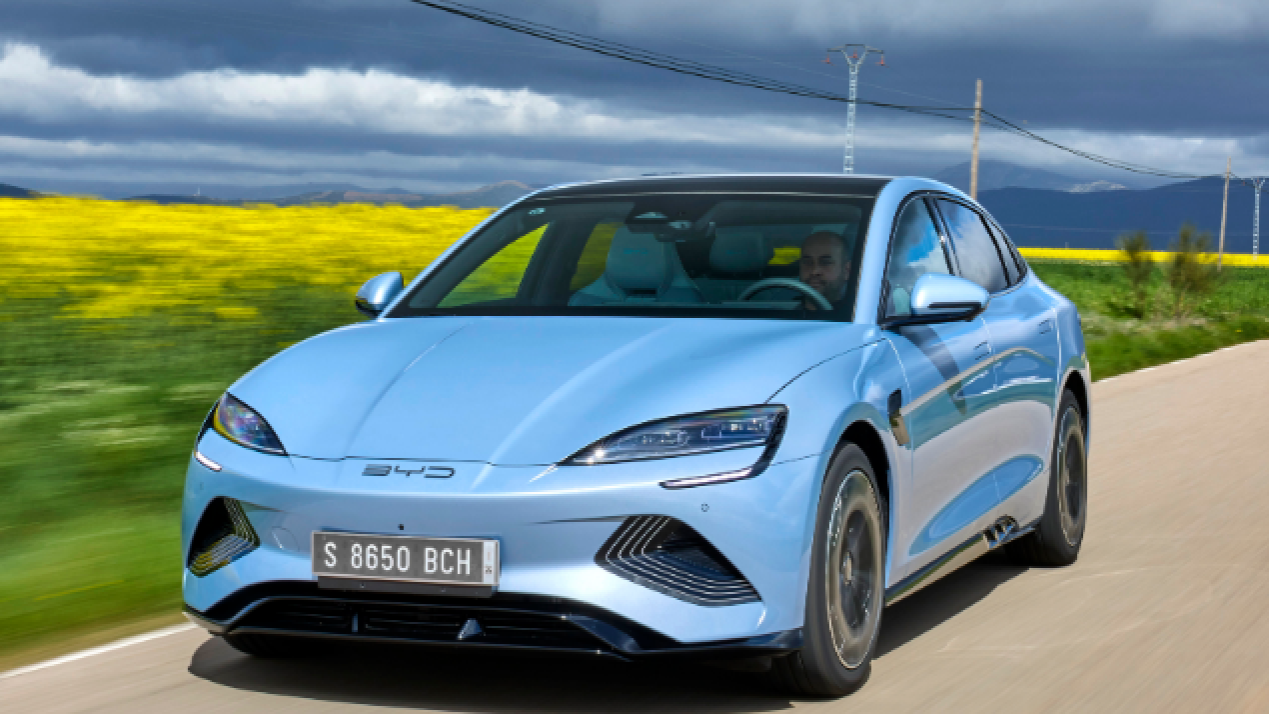
Chinese automakers are set to become the world’s largest sellers of new vehicles in 2025, surpassing Japanese manufacturers for the first time in more than two decades, driven by EV dominance, exports, and control of the industrial supply chain. Data compiled by Nikkei Asia using company disclosures and S&P Global Mobility figures from January to November show Chinese brands on track to sell close to 27 million vehicles globally, compared with just under 25 million for Japanese groups.
The shift confirms a prediction made in April 2023 by Guibing Zhang, CEO, Chery International Company. “American brands dominated at the start of the 20th century thanks to assembly-line production. Japanese and South Korean brands took the lead in the 1970s during fuel shortages with small, efficient models. Now it is China’s time,” Zhang said at the time.
Chinese manufacturers are expected to post annual global sales growth of about 17%. Japan’s sales are projected to remain flat, below 25 million units, down from a peak of nearly 30 million vehicles in 2018. Japan’s advantage of roughly 8 million units over China in 2022 has disappeared within three years.
Electrification is the central factor behind the shift. In China’s domestic market, which accounts for about 70% of total Chinese automaker sales, EVs and plug-in hybrids represent almost 60% of passenger car sales. From January to November 2025, sales of new-energy passenger vehicles reached 11.47 million units, surpassing 10.01 million internal combustion vehicles.
This position is reinforced by China’s control over key electrification components, including batteries, motors, electronics, and advanced driver assistance systems. BYD employs about 120,000 engineers, enabling rapid development and cost reductions. S&P Global Mobility estimates battery costs in China at about US$52 per kilowatt-hour, compared with starting costs of US$60 for internal combustion engines. “This means China already produces EVs cheaper than combustion models,” says Guido Vildozo, Associate Director, S&P Global Mobility.
China’s rise in new-energy vehicles traces back to policies set a decade earlier. In 2015, the “Made in China 2025” plan identified new-energy vehicles as a strategic priority. Over the following years, the country combined subsidies, charging infrastructure expansion, and sustained investment in R&D to build a full industrial ecosystem. Core technologies, including power batteries, electric drive systems, and intelligent cockpit platforms, shifted from technology adoption to global leadership.
Export growth has followed domestic saturation. Vehicle exports are expected to reach 6.8 million units in 2025, up 16% year over year. In Southeast Asia, sales of Chinese vehicles are forecast to rise 49% to nearly 500,000 units. In Thailand, Japanese brands’ market share has fallen from about 90% five years ago to 69%, according to Toyota Thailand data cited by Nikkei Asia.
Despite tariffs, Chinese vehicle sales in the European Union are projected to grow 7% to 2.3 million units. “BYD is one of the pioneers in establishing overseas EV production and supply chains,” says Jing Yang, Asia-Pacific Corporate Ratings Director, Fitch Ratings, adding that geographic diversification helps manage rising trade barriers. BYD is building production capacity in Hungary as US tariffs on Chinese EVs stand at 100%.
In emerging markets, Chinese vehicle sales are expected to grow 32% in Africa to 230,000 units and 33% in Latin America to 540,000 units. BYD, Geely, and Chery are now in the global Top 10 by volume, with BYD projected to hold a 15.7% share of the global EV market.
BYD and Geely have entered the global top ten automakers by sales, reflecting higher volumes driven by EVs and expanded international distribution. Chery has ranked among China’s largest vehicle exporters, supported by rising overseas shipments across the European Union, Latin America, and Southeast Asia.
In Mexico, Japanese brands still account for 41.4% of vehicle sales, led by Nissan with 17.9%. Chinese brands, however, have gained nearly 20% market share over five years, signaling growing competitive pressure even in long-standing Japanese strongholds.