2026-01-05T18:16:34+00:00
font
Enable Reading Mode
A-
A
A+
Shafaq News– Middle East
Israeli Prime Minister Benjamin Netanyahu said on Monday that preventing
Iran from rebuilding its nuclear program or advancing its ballistic missile
capabilities remains the top priority of his government, warning that any
Iranian attack on Israel would trigger “very serious consequences” for Tehran.
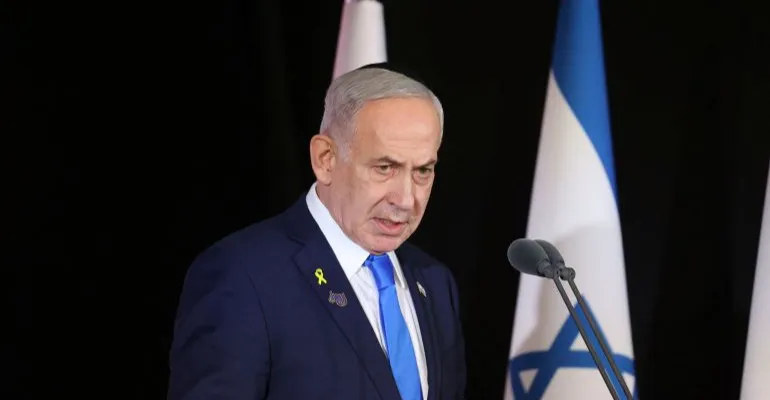
Speaking during a special session of the Israeli Knesset, Netanyahu said
Israel shares a “clear and firm” position with the US administration on Iran,
centered on “non-negotiable red lines,” including blocking uranium enrichment,
removing all enriched uranium from Iran, and enforcing continuous and strict
oversight of nuclear facilities. He said the approach is aimed at preventing
the revival of Iran’s nuclear program or the rehabilitation of its ballistic
missile industry.
Netanyahu pointed out that these positions were reaffirmed during his
recent meeting with US President Donald Trump, adding that both sides expressed
a decisive stance against Iran restoring what he called strategic military
capabilities. He reiterated that any Iranian targeting of Israel would lead to
“grave repercussions.”
In the same address, Netanyahu accused Iran of directing “terrorist
activity in the Middle East and beyond,” referring to Iranian military
exercises conducted days before he visited Washington. “Israel has made clear
that it would respond forcefully if attacked.”
Regarding the ongoing protests inside Iran, he expressed Israel’s
support position to the Iranian people in “ their pursuit of freedom and
justice.”
“The current phase could represent a decisive moment for Iranians to
shape their future.”
Read more: Trader protests reshape Iran’s crisis while US signals grow sharper
Separately, Reuters reported on Monday, citing an Iranian official, that
concerns are growing in Tehran that Iran could be “the next victim of
Trump’s aggressive foreign policy”.
Protests broke out on December 28 in Tehran’s Grand Bazaar over the
sharp fall of the Iranian rial and deteriorating economic conditions, later
spreading to at least 222 locations across 78 cities in 26 provinces. The
demonstrations have largely centered on economic grievances, with limited
political slogans, while localized clashes were reported; the Human Rights
Activists News Agency (HRANA) said at least 22 people were killed, 51 were
injured, and 990 were detained.