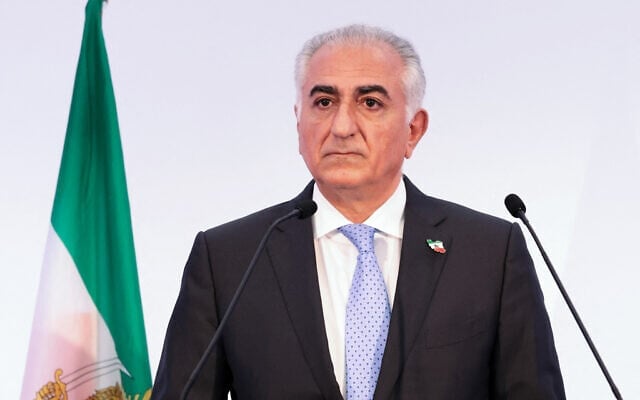
If war or social unrest finally shatters the Islamic Republic and the ayatollahs fall, the most reckless move imaginable would be to hand Iran’s future to a man who freezes when history calls.
What Iran is experiencing right now is not a salon debate or abstract dissent. It is pressure—raw, grinding, and cumulative.
A fresh wave of unrest—driven by currency collapse, cost-of-living pressure, and long-deferred social exhaustion—has spread across multiple provinces, reached universities, and already produced deaths and violent clashes with security forces. This is not a theory. It is reality unfolding in real time.
In such an environment, the decisive question is not who carries a famous surname, but who can convert rage into operational political power without burning the country down in the process.
That is precisely why precedent matters.
During the Israel–Iran war in the summer of 2025, when Iranian airspace was penetrated and the regime was psychologically shaken, Reza Pahlavi was handed a once-in-a-generation opening. That moment demanded leadership in its hardest form: political command, an embryonic chain of authority, a center of gravity capable of coordinating students, labor, minorities, technocrats, and—most critically—fractures inside the coercive apparatus.
Instead, what materialized were interviews, statements, and appeals without structure. No mobilization. No command. No enforceable plan. In revolutionary terms, that is not leadership; it is commentary.
Lamentably, history is unambiguous on this point. Revolutions do not reward famous names; they reward organizers. When regimes collapse, power flows to whoever can secure streets, split security forces, hold ministries, prevent looting, and impose order fast enough to stop the vacuum from swallowing the state.
But Pahlavi lacks those capacities. He has a brand instead of a machine, followers abroad instead of authority inside Iran. In that context, symbolism without leverage is not leadership—it is theater.
Even analysts sympathetic to an opposition role have acknowledged the same structural weakness: fragmentation, lack of internal discipline, and the absence of a domestic apparatus capable of coordinating real insurrectionary power. These are not ideological critiques; they are mechanical ones.
Politically, the problem only deepens. At the height of the Israel–Iran confrontation, Pahlavi’s posture toward Israeli strikes triggered backlash within Iran’s own opposition. Fairly or not, he came to be seen as the “foreign option.”
In a nationalist surge—especially one the regime actively frames as resistance against external enemies—that perception is lethal. A collapsing regime will not be replaced by moral consensus but by a grim, transactional coalition: workers, students, bazaar networks, peripheral minorities, defecting technocrats, and segments of the security forces choosing survival over ideology. Pahlavi does not unify that tent; he fractures it.
There is also a cultural and symbolic dimension that cannot be ignored. The pageantry, the titles, the royal aura paired with repeated insistence that no throne is sought—this does not read as statecraft. It reads as personal validation.
To many Iranians, it looks like a “man of curating stature”, trying to appear historic, rather than doing the unglamorous work of power: building cadres, enforcing discipline, securing logistics, protecting urban nodes, and negotiating defections. Optics matter, and these optics communicate ceremony over competence.
Without a doubt, that failure becomes even more acute when applied to the present uprising. The current moment demands immediate direction: coordination of strikes, protection of protest hubs, messaging designed to fracture the Basij and IRGC, and secure command channels inside the country.
From abroad, Pahlavi is structurally incapable of delivering this or fostering it. He cannot command forces he does not control. Any externally based leadership is easily weaponized by the regime as proof of foreign orchestration. And revolutions are logistical races, not media cycles—the street does not need another press conference; it needs coordination, protection, resources, and the ability to negotiate surrenders and defections in real time.
When pressed on the hard questions—who controls the streets, what happens to IRGC economic empires, how revenge killings are prevented, how Iran remains intact while power is decentralized—the answers remain conceptual. Frameworks. Talking points. Paper plans without enforceable guarantees. No teeth.
If the ayatollahs fall, Iran will not need a crown in exile. It will need a ruthless, disciplined coalition capable of seizing the moment, stabilizing the country, and reaching elections without descending into civil war.
In my opinion, Reza Pahlavi is not that leader. He is a symbol mistaking attention for authority—and in revolutionary moments, that mistake does not merely fail movements; it burns states.
Jose Lev Alvarez is an American–Israeli scholar.
Lev holds a B.S. in Neuroscience with a Minor in Israel Studies from The American University (Washington, D.C.), completed a bioethics course at Harvard University, and earned a Medical Degree.
On the other hand, he also holds three master’s degrees: 1) International Geostrategy and Jihadist Terrorism (INISEG, Madrid), 2) Applied Economics (UNED, Madrid), and 3) Security and Intelligence Studies (Bellevue University, Nebraska).
Currently pursuing a Ph.D. in Intelligence Studies and Global Security at Capitol Technology University in Maryland, his research focuses on Israel’s ‘Doctrine of the Periphery’ and the Abraham Accords’ impact on regional stability.
A former sergeant in the IDF Special Forces “Ghost” Unit and a U.S. veteran, Jose integrates academic rigor, field experience, and intelligence-driven analysis in his work.
Fluent in several languages, he has authored over 250 publications, is a member of the Association for Israel Studies, and collaborates as a geopolitical analyst for Latin American radio and television, bridging scholarship and real-world strategic insight.