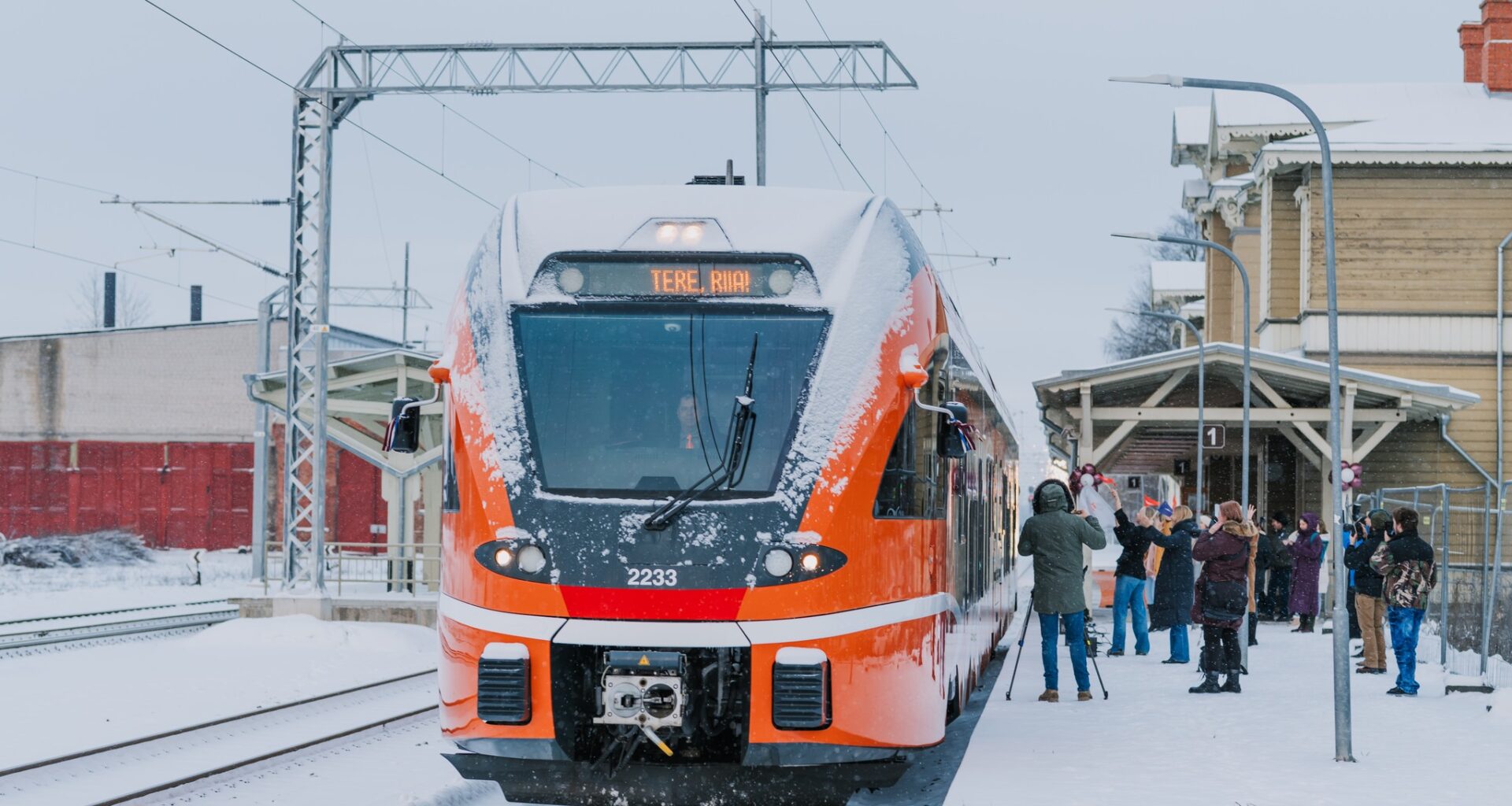
The departure of a morning train from Tartu to Riga on Monday marked a modest but meaningful moment in Baltic transport, reconnecting two historic cities by rail and signalling a renewed confidence in regional mobility.
A small but symbolically loaded moment in Baltic connectivity unfolded in the morning of Monday, 5 January, when a passenger train departed Tartu at 10:05 AM bound for Riga. The inaugural run of the new Tallinn–Tartu–Riga rail line was more than a timetable adjustment: it was a quiet statement about regional cohesion, mobility and the return of rail as a serious alternative to road and air travel in the eastern Baltic.
For centuries, Tartu and Riga belonged to the same economic and cultural space – from medieval Livonia and the Hanseatic trade network to the Swedish era and, later, the Baltic provinces of the Russian Empire. Riga functioned as the region’s outward-facing port and commercial hub; Tartu as its inland intellectual centre. Rail and road links once reflected that closeness. It was the ruptures of the 20th century – new borders, occupations and shifting transport priorities – that broke the connection. The new rail line restores a relationship that history had already established.
The first journey carried a distinctly diplomatic passenger list. Estonia’s infrastructure minister, Latvia’s transport minister, mayors, municipal leaders and tourism officials from both sides of the border were on board, alongside representatives of the rail operators. Regular passenger services are set to begin on 12 January.
 A new rail link reconnects Tartu and Riga, restoring a historic connection and strengthening cross-border travel. Photo: Joonas Sisask.
For southern Estonia, the new direct connection has been long overdue. Tartu, Estonia’s second-largest town, has always been intellectually confident and geographically self-assured, but rail links beyond the national capital have lagged behind its ambitions. As the country’s leading university town, with a growing international profile, Tartu has increasingly looked south as well as north.
Riga, meanwhile, remains the Baltic region’s largest metropolis: a port city, financial hub and architectural heavyweight whose Art Nouveau streets and historic old town draw millions of visitors each year. Despite their proximity – the two cities are roughly 245 kilometres (152 miles) apart – and a shared history, direct public transport links between them have been surprisingly patchy. This line begins to close that gap.
 Riga, the capital of Latvia. Photo by Martti Salmi/Unsplash.
Lauri Betlem, the chairman of the management board of Elron, Estonia’s state-owned passenger train operator, framed the launch in pragmatic terms. The direct service, he said, matters equally to people in southern Estonia and northern Latvia, strengthening economic ties while making tourism simpler and more sustainable. In other words, this was not nostalgia on rails but infrastructure with intent.
The inaugural journey itself was ceremonial rather commercial. No tickets were sold and no additional passengers were taken on en route, but the train was greeted at stations along the way – Elva, Valga, Valmiera, Cēsis and Sigulda – with short public events marking the arrival of the new line. At each stop, local leaders formally unveiled the timetable, turning what could have been a technical launch into a civic occasion.
 The inaugural journey was ceremonial, with no ticketed passengers, and was greeted by public events in towns along the route. Photo by Joonas Sisask.
The train arrived in Riga shortly after 2:00 PM and returned to Tartu in the early evening, closing a carefully choreographed day of Baltic railway diplomacy.
From 12 January, the service will become part of everyday life. One daily train will leave Tallinn at 2:50 PM, call at Tartu at 5:05 PM and arrive in Riga at 8:46 PM. The return service will depart Riga at 7:38 AM, reaching Tartu at 11:45 AM and Tallinn at 1:57 PM. The journey time is competitive by regional standards: three hours and 41 minutes between Tartu and Riga, just under six hours from Tallinn.
Ticket prices have been pitched with accessibility in mind, starting at €19 from Tartu and €29 from Tallinn. Services will be operated using a two-car Stadler Flirt diesel multiple unit – not glamorous, perhaps, but reliable and well suited to the route.
 A bridge over the River Emajõgi in Tartu, with the town hall in the background. Photo by Riina Varol.
This was not the first rail link to stitch together the Baltic capitals. Transfer-based connections already operate between Tallinn, Tartu, Riga and Vilnius, run jointly by Estonian, Latvian and Lithuanian rail companies. But the new direct Tartu–Riga service is different in tone. It prioritises regional cities, not just capitals, and reflects a broader shift towards practical cross-border cooperation ahead of larger projects such as Rail Baltica.
Railway lines rarely make headlines. But occasionally, as this one did on Monday, they quietly redraw the mental map.