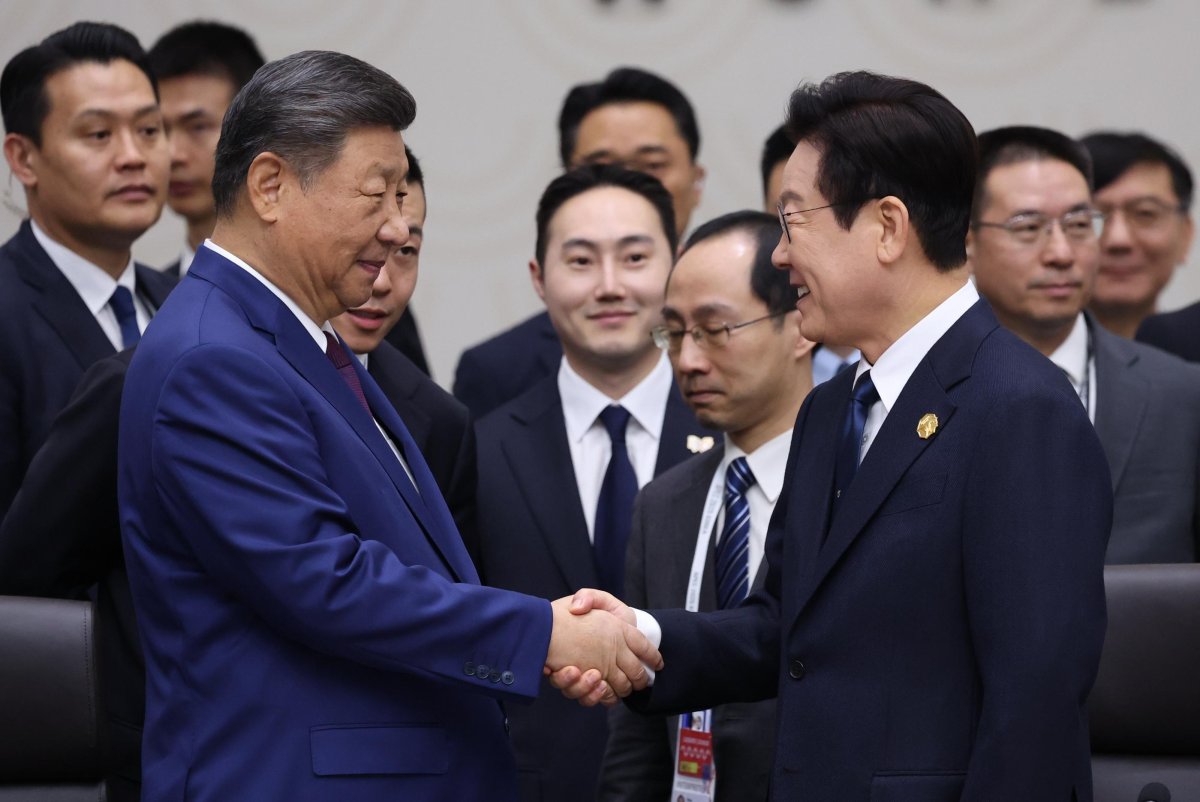
South Korean President Lee Jae Myung (R) shakes hands with Chinese President Xi Jinping (L) during the second session of the APEC Economic Leaders’ Meeting (AELM), as part of the Asia-Pacific Economic Cooperation (APEC) summit in Gyeongju, South Korea, 01 November 2025. File Photo by YONHAP/ EPA
Jan. 4 (Asia Today) — As South Korean President Lee Jae-myung began a state visit to China on Saturday, major Japanese media outlets closely tracked Beijing’s efforts to strengthen ties with Seoul amid worsening China-Japan relations.
Japanese newspapers and broadcasters published a series of analyses examining how Lee’s trip to Beijing could affect Northeast Asian diplomacy, particularly as tensions between China and Japan have risen over recent remarks by Prime Minister Sanae Takaichi on Taiwan.
The Asahi Shimbun reported that Lee’s visit was finalized shortly after Chinese Foreign Minister Wang Yi criticized Japan’s “attempts to rewrite history” during a phone call with South Korean Foreign Minister Cho Hyun. The newspaper said Beijing appears eager to position South Korea as a strategic partner to counter Japan.
Citing a Chinese Foreign Ministry statement, Asahi reported that Wang accused “some political forces in Japan” of denying responsibility for invasion and colonial rule, while urging Seoul to maintain what he called a correct understanding of history and adhere to the One China principle.
The Sankei Shimbun highlighted Lee’s recent interview with Chinese state broadcaster China Central Television, in which the South Korean president said he respects the One China principle regarding Taiwan. Sankei interpreted the remarks as part of China’s effort to upgrade its strategic cooperative partnership with South Korea.
The newspaper also noted Lee’s planned visit on Tuesday to the site of the Provisional Government of the Republic of Korea in Shanghai, calling it symbolic material China could use to foster a united front against Japan.
The Yomiuri Shimbun warned that South Korea’s outreach to China could strain trilateral security cooperation among Seoul, Washington and Tokyo at a time of intensifying Japan-China rivalry. The Mainichi Shimbun likewise reported that China is pressuring Japan over Taiwan and historical issues while simultaneously seeking cooperation from South Korea.
A column on Yahoo Japan said it remains unclear how far Seoul can tilt toward Beijing given strong anti-China sentiment in South Korea. The commentary described Lee as pursuing a balanced diplomacy that avoids aligning fully with either China or Japan, while noting that his moves are drawing attention as cooperation among South Korea, the United States and Japan has strengthened following President Trump’s re-election.
Japanese media also focused on Lee’s scheduled summit with Chinese President Xi Jinping on Sunday and his meeting with Premier Li Qiang on Monday. The meetings mark the first in-person South Korea-China summit in two months since last November’s APEC gathering in Gyeongju, with economic and trade cooperation high on the agenda.
Sankei reported that South Korean business and entertainment circles are hoping for tangible gains from the visit, while adding that Japan remains wary that deeper economic cooperation could weaken regional security coordination.
Meanwhile, Japanese public broadcaster NHK said in a morning report that Chinese media are giving extensive coverage to Lee’s visit to highlight Beijing’s intent to improve bilateral relations. NHK cited a close aide to Takaichi as saying Japan will continue cooperation with South Korea within the Japan-U.S.-South Korea framework.
Japanese outlets said they will continue to closely monitor how the outcomes of Lee’s China visit affect Japan-South Korea relations and trilateral cooperation with the United States.
— Reported by Asia Today; translated by UPI
© Asia Today. Unauthorized reproduction or redistribution prohibited.